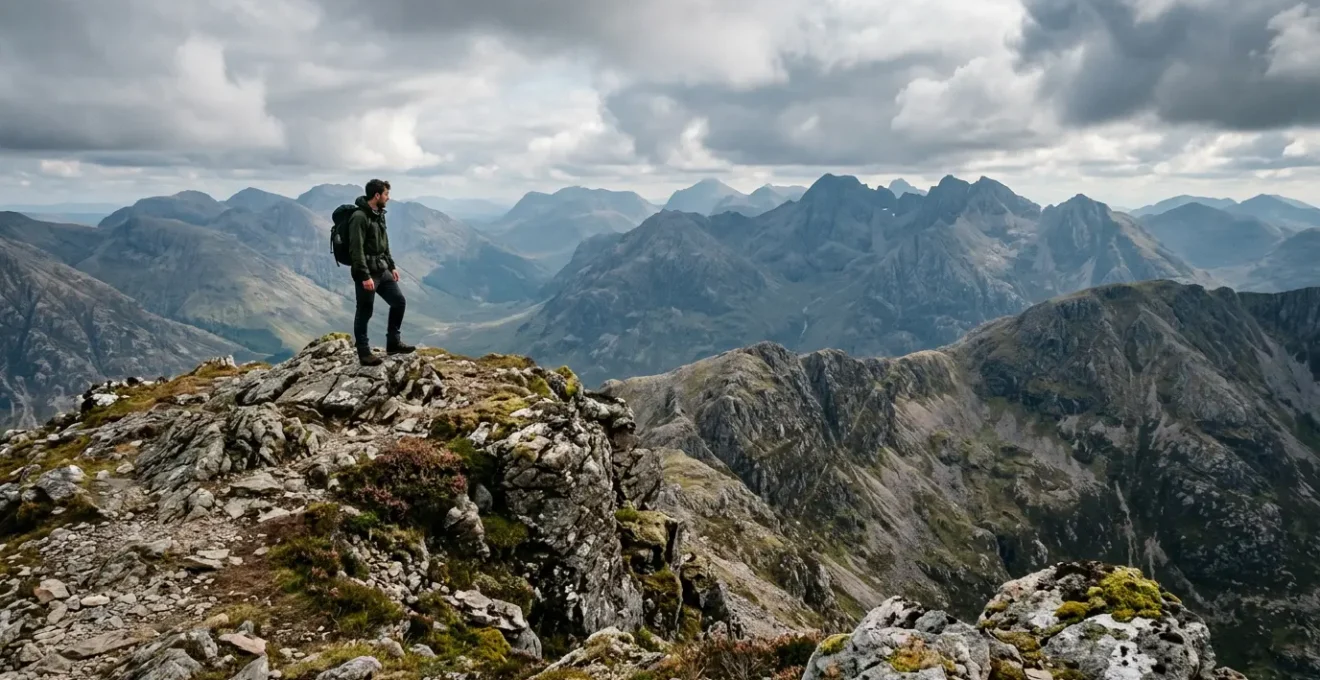
Choosing a Corbett isn’t settling for less; it’s a deliberate upgrade to a more authentic and rewarding mountain experience.
- Corbetts trade the well-trodden “Munro motorways” for a genuine navigational challenge that tests true mountaincraft.
- Their individual prominence often delivers more dramatic, hard-earned views than their taller but more crowded neighbours.
- They serve as the perfect, lower-risk “apprenticeship” for developing serious winter mountaineering skills.
Recommendation: Ditch the peak-bagging queues and embrace the Corbett challenge for a deeper, more solitary connection with the Scottish hills.
There’s a familiar scene that plays out across the Scottish Highlands every weekend: a long line of brightly-coloured jackets snaking its way up a heavily eroded path to a crowded summit. This is the Munro-bagging experience. The allure of ticking off all 282 peaks over 3,000 feet is a powerful one, a national pastime that has introduced countless people to the joy of the hills. But for the hiker who has grown weary of these “Munro motorways,” who craves the quiet rustle of wind on an empty ridge rather than the chatter of a dozen other walking groups, the conventional answer is often just to find a more obscure Munro.
This approach misses the point. It assumes that height is the only metric of a mountain’s worth. But what if the secret to finding true solitude, more dramatic views, and a far greater sense of achievement isn’t to look for a different 3,000-foot peak, but to look just below that arbitrary line? This is the contrarian case for the Corbetts—the 222 Scottish hills between 2,500 and 3,000 feet. Choosing a Corbett is not a downgrade in ambition; it’s a conscious upgrade in mountaineering authenticity, trading the security of the crowd for a richer, more demanding experience.
This guide will dismantle the myth that shorter means easier. We will explore why Corbetts present a tougher navigational test, how their unique geography often yields superior and more dramatic vistas, and why they represent the single best training ground for any aspiring winter mountaineer. It’s time to look beyond the tick-list and rediscover the wild heart of the Scottish hills.
To navigate this argument, we will explore the specific advantages that elevate the Corbett experience, from the raw challenge they present to the unparalleled solitude they offer.
Table of Contents: Why Corbetts Are the Discerning Hiker’s Choice
- The Navigation Challenge: Why Corbetts Are Often Harder Than Munros?
- The Cobbler: Why This Corbett Has Better Views Than Its Munro Neighbours?
- Stalking Season Restrictions: Are Corbetts More Affected Than Munros?
- Can You Climb a Corbett in a Winter Afternoon?
- Island Corbetts: Why the Arran Ridges Are Unique?
- Ben Lomond or Schiehallion: Which Is the Best First Munro?
- How Far Should You Hike from the Road for True Solitude?
- How to Start Munro Bagging Safely in Winter as a Beginner?
The Navigation Challenge: Why Corbetts Are Often Harder Than Munros?
The most persistent myth in the Scottish hills is that height equals difficulty. A Munro, being over 3,000 feet, must be a greater challenge than a Corbett. This is a fundamental misunderstanding of what makes a day in the mountains demanding. The greatest challenge on a popular Munro is often finding a parking space. The greatest challenge on a Corbett is frequently the mountain itself. The reason is simple: the paths are few and far between. This is the “navigation tax” you pay for solitude, and it’s the very thing that makes the experience superior.
Without a deep, eroded trench to follow, you are forced to engage with the landscape on a more intimate level. You must read the contours of the map, identify features on the ground, and trust your compass bearing. This is the essence of mountaincraft. As one analysis of the challenge explains, the strict prominence criteria for Corbetts ensures that each Corbett is a stand-out individual summit that really has to be earned. They might be smaller, but they concede nothing in ruggedness.
This isn’t just an opinion; it’s a widely held belief among seasoned hillwalkers. It represents a graduation from simply following a crowd to becoming a self-reliant mountaineer. As Mountaineering Scotland, the national body for hillwalking and climbing, wryly notes:
the real aficionados get going on the Corbetts and never tire of telling all who’ll listen that the Corbetts are far more challenging than the Munros
– Mountaineering Scotland, Official guidance on Munros and Corbetts
This challenge is not a barrier; it is the main attraction. It transforms a simple walk into a cerebral and deeply rewarding puzzle, fostering skills and confidence that the Munro motorways can never provide.
The Cobbler: Why This Corbett Has Better Views Than Its Munro Neighbours?
Nowhere is the Corbett’s superiority more evident than in the Arrochar Alps. Here, surrounded by a cluster of Munros, stands Ben Arthur, universally known as The Cobbler. At 884 metres, it falls short of Munro status, yet it is the undisputed jewel of the region. Why? Because its dramatic, rocky architecture delivers an experience of theatrical grandeur that its taller, more rounded neighbours simply cannot match. It’s a prime example of an earned vista.
The Cobbler’s iconic, triple-peaked silhouette is so inspiring that for many, it’s their very first hillwalk. Yet it is no mere beginner’s hill. The true summit involves a famous scramble through a rock window and onto an exposed pinnacle, a move known as “threading the needle.” It’s an exhilarating climax that requires a genuine head for heights. The view from the top isn’t just seen; it’s achieved. According to one source, though its Munro status neighbours may be taller, The Cobbler is head and shoulders the star attraction hereabouts.
This principle holds true across Scotland. Corbetts, by virtue of their prominence and often more rugged, isolated character, frequently provide more dramatic viewpoints. They are the grandstands of the Highlands, perfectly placed to admire the larger ranges. While the view from a high Munro plateau can be vast, the view from a sharp Corbett peak, surrounded by giants, is often more breathtaking and compositionally perfect.
Stalking Season Restrictions: Are Corbetts More Affected Than Munros?
A common concern for autumn walkers in the Highlands is the deer stalking season. The received wisdom is to check estate websites for information on access. However, the nature of Corbetts can add a layer of complexity. While a Munro massif might span several large estates, a Corbett often lies entirely within a single, private sporting estate, making access potentially more restrictive. Furthermore, the lower, rolling terrain of many Corbetts is prime deer habitat, meaning walkers may be more likely to interfere with stalking activities than on high, rocky Munro plateaus.
This doesn’t mean they are off-limits, but it does require more diligent planning. A key part of the “mountaineering authenticity” that Corbetts demand is respecting the landscape and its management. For any planned Corbett ascent between July and February, it’s crucial to take specific steps:
- Check estate-specific restrictions, as a Corbett may have a single point of contact for all access queries.
- Understand the difference between stag stalking (mainly August to mid-October) and hind culling (late October to mid-February), as restrictions can vary.
- Be prepared to contact estates directly by phone for hills where information isn’t readily available online.
- Plan alternative routes or even alternative hills, as the rolling nature of Corbetts means stalking can cover a wider area than on a Munro ridge.
This proactive approach is part of the Corbett ethos. It’s about engaging with the working landscape, not just treating it as a sterile playground. The solitude you find is partly a result of this managed, wild environment.
Can You Climb a Corbett in a Winter Afternoon?
Yes, and in many cases, it’s the smartest decision a winter hillwalker can make. The shorter daylight hours and often severe weather of a Scottish winter demand a recalibration of ambition. Attempting a long, high-altitude Munro route can quickly turn into a desperate race against darkness. Corbetts, however, offer the perfect solution: a full-value winter mountain day packed into a more manageable timeframe. This isn’t about cutting corners; it’s about intelligent mountain strategy.
The shorter distance and lower altitude of a typical Corbett mean you get a more concentrated dose of winter challenge. You still need an ice axe, crampons, and the skills to use them, but the objective is often more attainable within a 4-6 hour window. As the experts at Wilderness Scotland advise, “A winter Corbett is a lower-commitment day (shorter, less altitude, often less avalanche-prone terrain) and is perfect for building experience safely.”
This approach is exactly what seasoned local mountaineers do. While tourists may feel compelled to tackle a big-name Munro regardless of conditions, those with deep experience know the value of a Corbett on a short winter’s day. They offer the solitude and pristine snow that is often missing on the popular winter Munros. If you want a truly wild winter experience with fewer people, the best advice is to do what the locals do: climb a Corbett instead. It’s the foundation of a safe and rewarding winter hillwalking career.
Island Corbetts: Why the Arran Ridges Are Unique?
The reach of the Munros is limited to the Scottish mainland. The Corbetts, however, extend their domain to the islands, offering some of the most spectacular and unique mountain experiences in the country. They can be found on Rum, Jura, Harris, and most famously, the Isle of Arran. It is here that the Corbett’s ability to deliver a grand-scale adventure from a sub-3,000-foot peak is most profoundly demonstrated.
The experience of climbing a hill like Goatfell on Arran is entirely different from a mainland peak. You begin your walk at, or very near, sea level. This “sea-to-summit” journey means that the total ascent on an Arran Corbett can be equal to, or even greater than, that of many Munros started from a high glen. As one guide notes about Goatfell, “as you start your walk from pretty much sea level you’re doing as much if not more ascent than on many more baggable Munro routes.” This completely refutes the idea that lower summit height means less effort.
What you get in return for this effort is a world-class vista. The jagged granite ridges of Arran rise dramatically from the Firth of Clyde, offering panoramic views that blend mountain, sea, and sky in a way that no inland peak can. The sense of exposure and the constant presence of the ocean create a uniquely maritime alpine environment. It’s a powerful reminder that the most memorable mountain days are defined by the quality of the journey and the drama of the landscape, not by a number on a list.
Ben Lomond or Schiehallion: Which Is the Best First Munro?
This is one of the most frequently asked questions by aspiring hillwalkers. Ben Lomond offers accessibility and an iconic view; Schiehallion provides a well-engineered path and geological intrigue. Both, however, suffer from the same problem: extreme popularity. They are classic “Munro motorways.” The real question a discerning beginner should ask is not “which first Munro?” but “is a Munro the best first peak at all?”
Often, a well-chosen Corbett provides a far better introduction. Take Ben Vrackie, near Pitlochry. It’s one of the most popular Corbetts due to its excellent paths and central location. Yet, it offers a sense of discovery that can be lost on its Munro counterparts. From its summit, the views are arguably the finest in the Southern Highlands. The experience is one of pure mountain joy without the accompanying crowds.
The following comparison, based on data from sources like VisitScotland’s guides to Scotland’s hills, puts the choice into sharp relief:
| Mountain | Type | Height | Crowds | Path Quality | Experience |
|---|---|---|---|---|---|
| Ben Lomond | Munro | 974m | Very High | Heavily eroded | Classic but crowded |
| Schiehallion | Munro | 1083m | High | Engineered/monotonous | Geological interest |
| Ben Vrackie | Corbett | 841m | Moderate | Good natural paths | Best Southern Highland views |
| The Cobbler | Corbett | 884m | Moderate | Natural/engaging | Dramatic and inspiring |
The table makes it clear. For an aspiring hiker, a peak like The Cobbler or Ben Vrackie can be more inspiring, less crowded, and offer a more engaging and authentic first taste of the Scottish mountains.
How Far Should You Hike from the Road for True Solitude?
In the age of social media and exhaustive online guides, finding genuine solitude can feel like an impossible quest. Even on remote Munros, you are likely to cross paths with other “baggers.” True solitude isn’t just about distance from the road; it’s about stepping off the beaten track. And there is no more effective way to do this than by choosing to climb a Corbett.
The numbers tell an undeniable story. The quest to “compleat” the Munros has become a national obsession. In contrast, the Corbetts remain the preserve of a smaller, more dedicated group of connoisseurs. According to data from the national body for hillwalking, those who have climbed all the Munros are counted in the thousands, while only a few hundreds have registered as completing the Corbetts. This staggering difference is the clearest possible indicator of where to find peace and quiet.
This solitude is the direct result of the Corbetts’ status. They are often overlooked, “nestled away in the landscape,” which, as VisitScotland points out, makes for an “even more tranquil outing in Scotland.” On a Corbett, the only sounds are often the croak of a raven, the whistle of the wind, and your own footsteps. You are not a tourist on a mountain; you are a visitor in a wild place. It’s a more profound and immersive experience, one that allows for a genuine connection with the environment, far from the madding crowds of the Munro checklist.
Key Takeaways
- Corbetts demand superior navigation skills due to less-defined paths, offering a more authentic challenge than crowded Munros.
- Their individual prominence often results in more dramatic, “earned” vistas than those from taller but more rounded Munro plateaus.
- They serve as the ideal and safer “apprenticeship” for developing genuine winter mountaineering skills before tackling high-altitude winter peaks.
How to Start Munro Bagging Safely in Winter as a Beginner?
The answer, paradoxically, is not to start with a Munro at all. The leap to full winter conditions on a high-altitude peak is a serious one, fraught with risk for the inexperienced. The single best way to prepare for winter Munros is to serve a “Corbett Apprenticeship.” This means using the more accessible, lower-consequence environment of winter Corbetts to build skills, confidence, and experience methodically. It’s a strategy used by professional guides and seasoned mountaineers.
A client of one such guide, Richard Kermode, perfectly illustrates this progression, noting his “1st real winter season involving ice axe and crampons” was part of a journey that included “numerous Corbetts and Grahams” alongside his Munro climbs. This is the model to follow. By starting on Corbetts, you can practice core skills in a more forgiving setting. You can learn to walk in crampons on gentler slopes, practice an ice axe arrest where the runout is safe, and test your winter navigation in conditions that are less likely to become a survival situation.
Your Winter Corbett Apprenticeship: A 5-Step Plan
- Establish ‘Step Zero’: Formally decide to start with accessible winter Corbetts before attempting any winter Munro. This is your foundational training phase.
- Build Crampon Skills: Choose a Corbett with broad, open slopes (like Meall a’ Bhuachaille near Glenmore) to practice your first steps in crampons on low-consequence terrain.
- Practice Low-Visibility Navigation: Use the less-committing nature of a familiar Corbett to deliberately practice navigating in poor weather, honing your map and compass skills.
- Target Specific Skills: Select different Corbetts to practice different techniques. Use a rounded one for navigation and a rockier one for mixed-terrain footwork.
- Set Graduation Criteria: Decide that you will only “graduate” to attempting a straightforward winter Munro after you have successfully and confidently completed several Corbett ascents in a variety of winter conditions.
This structured approach transforms the daunting prospect of winter mountaineering into a manageable, step-by-step process. It replaces ambition with intelligence and respects the profound challenge of the Scottish winter.
Stop following the crowds up the Munro motorways. The real challenge, the better views, and the true, soul-stirring solitude of the Scottish Highlands are waiting for you on the Corbett peaks. It’s time to begin your apprenticeship and earn your place in the quiet hills.