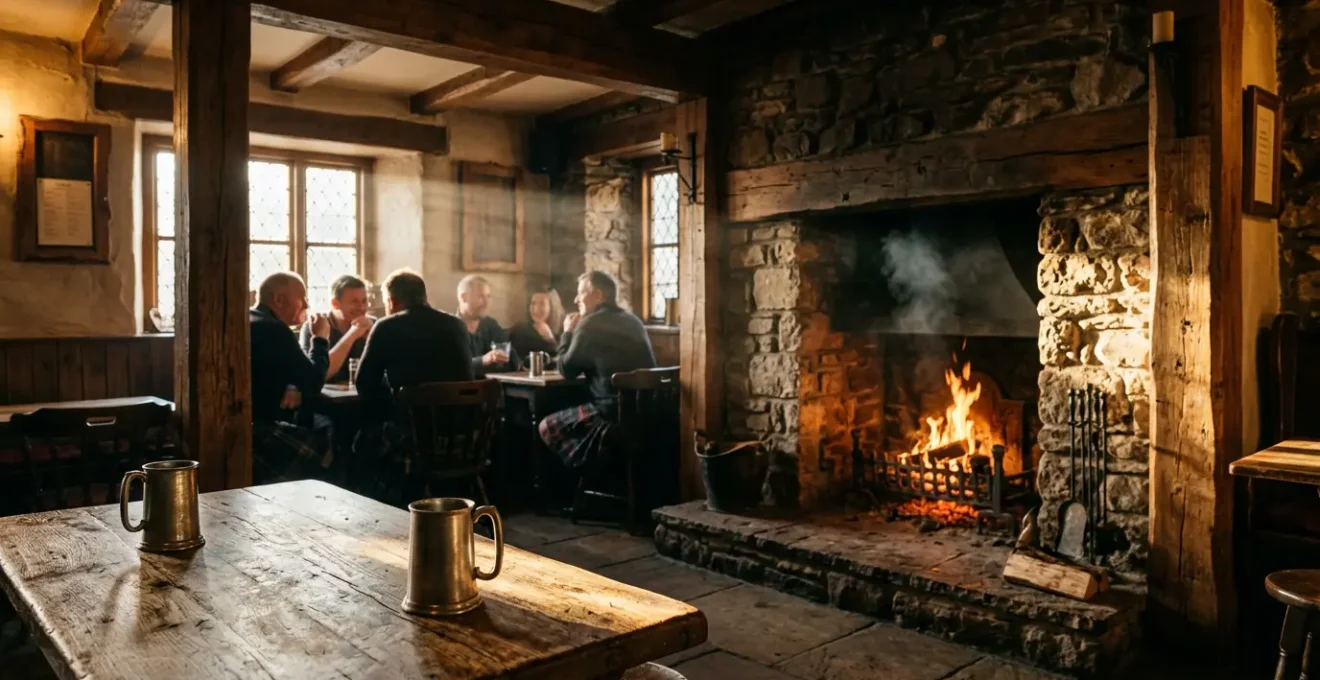
Forget the laminated menus and bagpipe soundtracks; authentic Scottish food is a quiet affair of seasonality, provenance, and technique.
- True quality is found in menus that change with the seasons, not those offering the same generic dishes year-round.
- Authenticity lies in the infrastructure of a neighbourhood—the independent butchers, cheesemongers, and farmers’ markets—not in tartan decor.
Recommendation: When in Scotland, eat like a chef. Ask where the ingredients come from, favour places where locals shop for produce, and choose the dish that is unapologetically in season.
As a chef in Edinburgh, I watch countless travellers arrive with a romantic notion of Scottish food, only to be funnelled towards the same handful of establishments. They seek the soul of our cuisine on the Royal Mile and find, more often than not, a caricature: frozen fish and chips, pre-made steak pies, and a ‘famous’ haggis that has more to do with marketing than tradition. The disappointment is palpable for any discerning palate. They’ve come for an authentic experience but are being sold a theme park version of our culinary heritage.
The standard advice—”try haggis,” “visit a pub”—is not wrong, but it lacks the crucial detail that separates a memorable meal from a costly mistake. The real conversation in Scottish food isn’t about *what* to eat, but *why* and *when*. It’s a dialogue about provenance, seasonality, and technique. It’s about understanding why venison tastes best in autumn or why a true Arbroath Smokie carries a legally protected status, much like Champagne or Parma ham.
The secret to avoiding the tourist traps isn’t a magical map; it’s a change in perspective. It’s about learning to read the subtle cues of quality that we chefs look for. It’s not about finding a restaurant decorated with tartan, but one whose menu proudly names its butcher, its fisherman, or the estate where its game was sourced. This guide is built on that principle. We will deconstruct the icons of Scottish cuisine to reveal the logic behind them, giving you the tools not just to find a good meal, but to understand what makes it so.
This article provides a chef’s perspective on navigating Scotland’s culinary landscape. We will explore the function behind our famous breakfast, the science of pairing whisky, the importance of seasonality, and the tell-tale signs that distinguish a genuine local gem from a tourist-focused establishment.
Table of Contents: A Culinary Tour of Scotland’s True Flavours
- Full Scottish vs Continental: Why You Need the Calories for Hiking?
- Cheese or Chocolate: Which Pairs Better with Islay Malts?
- Why You Should Order Venison in Autumn and Not Spring?
- What is ‘Clootie Dumpling’ and Why is it Heavy?
- Service Charge Included: Do You Need to Tip in Rural Pubs?
- Royal Mile vs Stockbridge: Where to Find Authentic Scottish Food?
- Dyed or Undyed Haddock: Which Makes the Better Soup?
- How to Try Haggis for the First Time If You Are Squeamish?
Full Scottish vs Continental: Why You Need the Calories for Hiking?
The Full Scottish breakfast is not an act of gluttony; it is a masterpiece of function. Faced with a day of hiking the Highlands or climbing a Munro like Ben Nevis, a continental breakfast of a croissant and coffee is woefully inadequate. This meal was engineered for energy. It’s a carefully constructed plate of protein, fat, and carbohydrates designed to fuel hard labour in a cold, damp climate. A nutritional analysis confirms a typical plate contains around 1000 calories with 50-60g of fat, providing a slow-release energy source that sustains you for hours.
The key components are all there for a reason. The Lorne sausage and bacon provide protein and salt; the black pudding is rich in iron; the tattie scones offer complex carbohydrates; and the fried egg or mushrooms add further sustenance. It is, in essence, a strategic energy load. To put it in perspective, consider the energy expenditure required for common Scottish activities.
The comparison below clearly illustrates why the Full Scottish isn’t just a tradition, but a practical necessity for anyone planning to be physically active. For a shorter walk, a simple bowl of porridge—another Scottish staple—may suffice. But for a true day out in the hills, the Full Scottish is the only logical choice. It’s about matching your fuel to your ambition.
The following table demonstrates the direct relationship between physical exertion in the Scottish landscape and the caloric necessity of our traditional breakfast options.
| Activity | Calories Burned | Recommended Breakfast |
|---|---|---|
| Climbing Ben Nevis | ≈1500 kcal | Full Scottish (1000 kcal) |
| Highland Trail Hiking (5 hours) | ≈1200 kcal | Modified Scottish with porridge (760 kcal) |
| Loch Walking (2 hours) | ≈400 kcal | Porridge with honey (350 kcal) |
So, before you dismiss it as heavy, ask yourself what your day holds. If it involves anything more strenuous than a stroll to a coffee shop, the Full Scottish is your best and most authentic preparation.
Cheese or Chocolate: Which Pairs Better with Islay Malts?
Pairing food with a fine single malt, particularly a peated Islay whisky like a Laphroaig or Ardbeg, is an exercise in balance and chemistry. The common temptation is to pair it with dark chocolate, a classic combination for many spirits. However, from a chef’s perspective, this is often a misstep with heavily peated malts. The intense, smoky, and medicinal notes of an Islay whisky can overwhelm the subtleties of cocoa, or worse, the sweetness of the chocolate can clash with the dry, phenolic finish of the spirit, creating a discordant note on the palate.
The superior partner is, almost without exception, a good, sharp cheese. The principle here is one of contrast and complement. The high fat content of the cheese coats the palate, softening the alcoholic burn of the whisky and allowing its more complex flavours to emerge. More importantly, the sharp, salty tang of a well-aged cheddar or, even better, a pungent blue cheese like a Stilton or a Scottish Crowdie, provides a perfect counterpoint to the whisky’s intense smoke.
As experts at The Whiskey Reserve note, the strong, smoky notes of a peated whiskey pair perfectly with the sharp and salty tang of blue cheese. This creates a “flavour explosion” where both elements are enhanced. The saltiness of the cheese amplifies the hidden sweet, malty notes in the whisky, while the peat smoke cuts through the richness of the cheese, cleansing the palate for the next sip. It’s a dynamic, powerful pairing that respects the integrity of both the spirit and the food. Chocolate is a wonderful thing, but with an Islay malt, cheese is the technically superior and more rewarding choice.
Next time you are presented with the choice, forgo the sweet option and ask for a piece of the strongest, sharpest cheese available. You will be experiencing a pairing rooted in balance, not just convention.
Why You Should Order Venison in Autumn and Not Spring?
In my kitchen, seasonality is not a trend; it is a governing law. And nowhere is this more apparent than with Scottish game, particularly venison. While you may find it on tourist-oriented menus year-round, a restaurant that truly understands its produce will feature it most prominently in the autumn. To order venison in spring is to fundamentally misunderstand the animal and the flavour of our land.
The reason is simple: terroir. Throughout the spring and summer, Scottish deer—be they the large Red Deer of the Highlands or the more delicate Roe Deer—graze on fresh grasses and foliage. By autumn, their diet has shifted. They have spent months foraging on wild heather, berries, and fungi. This diet directly infuses the meat with a rich, complex, and deeply gamy flavour that is its true expression. Venison in autumn is not just meat; it’s a taste of the Highland landscape itself. In spring, the flavour is far milder and less characterful.
A discerning menu will often reflect this. It will not simply say ‘venison’; it will provide details that speak to its provenance and quality. Learning to decode these clues is essential for an authentic experience. Look for mentions of the specific type of deer or the estate it came from, as these are hallmarks of a kitchen that cares about sourcing.
A Guide to Venison on a Scottish Menu
- Red Deer: This is the classic. A large animal yielding meat with a rich, powerful game flavour. It’s most likely to be wild-sourced from a Highland estate.
- Roe Deer: Smaller and more delicate, its meat has a subtler, more refined taste. A true delicacy.
- Sika Deer: Often farmed, it has a distinctive flavour that stands apart from Red or Roe deer.
- Estate Names: If the menu lists a specific Scottish estate (e.g., “Glenfeshie Estate Venison”), it’s a strong indicator of authenticity and quality.
- Seasonal Clues: An autumn menu that pairs venison with root vegetables, blackberries, or mushrooms is a kitchen working in harmony with the seasons.
Choosing venison in autumn is more than just ordering a meal; it’s an appreciation for the cycle of nature and the very essence of what makes Scottish game unique. Any other time of year, a true Scottish chef would be serving something else.
What is ‘Clootie Dumpling’ and Why is it Heavy?
To understand Clootie Dumpling, you must first understand the Scotland it was born from—a place of stone cottages, harsh winters, and no central heating. The dumpling’s signature density is not a flaw; it is its entire purpose. This is not a light, airy dessert. It is a substantial, suet-based pudding designed to provide slow-release energy and internal warmth to crofters and labourers facing the biting cold. Its weight is a feature, a testament to its historical function as a fuel source.
The name itself, ‘Clootie’, comes from the ‘cloot’ or cloth it is boiled in. The traditional preparation is a laborious process. A mixture of flour, suet, dried fruit, and spices is wrapped in a floured cloth and then simmered in a large pot of water for several hours. This boiling process is key; it cooks the dumpling while the floured cloth forms a distinctive ‘skin’ on the outside. This skin seals in moisture and is crucial for creating the characteristic dense, moist texture that defines the pudding.
This technique is a world away from modern baking. The long, slow boiling gelatinizes the starches and melds the flavours of the fruit and spice into a rich, deep complexity. After boiling, the dumpling is often dried in an oven or in front of a fire, which firms up the skin. A slice is traditionally served with a dram of whisky or, for a truly decadent treat, pan-fried in butter the next day for breakfast.
Finding an authentic version requires looking beyond tourist shops. The best examples are often found at local farmers’ markets in Highland villages, at Women’s Institute (W.I.) bake sales, or in small, family-run village bakeries. You should look for an irregular, slightly rustic shape, as this indicates it was hand-wrapped in a cloot, not mass-produced in a mould.
So when you try it, don’t judge it by the standards of a light sponge cake. Appreciate it for what it is: a delicious, warming piece of Scottish social history, built for resilience and comfort.
Service Charge Included: Do You Need to Tip in Rural Pubs?
Tipping culture in Scotland, especially outside the main cities, can be perplexing for visitors. The short answer is that tipping is far less ingrained and expected than in many other parts of the world. In most Scottish restaurants, if you receive good table service, a tip of around 10% is customary and appreciated, but only if a service charge has not already been added to your bill. If a “service charge” of 10-12.5% is listed, no additional gratuity is required or expected.
The etiquette shifts significantly when you move from a city restaurant to a rural pub, particularly in the Highlands and Islands. Here, the transactional nature of tipping is often replaced by a more communal culture. When you order drinks directly from the bartender at the bar, a monetary tip is very rarely given. Instead, a common local custom is to say, “and one for yourself.” This is an offer to buy the bartender a drink, the cost of which they will add to your bill. They may pour themselves a drink then or later, or simply pocket the cash equivalent. It’s a gesture of appreciation couched in sociability rather than service.
In these smaller, community-focused establishments, genuine human connection can often be valued more highly than a small cash tip. The staff are often a core part of the local fabric, and treating them with respect and friendliness is paramount. As one local from a Highland village puts it, the currency of appreciation is different.
In rural Scottish pubs, genuine appreciation, a good online review mentioning staff by name, or simply becoming a ‘regular’ during your stay can be as valued as a monetary tip. The culture values connection over cash.
– Local Perspective
Ultimately, in rural Scotland, excellent service is often considered part of the job, not an add-on that requires a supplementary payment. A simple, sincere “thank you” to the staff goes a very long way.
Royal Mile vs Stockbridge: Where to Find Authentic Scottish Food?
A common mistake for foodie travellers in Edinburgh is to equate the city’s historic heart, the Royal Mile, with its culinary heart. While architecturally stunning, the Royal Mile and its immediate vicinity are heavily saturated with businesses designed for high-volume tourism. This environment is rarely conducive to authentic, quality-focused cuisine. You are more likely to find laminated menus in multiple languages, generic dish names, and an overabundance of tartan decor than a meal that truly represents Scotland.
In contrast, an area like Stockbridge—or Leith, or Finnieston in Glasgow—reveals the true nature of authentic Scottish food through its very infrastructure. To eat authentically, you must go where Scots actually shop for quality ingredients. Stockbridge is not a tourist attraction; it’s a living neighbourhood with a thriving ecosystem of independent, specialist food producers. It has artisan butchers selling hand-made Scotch pies, dedicated cheesemongers like I.J. Mellis offering a curated selection of Scottish cheeses, and fishmongers with fresh, locally smoked salmon and haddock.
This is the key difference: one area sells the *image* of Scottish food, while the other is part of the *supply chain*. Restaurants in these more residential neighbourhoods are directly supplied by and accountable to these local purveyors and a discerning local clientele. Their menus are consequently more dynamic, honest, and reflective of true Scottish produce.
Case Study: The Authentic Food Infrastructure of Stockbridge
According to insights from tourism body VisitScotland, areas like Stockbridge showcase authenticity through their very fabric. The presence of independent butchers selling Scotch pies, cheesemongers offering Arran or Mull cheddar, fishmongers with fresh smoked salmon, and bustling Sunday farmers’ markets where local residents do their weekly shopping, creates an environment where restaurants must compete on quality and provenance, not just location. This infrastructure is the bedrock of an authentic local food scene.
To navigate this, a foodie traveller must become a culinary detective. Learning to spot the red flags of a tourist trap and the green flags of an authentic establishment is the most crucial skill you can develop. Here is a practical checklist to guide you.
Your Checklist for Spotting Tourist Traps vs. Authentic Gems
- Check the Menu: Are there laminated menus in multiple languages with pictures of the food? This is a major red flag. Look for handwritten daily specials boards, which indicate a kitchen responding to market availability.
- Observe the Staff: Is there staff outside trying to beckon customers in? An authentic, quality restaurant relies on its reputation, not on hustling passersby.
- Read the Sourcing: Does the menu use generic names like ‘Famous Scottish Haggis’, or does it name its suppliers (e.g., ‘I.J. Mellis cheese’, ‘John Gilmour butchers’)? Named suppliers are a huge green flag.
- Assess the Decor: Is the decor an overwhelming pastiche of tartan and Highland imagery? Authentic spots are often understated, focusing on the food, not the theme.
- Look at the Clientele: Is the establishment filled exclusively with tourists, or can you see and hear local residents dining? The presence of locals is the ultimate seal of approval.
So, walk the Royal Mile for its history, but when you get hungry, head down the hill to Stockbridge or take a bus to Leith. Your palate will thank you for it.
Dyed or Undyed Haddock: Which Makes the Better Soup?
For a chef, the answer to this question is unequivocal: undyed haddock makes the better soup, every single time. This is not a matter of aesthetic preference, but of flavour and integrity. The bright, almost radioactive yellow colour you see on some smoked haddock is not a sign of quality; it is the result of an artificial dye, typically tartrazine, used to mimic the golden hue of traditional smoking methods.
Historically, haddock was smoked over wood chips for preservation and flavour, a process that naturally imparted a pale, straw-like colour. The artificial dye was introduced as a shortcut—a way to give the impression of a quality smoke without the time or expense of the real thing. Unfortunately, this dye can impart a subtle but distinct bitter, chemical aftertaste to the fish, which becomes particularly noticeable when its flavours are infused into a delicate milk-based soup like Cullen Skink.
A true smoked haddock, often known as ‘Finnan Haddie’, or the revered ‘Arbroath Smokie’, relies on nothing but salt and wood smoke. Its colour is a gentle off-white or pale gold, and its aroma is of natural wood, not chemicals. When you poach this superior fish in milk to create the base for your soup, the only flavours that are released are the pure, sweet taste of the haddock and the gentle fragrance of the smoke. This creates a clean, authentic, and deeply flavourful broth, which is the soul of a great Cullen Skink.
Arbroath Smokies have been awarded Protected Geographical Indication, meaning that the only place that can produce Arbroath Smokies is Arbroath itself.
– Mark Wiens, An Introduction to Food in Scotland – Migrationology
This PGI status underscores the importance of provenance. When you choose a fish like the Arbroath Smokie, you’re not just choosing an ingredient; you’re choosing a specific tradition, location, and method. When at a fishmonger, always opt for the paler, naturally smoked product. Your soup will be infinitely better for it.
Ask for undyed haddock, or better yet, an Arbroath Smokie. It is the first and most important step in making a Cullen Skink that a Scottish grandmother—or a Michelin-starred chef—would approve of.
Key Takeaways
- Seasonality Over Availability: The best Scottish food follows the calendar. Order game in autumn, shellfish in months with an ‘r’, and whatever the local market is celebrating.
- Provenance Is a Non-Negotiable Sign of Quality: Look for menus that name their farms, estates, and fishers. A PGI designation like ‘Arbroath Smokie’ is a guarantee of authenticity.
- Judge a Place by Its Infrastructure, Not Its Decoration: An authentic food neighbourhood has butchers, bakers, and cheesemongers. A tourist trap has tartan curtains and laminated menus.
How to Try Haggis for the First Time If You Are Squeamish?
Haggis has an unfortunate PR problem. The description—sheep’s pluck (heart, liver, and lungs) minced with onion, oatmeal, suet, and spices—is admittedly challenging for the uninitiated. As a chef, however, I encourage you to think of it not by its ingredient list, but by its final form: a rich, peppery, and savoury dish with a texture similar to a crumbly sausage or a rustic pâté. When made well, it is absolutely delicious.
The key to overcoming any squeamishness is to de-escalate the challenge. You do not need to start with a full, ceremonial Burns Supper serving. Modern Scottish cuisine has embraced haggis in myriad accessible and “beginner-friendly” forms. By approaching it incrementally, you can discover its flavour without the psychological baggage of its traditional presentation. I call this the “Haggis Ladder of Courage”—a step-by-step introduction to our national dish.
This ladder allows you to progress at your own comfort level, focusing on the taste and texture in familiar contexts before moving to the classic preparation. You will find that the flavour is earthy, warming, and deeply satisfying, far from the intimidating image it often carries.
The Haggis Ladder of Courage: A 4-Step Guide
- Step 1: Haggis Bon Bons. This is the perfect entry point. Small, deep-fried balls of haggis, often served as a bar snack with a whisky or mustard dipping sauce. They are crispy, savoury, and the haggis is just one component.
- Step 2: Fusion Haggis. Look for haggis used as a component in a familiar dish. Many pubs and restaurants offer it as a burger topping, mixed into a lasagna, or as ‘Haggis Nachos’. This allows you to taste it in a low-risk, highly delicious format.
- Step 3: The Classic Taster. Now you’re ready for the classic trio. Order a small “taster” portion of haggis, neeps (mashed turnips), and tatties (mashed potatoes). It’s the traditional combination in a manageable size.
- Step 4: The Burns Supper. The final step. A full, traditional serving of haggis, often piped in with ceremony. By now, you’ll have learned to love the flavour and can fully appreciate the tradition.
Start with a bon bon. I have yet to meet anyone who, having tried one, was not immediately won over. It is the first step to truly understanding and enjoying one of Scotland’s greatest culinary treasures.
Frequently Asked Questions on Scottish Tipping and Dining
Should I tip if there’s already a service charge on the bill?
No, an additional tip is not required or expected if a service charge is already included on your bill. The service charge is considered the staff’s gratuity.
What about ordering drinks at the bar in a rural pub?
No tip is expected when ordering at the bar. Instead, a more common local custom is to say ‘and one for yourself’ to the bartender. This is an offer to buy them a drink, the cost of which they will add to your bill as a gesture of thanks.
How much should I tip for table service in Scottish restaurants?
For good table service in a sit-down restaurant, 10% is a standard and appreciated amount, provided no service charge has been added. In more casual rural inns, simply rounding up the bill to the nearest convenient figure is also a common and perfectly acceptable practice.