The clash between Scotland’s ‘Right to Roam’ and Loch Lomond’s summer camping byelaws can be confusing. This guide clarifies that the restrictions are not a total ban, but a system to protect specific high-pressure areas. By understanding the core principles of responsible access—camping light, far from roads, and leaving no trace—you can confidently and legally enjoy wild camping outside the managed zones, even during the restricted period. It’s about shifting from ‘can I?’ to ‘should I?’.
As a Park Ranger, I see the allure of Loch Lomond & The Trossachs in summer. You’ve seen the incredible photos of tents pitched by mirror-still lochs and woken up to misty glens. You’ve also heard about Scotland’s famed “Right to Roam,” which seems to promise this freedom. But then you encounter the confusing reality: Camping Management Zones, permits, and rules that seem to contradict that very freedom, especially from March to September. This isn’t a trap; it’s a necessary balance. The common advice to “leave no trace” is a good start, but it doesn’t help you navigate the specific legalities on the ground.
The key isn’t just to learn the rules, but to understand the reasons behind them. This isn’t about restricting your enjoyment; it’s about protecting the very landscape you’ve come to admire, ensuring it remains wild and beautiful for everyone, forever. The true spirit of wild camping goes beyond what is technically legal. It’s an ethic of responsible access and environmental awareness. This guide will walk you through the core principles of this ethic, transforming your confusion into the confidence of a seasoned and respectful camper. We’ll cover everything from the practicalities of waste disposal and water safety to the unwritten rules of countryside etiquette.
This comprehensive overview is designed to help you navigate the specifics of camping in the National Park. The following sections break down the key questions and responsibilities you need to understand to ensure your trip is both memorable and sustainable.
Summary: Navigating the Loch Lomond Wild Camping Byelaws
- Trowel or Bag: How to Deal with Human Waste When Wild Camping?
- Why Camping Near Your Car Is Not ‘Wild Camping’ in Scotland?
- Gas Stove vs Open Fire: Why Campfires Are Often a Bad Idea in Peatland?
- The Gate Etiquette Mistake That Angers Scottish Farmers
- Stream or Loch: Which Water Source Is Safer to Filter?
- Why ‘Right to Roam’ Does Not Mean You Can Camp Anywhere?
- How to Spot Boggy Ground Before You Pitch Your Tent?
- Coastal vs Inland: Which Wild Camping Spot Has Less Condensation?
Trowel or Bag: How to Deal with Human Waste When Wild Camping?
Let’s start with the least glamorous but most critical aspect of leaving no trace: human waste. The principle is simple: what you carry in, you must carry out. For solid waste, this means you have two responsible options: burying it correctly in a “cathole” or packing it out. The choice depends on the environment. In areas with deep, rich, mineral soil, a properly dug cathole is an acceptable method as it aids decomposition.
However, much of the Highlands, including areas around Loch Lomond, is characterised by peatland and thin, acidic soils. Here, decomposition is incredibly slow. The delicate ecosystem of peatland is particularly important; according to official guidance, Scotland’s peat soils store approximately 1600 million tonnes of carbon. Digging in these areas can disrupt this fragile system, and waste will not break down effectively. In such sensitive or high-use areas, the gold standard is to use specialised waste-gelling bags (often sold as “WAG bags”) and pack everything out. It may seem extreme, but it’s the only way to leave a place truly as you found it.
Your checklist for the proper cathole technique
- Locate a spot at least 60 metres (200 feet) from any water sources, paths, or your campsite.
- Test the soil with your trowel. If you hit rock or water within 15cm, find a new spot.
- Dig a cathole 15-20cm deep and about 10-15cm wide, aiming for dark, rich mineral soil.
- After use, stir the waste with a stick and add some soil to kick-start decomposition.
- Fill the hole completely and disguise the surface with natural materials like leaves or pine needles to make it invisible.
This diligence ensures that the beauty of the landscape isn’t spoiled for the next person and that our natural water sources remain clean.
Why Camping Near Your Car Is Not ‘Wild Camping’ in Scotland?
This is a fundamental point of confusion that the Scottish Outdoor Access Code seeks to clarify. “Wild camping” is an activity that requires you to be self-sufficient and to travel by foot, bike, or boat to your camping spot. It’s about immersion in the landscape, away from infrastructure. Parking your car by a loch and pitching a tent next to it is what we call “roadside camping,” and it falls under different rules—specifically, it’s not permitted under the access rights.
The distinction is about impact. Roadside camping often involves larger tents, more gear, and higher concentrations of people in easily accessible spots. This creates a much higher impact on the environment and local communities. True wild camping is defined by its low-impact nature. As the Loch Lomond & The Trossachs National Park Authority states, it’s about being lightweight and transient:
This type of camping is lightweight, done in small numbers and only for two or three nights in any one place.
– Loch Lomond & The Trossachs National Park Authority, Official camping guidelines
The Camping Management Zones (CMZs) were created specifically to manage the pressures of high-impact roadside camping in popular, accessible areas. It’s crucial to remember that these byelaws create Camping Management Zones covering less than 4% of the National Park’s total area. Outside these specific zones, the principles of responsible wild camping—on foot and away from roads—still apply.
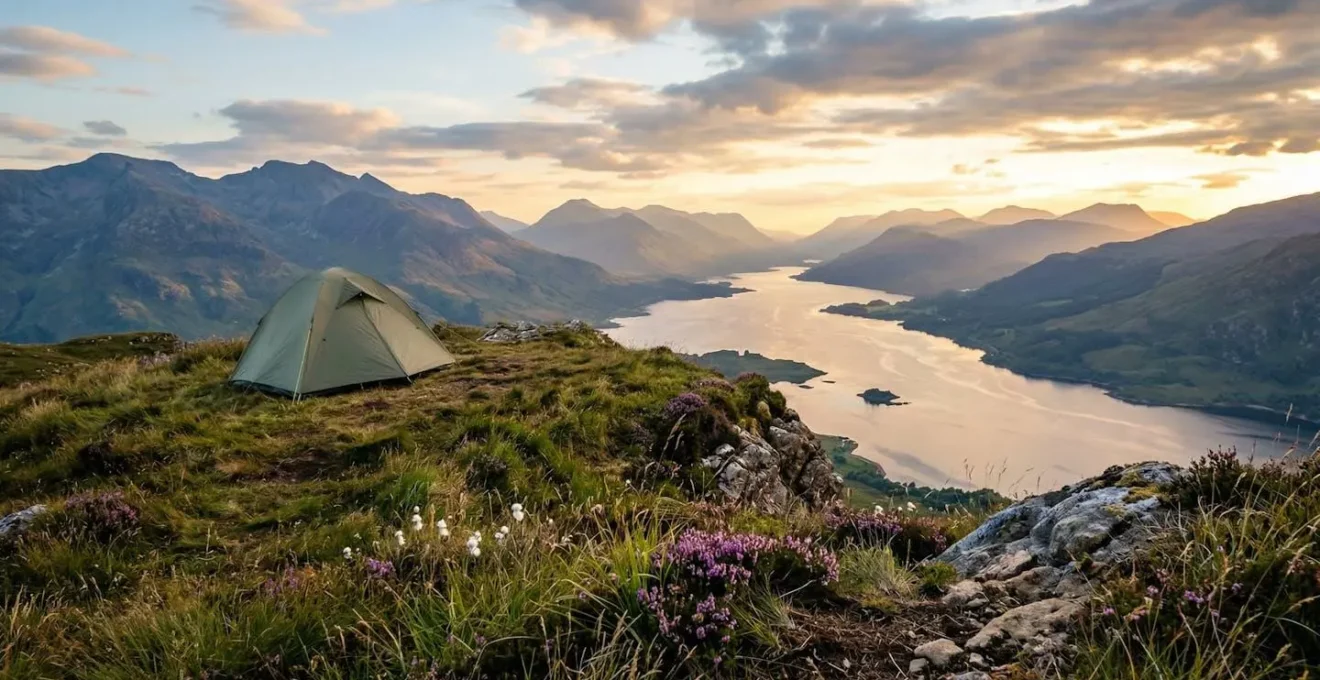
This image captures the essence of true wild camping: leaving the road behind and heading into the wilderness under your own power. It’s this commitment to effort and low-impact travel that defines the activity and is at the heart of our access rights.
By understanding this, you can see the byelaws not as a restriction on wild camping, but as a tool to manage a different, higher-impact activity.
Gas Stove vs Open Fire: Why Campfires Are Often a Bad Idea in Peatland?
The image of a crackling campfire is deeply ingrained in our idea of camping, but in the Scottish Highlands, it’s a practice that must be approached with extreme caution, and often avoided entirely. The primary reason is the very ground beneath your feet: peat. Peat is not soil; it’s a unique accumulation of partially decayed vegetation built up over millennia. In fact, scientific analysis shows it takes thousands of years for these layers to form.
This organic material is incredibly carbon-rich and flammable, especially when dry. A surface fire can easily ignite the peat underground, where it can smoulder undetected for days or even weeks, only to re-emerge far from its origin point, causing devastating wildfires. This releases massive amounts of stored carbon into the atmosphere. A 2019 study on Scottish peatlands emphasized that when damaged by fire, these vital landscapes can switch from being carbon sinks to becoming net sources of greenhouse gases, fundamentally harming our environment.
For this reason, a lightweight gas stove is the only truly responsible choice for cooking while wild camping in most parts of the Highlands. It’s efficient, controllable, and leaves absolutely no scar on the landscape. While a small, contained fire on a beach below the high-tide line might be acceptable, a fire on or near peaty ground is an unacceptable risk. It’s a clear case where the romantic ideal must give way to ecological sensitivity.
Choosing a stove over a fire is one of the most significant positive impacts a wild camper can make.
The Gate Etiquette Mistake That Angers Scottish Farmers
Your right to roam exists within a working landscape. The hills and glens are not just a wilderness playground; they are workplaces for farmers and land managers. One of the most common points of friction between outdoor enthusiasts and the people who work the land is a simple farm gate. The rule is straightforward: leave a gate as you find it. If it’s closed, close it behind you. If it’s open, leave it open.
The reason is livestock management. A closed gate is there to keep sheep or cattle in a specific field. Leaving it open can lead to animals escaping onto roads, causing accidents, or mixing with other flocks, which can have serious implications for breeding and disease control. Conversely, an open gate may have been left that way intentionally by a farmer to allow livestock to move between pastures or access water. Closing it could cut them off from vital resources. This forms a core part of the land management partnership between all users of the countryside.
A forum user shares: ‘I wouldn’t get bogged down in this stuff too much, just avoid the Camping Management Zones. Even then, the chances of being spotted camping late on in a secluded part of WHW will be remote, especially at this quiet time of year.’ This highlights the importance of following proper etiquette to maintain good relationships with landowners.
– Experience from West Highland Way Walker, Walkhighlands
While some campers may feel these details are minor, this attitude, if widespread, erodes the trust that underpins our access rights. Following simple etiquette is not about avoiding being “spotted”; it’s about active respect. Always be particularly mindful during lambing season (usually March-May), when disturbing ewes can have tragic consequences.
Your simple actions at a gate can make the difference between being a welcome visitor and an unwelcome problem.
Stream or Loch: Which Water Source Is Safer to Filter?
Scotland appears to be blessed with an endless supply of fresh, clean water. Streams cascade down every hillside, and lochs stretch for miles. However, you should never assume this water is safe to drink without treatment. Even the most pristine-looking burn can carry invisible pathogens like Giardia or Cryptosporidium from upstream livestock or wildlife. A reliable water filter or purification method is a non-negotiable piece of kit.
But where you collect your water from also matters. Fast-flowing streams are generally a better option than still loch water. The movement and oxygenation of the water help to keep some pathogens at bay. When taking water from a stream, always try to collect it as far upstream as possible, away from any obvious sources of contamination like farm fields or bothies. Still, your situational awareness is key; check what’s upstream before you drink from downstream.
Lochs present a different challenge. While their large volume can dilute contaminants, the still water, especially near the shore, can be a breeding ground for bacteria. If a loch is your only option, wade out as far as you can and collect water from below the surface, avoiding any surface scum or areas where streams enter, which might carry silt and other runoff.
| Water Source | Advantages | Risks | Best Practice |
|---|---|---|---|
| Fast-flowing stream | Higher oxygen content, natural filtration through movement | May contain runoff from upstream farms | Check upstream for contamination sources |
| Loch water | Large volume dilutes contaminants | Stagnant areas harbour more pathogens | Collect from deeper water away from shore |
| Spring source | Often naturally filtered through rock | Can still contain Giardia | Always filter or purify regardless |
Ultimately, the golden rule remains: no matter how clear and inviting the water looks, always treat it before you drink it.
Why ‘Right to Roam’ Does Not Mean You Can Camp Anywhere?
This is the heart of the matter for many confused campers. The Land Reform (Scotland) Act 2003 grants everyone statutory access rights over most of Scotland’s land and inland water. This is a fantastic freedom, but it is not unconditional. The Act is built on a foundation of responsible access. The Scottish Outdoor Access Code explicitly states that these rights must be exercised reasonably and with respect for the interests of other people and for the environment.
Wild camping is a legitimate activity under these rights, but it is subject to specific guidelines. You cannot camp in enclosed fields of crops or animals, near buildings, or in places that interfere with local people’s privacy or work. The byelaws creating Camping Management Zones (CMZs) in places like Loch Lomond are a direct response to situations where the volume of camping—specifically, high-impact roadside camping—was causing significant environmental damage and social problems, thus failing the “responsible” test.
Therefore, the CMZs are not a removal of the Right to Roam, but a specific, localized management tool to uphold its core principle of responsibility. During the restricted season (1st March to 30th September), your access rights are modified in these small, designated zones. As the National Park Authority clarifies:
During this time, you need to either book into a campsite or use a permit to camp or (in some locations) to stay overnight in your motorhome in these Camping Management Zones.
– National Park Authority, Official Camping Management Bylaws
This system allows access to continue in a managed, sustainable way. It’s also important to note that these permits cost just £3 per tent or so, a small price to help fund the infrastructure that protects these popular spots. Outside of the very limited CMZ areas, responsible wild camping is still permitted year-round.
The system is designed to enable, not to prohibit, as long as that access does not cause harm.
How to Spot Boggy Ground Before You Pitch Your Tent?
Beyond legal and ethical considerations lies a crucial practical skill: site selection. Choosing a good pitch is an art, and one of the biggest mistakes newcomers make is setting up on what appears to be a flat, grassy patch, only to wake up in a puddle. Much of the Scottish landscape is boggy, and learning to read the ground is essential for a comfortable and dry night.
Your boots are your best tool for this. Before you even unpack your tent, perform the “boot press test.” Walk the area where you plan to pitch and press down firmly with your heel. If the ground feels spongy, like a wet mattress, or if water pools around your boot, move on. A good pitch should be firm underfoot. Remember to test the entire footprint of your tent, not just one spot.
You can also use vegetation as a clue. Bright green sphagnum moss is a classic indicator of waterlogged ground; it acts like a giant sponge. Rushes and cotton grass also thrive in wet conditions. Look instead for areas with heather and fine grasses, which prefer better-drained soil. This is situational awareness in action: using visual cues from the landscape to make better decisions. A bad pitch doesn’t just mean a wet sleeping bag; it also means your weight can damage the fragile vegetation and soil structure of these waterlogged areas.
Action plan: The boot press test technique
- Stand with your full body weight on one foot for 5 seconds on a potential tent spot.
- Observe the ground. If water pools around your boot immediately, the ground is saturated; find another spot.
- Step off and check if the ground springs back. Truly boggy ground will often stay compressed.
- Walk the entire area of your tent’s footprint, testing multiple points to ensure consistent firmness.
- Look for warning signs of waterlogged soil, such as an abundance of sphagnum moss and rushes.
A few minutes of careful inspection before you set up can make all the difference between a great night’s sleep and a damp disaster.
Key takeaways
- The summer byelaws are highly targeted, covering less than 4% of the park, and are not a total ban on wild camping.
- True wild camping is lightweight, on foot, and low-impact; it is fundamentally different from the higher-impact activity of roadside camping.
- Your primary responsibility is to protect the fragile environment: avoid fires on peat, pack out all waste, and leave gates and the landscape as you found them.
Coastal vs Inland: Which Wild Camping Spot Has Less Condensation?
You’ve found the perfect, legal, and dry spot. You’ve pitched your tent, and you settle in for the night. Yet, you can still wake up with a damp sleeping bag, not from rain, but from condensation. This happens when warm, moist air inside your tent hits the cold outer fabric and turns to water. Managing it is key to comfort, and your choice of location—be it by a lochside or further inland—plays a significant role.
It seems counterintuitive, but a pitch near a large body of water like a loch can often be better for managing condensation, provided there is a breeze. The air is more humid, but the constant airflow helps to ventilate the tent, carrying the moist air away before it can condense. The key is to pitch in a slightly elevated, exposed spot where the breeze can work its magic. Avoid sheltered bays or hollows where air becomes stagnant.
Inland spots, especially in sheltered valleys or forest clearings, can be “condensation traps.” The air is often still, and on a clear night, cold air sinks into these hollows, causing the temperature to plummet. This greater temperature swing between the inside and outside of your tent creates perfect conditions for heavy condensation. Whatever your location, the golden rule is to maximize ventilation. Keep your inner and outer tent doors open if weather permits, and ensure your tent is pitched tautly so the inner and outer layers don’t touch.
| Factor | Coastal/Lochside | Inland |
|---|---|---|
| Humidity Level | Higher (70-90%) | Moderate (50-70%) |
| Wind Exposure | Constant breeze aids ventilation | Often sheltered, still air |
| Temperature Stability | More stable due to water thermal mass | Greater temperature swings |
| Morning Dew | Heavy but dries quickly with wind | Moderate but lingers in hollows |
| Best Pitch Location | Slight elevation with wind exposure | Avoid valleys and tree cover |
Now, equipped with this understanding of the law, ethics, and practical skills, you are ready to plan your trip. Review your gear, check the official park maps for Camping Management Zones, and head out with the confidence that you are not just a visitor, but a temporary guardian of this incredible landscape.