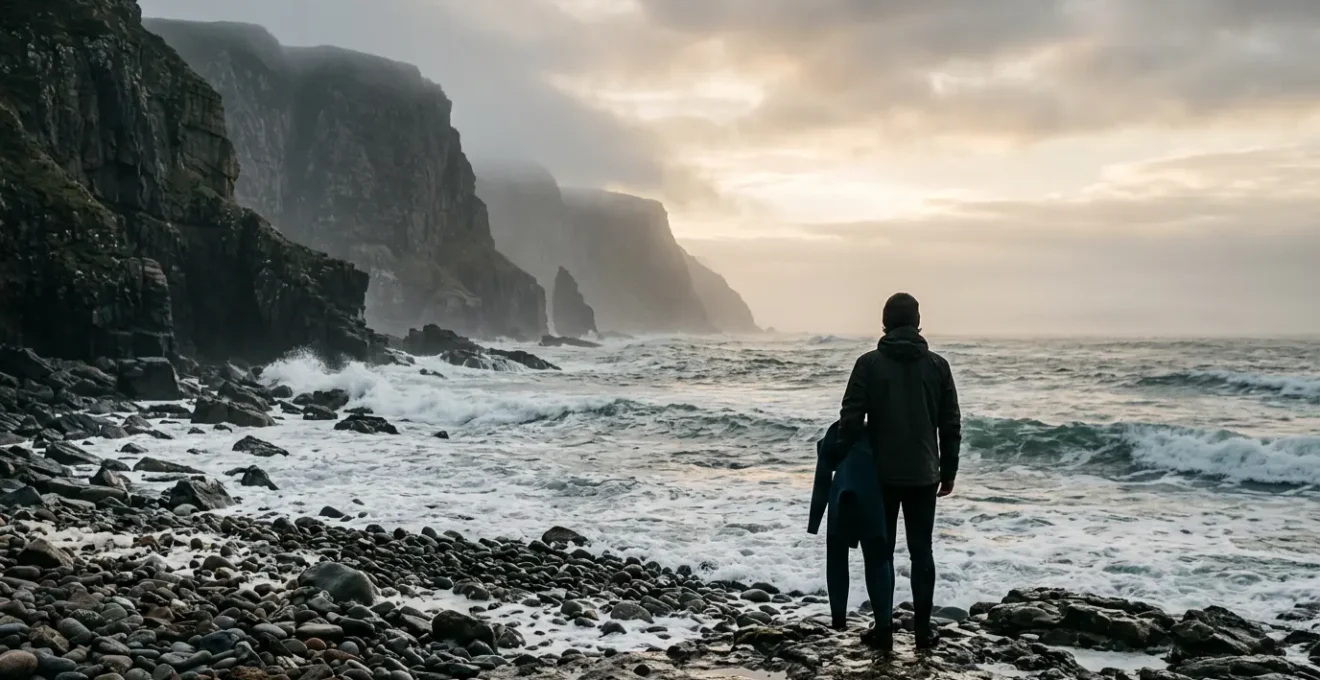
Thinking a 4/3mm wetsuit is fine for a Scottish summer? That’s the first and most dangerous mistake many warm-water surfers make.
- The Scottish “summer” involves water temperatures that rarely exceed 15°C, which can trigger hypothermia 25 times faster than cold air.
- Wind, tides, and specific environmental traps like katabatic gusts on lochs are bigger factors than the air temperature.
- Your gear is a complete survival system, not just a wetsuit. A hood, boots, and gloves are non-negotiable.
Recommendation: Forgo the 4/3mm and invest in a high-quality, well-fitting 5/4mm wetsuit. This isn’t about comfort; it’s about building in a critical margin of safety for the unpredictable North Sea.
I’ve seen it a hundred times up here in Thurso. A surfer pulls up, board bag fresh from a flight from Portugal or the south of France, beaming at the green hills and the summer sun. They look at the waves, then at their 4/3mm wetsuit, and think, “This’ll be grand.” An hour later, they’re back on the beach, shivering, confused, and with their session cut short. The biggest mistake you can make coming to surf in Scotland is underestimating our “summer.” The postcard-perfect weather on land has absolutely no relationship to the reality of our water.
The question isn’t just about wetsuit thickness. That’s a conversation for warmer climates. Here, the real question is: “What is my complete survival system for the North Atlantic?” Your wetsuit is the core of that system, but it’s just one piece. The cold is a constant, unforgiving presence that affects your body, your decision-making, and your ability to handle a bad situation. Forget simply feeling the chill; we need to talk about cold water shock, hypothermia, and environmental traps you’ve likely never considered.
This guide isn’t a simple temperature chart. It’s the advice I give to every single person who walks through my surf school doors. We’re going to break down why the Scottish environment demands more respect, what happens to your body in cold water, and how to understand the specific risks of our lochs and coasts. This is about ensuring you have the knowledge and the right gear to have an incredible—and safe—time surfing our world-class waves.
To navigate this properly, we will explore the critical elements of cold water safety, from understanding the real impact of our summer weather to learning the specific hazards of our unique aquatic environments. This structure will build your knowledge from the ground up, turning you from a visitor into a prepared cold-water surfer.
Summary: Your Guide to Safe Scottish Summer Surfing
- Why Summer Weather in Scotland Can Still Cause Hypothermia?
- The ‘Umbumbles’ and Stumbles: Early Signs of Cold Water Shock
- Loch Morlich or Loch Ness: Which Is Safer for Beginner Paddleboarders?
- Wind Direction on Loch Ness: When Should You Stay on Shore?
- How to Read Tide Tables to Avoid Being Stranded in Sea Caves?
- Do You Need a Permit to Paddle on Scottish Reservoirs?
- Roof Rack vs In-Car: How to Transport Wet Gear Without Ruining Your Rental?
- How to Paddle the Great Glen Canoe Trail Safely Without a Guide?
Why Summer Weather in Scotland Can Still Cause Hypothermia?
The single most important fact to grasp is this: the water is always cold. A beautiful 20°C day with blue skies on the Caithness coast feels warm, but the sea doesn’t care. As a surf school owner, I know that local data is what matters, and according to Coast to Coast Surf School data, even in peak summer, East Lothian water temperatures average just 12-15°C. This is a temperature that can incapacitate a poorly protected person in minutes, not hours. It’s a deceptive cold, one that feels manageable for the first ten minutes before it starts to drain your energy and core temperature at an alarming rate.
The science is brutally simple. As hypothermia expert Dr. Mark Harper explains, the physical properties of water make it a far greater threat than air. He provides a stark comparison:
Water conducts heat away from the body 25 times faster than air. Spending 10 minutes in 12°C water is equivalent to standing naked in a -5°C freezer.
– Dr. Mark Harper, Hypothermia expert analysis
This rapid heat loss is why a 4/3mm wetsuit, perfectly adequate for 16-18°C water in Biarritz, is pushing the limits here. It might keep you from freezing for a short session, but it offers a very thin margin of safety. If you get held down, have a long paddle back against the wind, or simply want to stay out for more than an hour, that thin margin disappears. A 5/4mm suit, complete with a hood, isn’t a luxury; it’s the standard-issue tool for maintaining core temperature and ensuring you have the energy reserves to deal with the unexpected.
This isn’t about being tough; it’s about being smart. The cold will always win a fight against inadequate gear.
The ‘Umbumbles’ and Stumbles: Early Signs of Cold Water Shock
Before the full-body shiver of hypothermia sets in, your body sends out subtle but clear warning signals. As a guide, I’m trained to watch for these, but you need to learn to recognize them in yourself and your buddies. In the search and rescue community, they have a name for it: the “umbles.” It’s a simple mnemonic that describes the progressive loss of coordination and cognitive function, where the ‘umbles’ appear in 100% of mild hypothermia cases: Fumbles, Stumbles, Tumbles, Mumbles, and Grumbles. It starts with difficulty using your fingers (fumbling with a zipper) and progresses to irritability and poor decision-making (grumbling).
These aren’t just quirks; they are direct signs your core temperature is dropping and your brain and muscles are being affected. The initial cold water shock, that involuntary gasp for air as you hit the water, is dangerous enough, but the slow, creeping onset of the “umbles” is what can turn a manageable situation into a critical incident. Your judgment becomes impaired, you might not realise you’re in trouble, and you might make a poor choice like paddling further from shore.
This is why a buddy system here is about more than just watching for wipeouts. It’s about active monitoring. You need to be able to check on your partner’s condition with simple, objective tests that can reveal a problem before it becomes a crisis.
Your 5-Point Buddy System Cognitive Check
- Fine Motor Skills: Ask your partner to touch their thumb to each finger on one hand, then reverse the sequence. Watch for hesitation or inability to perform the task smoothly.
- Memory & Speech: Ask a simple, factual question like “What did you have for breakfast?” or “What’s your postcode?” Listen for slurred speech, mumbling, or a slow response.
- Gross Motor Function: Keep an eye on their balance on the board and their general movements. Are they stumbling? Do they seem unusually clumsy when trying to paddle?
- Manual Dexterity: Watch them perform a simple task, like adjusting their leash or a zipper. Difficulty with these actions is a major red flag for stiff, cold hands.
- Reaction & Coordination: Casually ask them to catch a small, light object like a glove (if you have a spare). A slowed reaction time is a clear indicator of the cold’s effect.
–
If you or your buddy shows any of these signs, the session is over. No exceptions. It’s time to get to shore, get warm, and get dry.
Loch Morlich or Loch Ness: Which Is Safer for Beginner Paddleboarders?
This question comes up a lot, especially with the rise of paddleboarding. On the surface, both are large, beautiful bodies of fresh water. But from a safety perspective, they are worlds apart, and Loch Ness is one of the prime examples of Scotland’s environmental traps. For a beginner, the choice is clear: Loch Morlich is significantly safer.
Loch Morlich, nestled in the Cairngorms, boasts a sandy beach, relatively shallow water near the shore, and a dedicated watersports centre with safety boat cover. It is contained within a forested bowl, offering some protection from the worst of the wind. Its environment is predictable and managed, making it an ideal place to learn and build confidence.
Loch Ness, on the other hand, is a different beast entirely. It’s incredibly deep (over 200m), meaning the water is frigid year-round. Its sides are steep, offering few safe places to get out if you get into trouble. But its biggest hidden danger is the wind. The Great Glen acts as a massive wind tunnel, and Loch Ness is notorious for a phenomenon that catches even experienced water users by surprise.
Case Study: The Katabatic Wind Trap on Loch Ness
Meteorological studies of steep-sided lochs like Ness show they are prone to powerful katabatic winds. This occurs when cold, dense air from the surrounding high ground suddenly sinks and funnels down the mountainsides onto the loch’s surface. These gusts can appear on an otherwise calm day, creating offshore winds of up to 40mph in seconds. There have been numerous rescue incidents involving paddleboarders and kayakers pushed far from shore with no way to get back, demonstrating how this invisible force turns a pleasant paddle into a survival situation.
For a beginner, being caught by a katabatic wind on Loch Ness is a terrifying and life-threatening scenario. You can be blown into the vast, cold centre of the loch in minutes. Loch Morlich simply does not have this specific, high-risk characteristic. The choice is a classic example of looking beyond the scenic view and assessing the underlying environmental risks.
Always choose the location that matches your skill level, and on the big Highland lochs, assume the conditions can change in an instant.
Wind Direction on Loch Ness: When Should You Stay on Shore?
Knowing when *not* to go out is the most important skill you can have. On a huge body of water like Loch Ness, the wind is the master. An offshore wind (blowing from the land out to the water) is the single most dangerous condition for a paddleboarder. It feels deceptively pleasant near the shore, creating flat, glassy water that looks inviting. But as soon as you paddle out, it will start pushing you away from safety, and the further you go, the stronger it gets.
You must learn to read the water’s surface. Before you even think about getting on your board, stand on the shore for five minutes and just watch. The surface tells you everything you need to know about the wind’s strength. Forget the weather forecast for a moment; what you see in front of you is the reality.
- Glass surface (0-5 mph): The water looks like a mirror. These are generally safe conditions for all levels, but always be aware of the potential for sudden changes.
- Cat’s paws (5-10 mph): You’ll see small, dark patches ruffling the surface as gusts move across the water. Beginners should be extremely cautious; this is a sign the wind is active.
- Ripples (10-15 mph): A consistent pattern of small waves covers the surface. This requires intermediate skill and a good fitness level to paddle against. For most, this is a sign to stay on shore.
- Whitecaps (15+ mph): The crests of the small waves are breaking. This is for experts only, and even then, it’s often too risky. Stay on the shore.
- Foam streaks (20+ mph): The wind is now blowing spray off the water’s surface. These are absolute no-go conditions for any paddle craft.
Furthermore, the shape of the glen creates another hazard. The Venturi effect, where wind is forced to accelerate as it passes through a narrow gap, is a major factor at places like the narrows near Fort Augustus. Analysis of rescue incidents has shown that wind speeds in these narrows can be two to three times higher than the ambient forecast, creating localized and violent gusts. This is why you can’t blindly trust a forecast; you have to combine it with real-time observation and knowledge of the local topography.
If there is any significant offshore wind, or if you see whitecaps forming, the decision is simple: stay on shore. There will always be another day.
How to Read Tide Tables to Avoid Being Stranded in Sea Caves?
For the coastal surfer, tides are as important as the swell. In Scotland, our large tidal ranges create powerful currents and can dramatically change the shoreline in a matter of hours. Exploring sea caves and secluded coves is a magical part of the experience, but it’s also a classic environmental trap for the unwary. The same tide that grants you access to a beautiful cave on its way out can quickly trap you inside on its way in.
Reading a tide table is a start, but understanding the *speed* of the water’s movement is what keeps you safe. This is governed by the “Rule of Twelfths.” It’s a simple method to estimate the rate of flow. The rule states that in the first hour of a six-hour tide cycle, 1/12 of the water moves; in the second hour, 2/12; in the third and fourth hours, 3/12 each. This means that a staggering 50% of the total tidal water movement occurs in the middle two hours of the cycle. This is when the water level rises fastest and currents are at their peak. It’s the danger zone for cave exploration.
You also need to know whether you’re on a Spring or Neap tide. This has nothing to do with the season; it relates to the moon phase. Spring tides (occurring around the full and new moon) have the greatest range and therefore the fastest currents, posing the highest risk.
This table illustrates the difference in risk level when exploring coastal features.
| Tide Type | Tidal Range | Current Speed | Cave Entrapment Risk |
|---|---|---|---|
| Spring Tide | 5-6 meters | 3-4 knots peak | High – rapid water rise |
| Neap Tide | 2-3 meters | 1-2 knots peak | Low – slower changes |
Beyond the tables, learn to read the rocks themselves. The boundary between the dark, wet rock covered in barnacles and the lighter, dry rock with lichens shows you the high-water mark. It’s nature’s own tide gauge.
This visual clue is your most reliable guide. If you’re in a cave and the water is approaching that line, you should have left already. Never enter a sea cave on a rising tide, especially a spring tide.
Your watch and the high-water mark are your two most important safety tools when the coast gets complex.
Do You Need a Permit to Paddle on Scottish Reservoirs?
This is one of the few easy questions with a brilliantly simple answer: no, you do not need a permit. One of the greatest things about Scotland is our progressive access legislation, which is fundamentally different from the laws in many other parts of Europe. The Land Reform (Scotland) Act 2003 is the key piece of legislation here, and it’s a game-changer for anyone wanting to explore the outdoors.
In essence, the Act grants the public a right of responsible access to most land and inland water. This isn’t just a tolerated activity; it’s a statutory right. Research confirms that under the Land Reform Act 2003, statutory access rights extend to virtually 100% of Scotland’s land and inland water for non-motorised recreation, including surfing, kayaking, and paddleboarding. This applies to rivers, lochs, and almost all reservoirs.
The key word, however, is “responsible.” This right comes with duties. As the national governing body for paddling, Paddle Scotland, emphasizes, the right to access is conditional on your behaviour.
The Land Reform (Scotland) Act 2003 ensures everyone has statutory access rights to most of Scotland’s outdoors, if these rights are exercised responsibly.
– Paddle Scotland, Official Access Rights guidance
Responsible access means following the Scottish Outdoor Access Code. This includes simple, common-sense principles: respect the interests of other people, care for the environment, and take responsibility for your own actions. For reservoirs, this can mean specific things like not interfering with dam infrastructure, being aware of operational activities, and checking for any local guidance, particularly regarding biosecurity to prevent the spread of invasive non-native species. But in terms of a formal permit to launch your board or kayak? You can leave that worry at home.
Enjoy the incredible access we have, but always do so with respect for the environment and other users.
Roof Rack vs In-Car: How to Transport Wet Gear Without Ruining Your Rental?
This is the less glamorous, but highly practical, side of a Scottish surf trip. You’ve had a great session, you’re cold, and now you have a soaking wet, sandy 5/4mm wetsuit, boots, gloves, and a hood. The last thing you want is a huge cleaning bill or a dispute over your rental car deposit. The “just chuck it in the boot” approach that might work with board shorts and a rash vest will cause serious problems with a dripping winter suit.
A roof rack with a board bag is the ideal solution, keeping all the wet gear outside the car. However, many rental cars don’t come with them. So, you must have a bulletproof in-car system. This is about creating multiple layers of containment. One bag is not enough; a single leak can soak into the boot lining, and the smell of damp neoprene can linger for weeks. You need a multi-layered system.
The foundation of this system is a large, durable, waterproof sheet or tarp to line the boot. On top of this, use large, cheap, and surprisingly tough IKEA Frakta bags as your outer containment. Then, inside those, place your wetsuit and accessories, each in their own individual dry bag or even a sturdy rubble sack. This layering approach means that even if one bag has a small leak, there are two more layers of protection before water reaches the car’s interior.
Before you even load the gear, you should protect yourself. Use your phone to take timestamped photos of the car’s interior, especially the boot and seats, before you put anything in. Document any pre-existing stains or damage. This is your evidence in case of a dispute. Pay close attention to fabric seams and the edges of plastic trim, as this is where water damage becomes most obvious.
Treat the rental car with more care than you would your own, and you’ll have no problems.
Key Takeaways
- Underestimation is the greatest risk; Scottish summer water is dangerously cold (12-15°C), requiring a full survival system, not just a wetsuit.
- A 5/4mm wetsuit with a hood, boots, and gloves is the recommended standard for safety and endurance, not a 4/3mm.
- Learn to recognise environmental traps like katabatic winds on lochs and fast-rising spring tides in sea caves, as they pose a greater threat than the ambient weather.
How to Paddle the Great Glen Canoe Trail Safely Without a Guide?
Paddling the Great Glen Canoe Trail is an epic Scottish adventure, a 60-mile journey through the heart of the Highlands. Doing it without a guide elevates the sense of challenge and reward, but it also places the entire responsibility for safety squarely on your shoulders. This is not a trip to be undertaken lightly. It requires meticulous planning, a conservative mindset, and a deep respect for the scale and volatility of the lochs—Loch Lochy, Loch Oich, and the formidable Loch Ness.
The primary challenge of the trail is its commitment. Unlike a coastal paddle where you can often find a place to land, the Great Glen has long, remote stretches with no easy way off the water. A trail analysis reveals that the 60-mile trail has only 7 official safe exit points, with the longest and most committing no-return stretch being over 12 miles on the exposed waters of Loch Ness. An equipment failure or a sudden turn in the weather here can leave you dangerously isolated.
Your survival system here extends far beyond your wetsuit. It includes robust planning and communication. Since mobile signal is unreliable for much of the route, you must have a non-technical safety plan. Leave a detailed float plan with a trusted contact on shore. This is not a casual “I’m going paddling”; it’s a formal document.
- Itinerary: Lodge a detailed plan including launch/landing spots, intended daily mileage, and estimated checkpoint times.
- Check-in Protocol: Set rigid check-in times. If a check-in is missed by a pre-agreed window (e.g., 2 hours), your contact’s job is to initiate the rescue process.
- Bail-out Points: List all potential bail-out points along your route, with GPS coordinates and notes on the nearest road access.
- Details: Include descriptions of your gear, your vehicle’s location, and any relevant medical conditions for everyone in your party.
- Emergency Contacts: Provide the direct numbers for the local Police Scotland and Mountain Rescue teams.
This level of planning might seem excessive, but it’s what’s required when you remove the safety net of a professional guide. You are the guide, the logistician, and the rescue coordinator all in one. Preparation is everything.
To truly enjoy the wildness of the Great Glen, you must first mitigate its risks through rigorous and thorough planning.