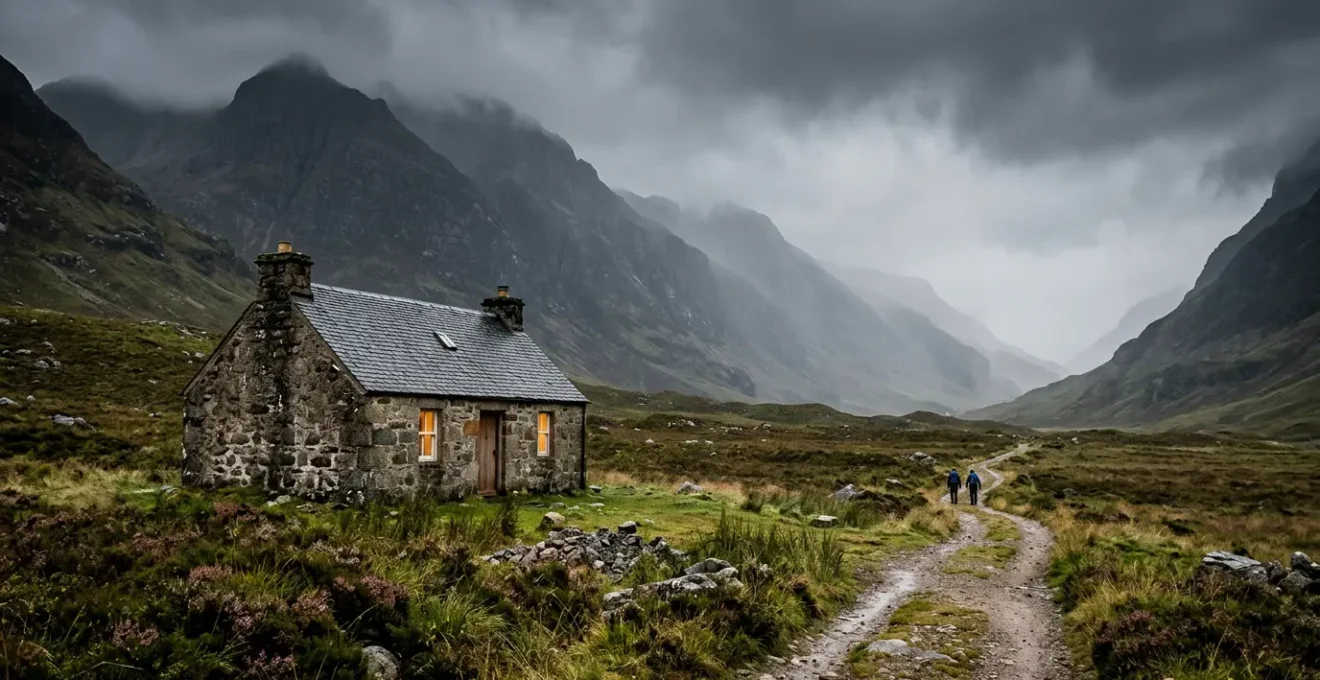
The key to a successful bothy trip isn’t just knowing the official rules, but deeply understanding the unwritten ethos of self-reliance and community that governs these simple shelters.
- Respect for the shelter and its history means carrying in your own fuel and never damaging the landscape for a fire.
- True bothy etiquette involves actively contributing to the space, from sharing a dram to ensuring there’s always room for one more, no matter how full it seems.
Recommendation: Before your first visit, shift your mindset from being a guest to being a temporary custodian, responsible for the shelter, the environment, and the experience of others.
The first time you see a bothy appear through the mist after a long day’s hike, it feels like magic. A simple stone shelter, a promise of refuge from the wind and rain. But for the uninitiated, that magic is often tinged with a quiet anxiety. What are the rules? Will I make a fool of myself? Will I accidentally offend the seasoned hillwalker who seems to have been born on a sleeping platform? Many guides will tell you to “leave it as you found it” or “carry out your rubbish,” but these are just the surface-level instructions. They don’t prepare you for the real, living culture of the bothy.
As someone who has spent more nights than I can count sleeping on wooden bunks and sharing stories around a sputtering fire, I can tell you this: the Mountain Bothies Association (MBA) code is the start, not the end, of your education. The true rules are unwritten. They aren’t about a list of dos and don’ts; they are about understanding the shared bothy ethos. It’s a philosophy built from decades of communal survival in the wild, a blend of fierce self-reliance and quiet cooperation. This guide isn’t just about how to use a bothy. It’s about how to become part of the bothy community, even if just for one night.
We’ll go beyond the obvious and delve into the ‘why’ behind the rules. We’ll cover everything from the sacred duty of carrying fuel to the subtle art of managing condensation, learning the practical skills and the mindset that will ensure you’re welcomed back time and time again. Forget the fear of getting it wrong; let’s learn how to get it right.
This article breaks down the essential, unwritten etiquette passed down from one generation of hillwalkers to the next. The following summary provides a roadmap to mastering the art of the bothy, ensuring your presence enhances, rather than detracts from, this unique tradition.
Summary: Mastering the Unwritten Rules of the MBA Bothy
- Why You Must Carry In Your Own Fuel and Not Cut Trees?
- How to Hang Your Food to Stop Mice Eating Your Breakfast?
- The Spade Method: How to Toilet Responsibly When There is No Loo?
- First Come First Served: What If the Bothy is Full?
- Sleeping Mat Selection: Insulation Against Cold Stone Floors?
- The Toilet Paper Mistake That Pollutes Scottish Bothies
- How to Spot Boggy Ground Before You Pitch Your Tent?
- Coastal vs Inland: Which Wild Camping Spot Has Less Condensation?
Why You Must Carry In Your Own Fuel and Not Cut Trees?
The heart of any good bothy night is the fire. We call it ‘bothy TV’ for a reason. It’s the focal point for stories, shared whisky, and the simple, profound warmth that makes a stone box feel like a home. But this is where the first, and perhaps most sacred, unwritten rule comes into play. The fire is a luxury you must earn, and you earn it with the weight in your pack. You must carry in your own fuel, preferably coal for its longevity and heat.
To a newcomer, the surrounding landscape might look like an untapped fuel source. A dead branch here, a rickety fence post there. This is a critical misunderstanding of the Highland environment. Many of these areas are ecological relics, still bearing the scars of historical deforestation from events like the Highland Clearances. That gnarled, dead-looking wood is a vital part of a fragile ecosystem, providing a home for insects, fungi, and mosses. It is not yours to take. The MBA’s strict fuel rules exist to protect what little remains.
This rule is about more than just conservation; it’s about respect for history and labour. Every bothy is maintained by volunteers. Hacking at a nearby fence for firewood isn’t just vandalism; it’s a slap in the face to the people who haul in materials to keep the shelter standing. A blazing fire, known as ‘bothy TV’, is a wonderful shared experience, but only when it doesn’t deplete the local resources. So, pack the coal. Your back might ache on the walk in, but the respect you show and the warmth you share will be more than worth it.
How to Hang Your Food to Stop Mice Eating Your Breakfast?
After a long day on the hills, the last thing you want is to wake up and find your carefully rationed breakfast has been raided. Welcome to the second reality of bothy life: you are not alone. Long before you arrived, the bothy had permanent residents – a thriving population of mice who are experts in liberated catering. The unwritten rule here is one of proactive defence. Your food is your responsibility, and protecting it is a test of your bothy craft.
Simply leaving your pack on the floor or even on a sleeping platform is an open invitation for a midnight feast. These creatures are master climbers and surprisingly intelligent. The only effective defence is elevation. Look for the signs of past battles: nails hammered into rafters, loops of string, or custom-built hooks. These are the communal weapons in the ongoing war against rodent theft. Use them. A sturdy dry bag with a secure closure, hung from a high point, is your best bet.
For ultimate protection, experienced bothy-goers use a multi-layered system. An odour-proof bag (like an Opsak) inside your main food bag can stop them from even noticing your supplies. For high-value items, a hard-sided container provides a final, impenetrable barrier. Remember, hanging space can be limited, so be courteous. Don’t let your bag drip onto someone else’s gear, and make space for others. This nightly ritual isn’t just about protecting your porridge; it’s a fundamental act of self-reliance in a shared environment.
The Spade Method: How to Toilet Responsibly When There is No Loo?
Let’s talk about the least glamorous, but most crucial, aspect of bothy etiquette: going to the toilet. Almost no bothies have toilet facilities. The spade you see by the door is not for gardening. This is where the concept of ‘invisible impact’ becomes paramount. The goal is for the next person, and the person after that, to have no idea you were ever there. Failing at this is the quickest way to mark yourself as a novice and ruin the area for everyone.
The rule is simple but requires diligence. You must walk a significant distance from the bothy. The official MBA guidance suggests that, as a minimum, users must go at least a couple of hundred metres from the bothy and keep well away from water courses. This isn’t a suggestion; it’s a strict requirement to protect water sources and prevent the immediate vicinity of the shelter from becoming a foul, unsanitary minefield. Find a spot with good, thick soil, far from any streams or lochs.
Using the spade, you dig a hole about 6-8 inches deep. Do your business in the hole. Afterwards, you bury it completely, replacing the turf or soil you removed. Tamp it down so it looks undisturbed. What about toilet paper? That’s a topic so important it deserves its own section. For now, know that the spade is your tool for responsible sanitation. Using it correctly is a non-negotiable sign of respect for the land, the bothy, and your fellow hikers.
Action Plan: Responsible Bothy Toileting
- Locate the bothy spade or your personal trowel before you are desperate.
- Walk at least 200 metres from the bothy and any water source, choosing a secluded spot.
- Probe the ground to find deep soil, avoiding rocky or shallow areas.
- Dig a hole 6-8 inches (15-20 cm) deep and wide enough for its purpose.
- After use, completely fill the hole with the excavated soil, replacing any turf on top to leave no trace.
First Come First Served: What If the Bothy is Full?
You’ve hiked for eight hours through wind and rain, dreaming of the bothy. You arrive, push open the door, and find it packed, with bodies and gear filling every available inch. Your heart sinks. Is it ‘first come, first served’? Do you have to pitch your tent in the gale? This is where the most beautiful part of the bothy ethos comes to life. The unwritten rule, the one that truly defines the community, is ‘there’s always room for one more’.
No one has the right to exclusive use of a bothy. It doesn’t matter if you got there first. As the writer at “Going the Whole Hogg” so perfectly puts it in a piece on the subject:
There’s no ‘first come, first served’ policy when it comes to the Scottish bothy. Instead, an ethos of ‘there’s always room for one more’. No one has the right to exclusive use of a bothy, or any part of it.
– Going the Whole Hogg, The Scottish Bothy: An Introduction
If you are inside a full bothy, your job is to shuffle, to make space, to welcome the newcomer with a smile, not a scowl. If you are the newcomer, your job is to be gracious, compact, and appreciative. This culture is so important that the MBA has policies to protect it; for example, large groups of six or more are discouraged from using bothies precisely because they can overwhelm this delicate social balance. The system is designed for individuals and small groups to share. The ‘squeeze’ is part of the experience, a physical manifestation of communal survival.
So, if you arrive to a full house, don’t despair. Announce your presence, be prepared to occupy a small patch of floor, and you’ll be welcomed. This shuffling of bodies and gear is the dance of the bothy, and in participating, you become part of the community.
Sleeping Mat Selection: Insulation Against Cold Stone Floors?
Once you’ve secured your small patch of floor space, the next challenge is getting a comfortable night’s sleep. A common rookie mistake is underestimating just how cold a stone or concrete floor can be, even inside a shelter. The ground acts as a massive heat sink, drawing warmth from your body all night long. Your high-tech sleeping bag is useless if its insulation is compressed beneath you. The unwritten rule here is one of thermal warfare: insulate or suffer.
Not all bothy sleeping surfaces are created equal. Some have raised wooden platforms or bunks, which are a godsend, lifting you away from the coldest floor. But you can never guarantee their availability. Most of the time, you’ll be dealing with wood, stone, or concrete. A sleeping mat’s insulating power is measured by its R-value; the higher the number, the better it resists heat loss. For a cold stone floor, you need a high R-value.
This table from a Wikipedia page on the topic gives a good overview of what you’re up against, though the specifics vary by location:
| Surface Type | Availability | Insulation Needed | Comfort Level |
|---|---|---|---|
| Raised platforms/bunks | Some bothies | Moderate (R-value 2-3) | Better than floor |
| Wooden floors | Many bothies | High (R-value 3-4) | Moderate |
| Concrete/stone floors | Most bothies | Very High (R-value 4+) | Poor without mat |
| Upstairs boards | Limited bothies | Moderate (R-value 2-3) | Good if available |
The veteran’s trick is the two-mat system. You lay down a cheap, closed-cell foam mat first. This provides a durable, insulating base and protects your more expensive gear. On top of that, you place your primary inflatable mat for comfort. This combination dramatically increases your overall R-value, protects your inflatable mat from punctures on the rough floor, and gives you a backup if your main mat fails. It’s a simple but incredibly effective strategy for ensuring a warm, restorative sleep.
The Toilet Paper Mistake That Pollutes Scottish Bothies
We need to return to the delicate subject of toileting, specifically to address the single biggest mistake people make: what to do with used toilet paper. The rule is absolute, unambiguous, and frequently ignored: you must pack it out. All of it. Every single piece. Burying it is not an option. Burning it is not an option.
You might think, “It’s biodegradable, what’s the harm?” The harm is that it biodegrades incredibly slowly in the cold, wet, acidic soil of the Scottish mountains. Instead of disappearing, it gets dug up by animals or washed out by rain, leaving disgusting ‘white flowers’ blooming across the landscape. It’s a visual pollutant and a health hazard. With the Mountain Bothies Association maintaining around 97 bothies in Scotland, England, and Wales, the cumulative impact of thousands of visitors leaving their paper behind would be catastrophic.
The solution requires a little preparation but is a non-negotiable part of your kit. You need a dedicated ‘waste’ bag – an opaque zip-lock bag, perhaps double-bagged for security. Used paper goes in here and is carried out with the rest of your rubbish. It might seem unpleasant, but it is the only responsible way. Your essential toilet kit for a bothy trip should therefore include a trowel, biodegradable toilet paper (for your comfort, not for the ground’s), hand sanitiser, and your waste bag system. Mastering this simple act of personal responsibility is a true sign of an experienced and respectful hillwalker. It’s the ultimate expression of leaving an invisible impact.
How to Spot Boggy Ground Before You Pitch Your Tent?
While the bothy offers shelter, sometimes it is full, or you may simply prefer the solitude of your tent. The area around a bothy can seem like an ideal camping spot, but it often hides a trap for the unwary: boggy ground. The unwritten rule here extends beyond the bothy walls: learn to read the land or prepare for a damp awakening. A flat, lush patch of green can quickly turn into a puddle with you in the middle of it.
Spotting boggy ground is a multi-sensory skill that veterans develop over time. It’s not just about looking; it’s about listening, feeling, and thinking ahead. Start with your eyes: look for warning signs like sphagnum moss, cotton grass, and rushes. These plants thrive in waterlogged soil. Then, consult your map. Contour lines that are far apart on a valley floor often indicate flat, poorly drained areas prone to bogginess. Any depression in the landscape is a potential water trap.
Next, use your tools. Before you even unpack your tent, probe the ground with a trekking pole. If it sinks in easily, move on. Perform a ‘heel stomp’ – a firm stomp on the ground. If you hear a tell-tale squelch or see water seeping up, that’s your cue to find another spot. Even the air can give you a clue; a feeling of damp coolness can indicate a high water table. The safest bet is always to choose a spot with a slight elevation, even a metre or two, above the surrounding ground. This allows water and cold air to drain away from you, ensuring a drier, warmer night.
Key Takeaways
- The bothy ethos prioritizes community and respect over individual claims to space or resources.
- Self-reliance is paramount: carry your own fuel, manage your own waste, and be prepared for a lack of facilities.
- Leaving an ‘invisible impact’ is the ultimate goal, requiring you to pack out everything, including all toilet paper.
Coastal vs Inland: Which Wild Camping Spot Has Less Condensation?
Whether you’re in a tent or a crowded bothy, one final enemy awaits: condensation. The moisture from your breath, wet gear, and the very air around you can conspire to create ‘indoor rain,’ leaving you and your sleeping bag damp and cold. Understanding how to manage this is the final unwritten rule of comfort. The principle is simple: ventilation is more important than warmth.
Inside a bothy, especially with the ‘bothy TV’ roaring and multiple people breathing, the air quickly becomes saturated. The unwritten rule requires that a window or door be cracked open, even on a cold night. It may seem counter-intuitive to let the heat out, but a dry, cool environment is far better than a warm, dripping one. This same principle applies directly to pitching your tent.
The location you choose has a huge impact on condensation. A common debate is coastal versus inland. While it seems like a coastal location would be more humid, it often suffers less from condensation due to one key factor: air circulation. A constant breeze helps carry moisture away. In contrast, still, sheltered inland valleys can trap humid air, leading to a very damp morning.
This comparative table from Walkhighlands gives a clear breakdown:
| Factor | Coastal Location | Inland Location |
|---|---|---|
| Air circulation | Constant breeze | Often still air |
| Humidity trap | Open, disperses quickly | Valleys trap humid air |
| Temperature variation | Moderated by sea | Greater extremes |
| Vegetation transpiration | Limited coastal plants | Dense vegetation adds moisture |
| Best practice | Face tent into prevailing wind | Seek slight elevation for airflow |
The takeaway is clear: prioritize airflow. In a bothy, argue for that cracked window. In a tent, pitch it where it can catch a breeze, open your vents, and don’t be afraid to sacrifice a little perceived warmth for a much drier and more comfortable night’s sleep. It is the final piece in the puzzle of mastering your mountain environment.
By embracing these unwritten rules—this shared ethos of respect, self-reliance, and community—you do more than just survive a night in the hills. You become a custodian of a tradition, ensuring that the magic of the bothy remains for the next weary traveller who sees it appear through the mist.