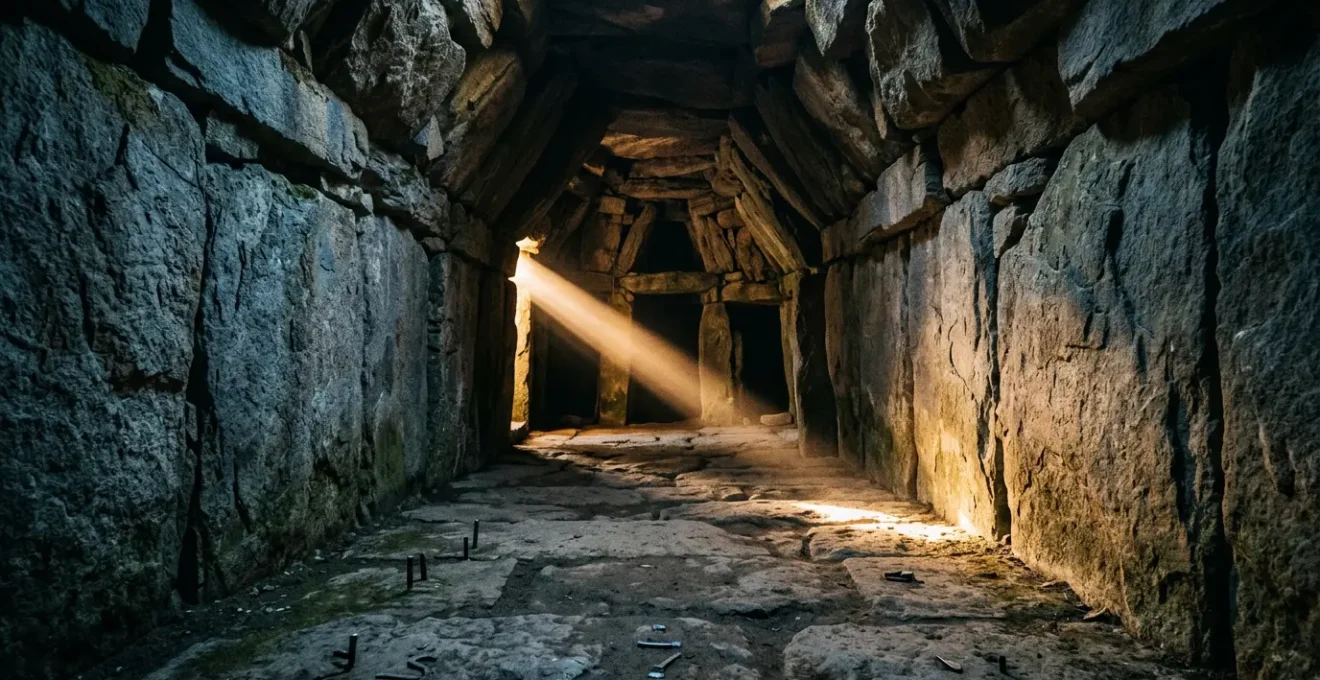
Deciding between Maeshowe and Newgrange isn’t about which is ‘better,’ but about understanding their profound differences in preservation, landscape, and our modern interaction with them.
- Maeshowe’s value lies in its context within Orkney’s vast, interconnected Neolithic landscape, which requires a visitor to become an active, observant explorer.
- Newgrange offers a more focused, reconstructed experience of a single monumental tomb, while Orkney presents a fragile, living archaeological record.
Recommendation: Choose Newgrange for a powerful, singular Neolithic moment. Choose Orkney for an immersive journey into the process of archaeology itself, where learning to see the landscape responsibly is the true prize.
For any enthusiast of the Neolithic world, the question inevitably arises: Maeshowe or Newgrange? It seems a natural comparison. Both are masterpieces of Stone Age engineering, magnificent chambered tombs famous for their dramatic winter solstice alignments. The temptation is to see them as rivals, to ask which one is ‘better’ or more ‘impressive’. This line of questioning, however, misses the point entirely and leads to a superficial understanding of what these incredible places represent. As an archaeologist, I propose that the real comparison isn’t about size, reconstruction, or the perfect sunbeam photo.
The conventional approach is to weigh the pros and cons: Newgrange’s stunning reconstructed facade versus Maeshowe’s subtle integration into the Orcadian landscape. But this checklist approach is a tourist’s game. To truly appreciate these sites, we must adopt an archaeologist’s gaze. This means moving beyond the monuments as static objects and seeing them as the fragile heart of a dynamic system—a system that includes weather, geology, millennia of human history, and crucially, our own impact as modern visitors. The most significant difference between them is not in the stones themselves, but in the questions they compel us to ask about our relationship with the deep past.
This guide abandons the simple ‘versus’ debate. Instead, it offers a framework for understanding what makes the Orkney experience unique and profoundly valuable. We will explore why not touching the stones is a profound act of scientific preservation, how to read the landscape like an ancient text, and why the most meaningful moments often happen away from the solstice crowds. The goal is to transform your visit from a sightseeing tour into an act of responsible archaeological engagement, answering not “which is better?” but “how can I see what truly matters?”
This article provides a detailed framework for understanding and responsibly visiting the Neolithic heart of Orkney, placing it in context and offering practical advice for the archaeologically-minded traveller. The following sections will guide you through this unique landscape.
Summary: Maeshowe and the Archaeological Secrets of Orkney
- Erosion Risk: Why You Shouldn’t Touch the Standing Stones?
- Tides and Weather: When is the Best Time to See the Village?
- Solstice at the Ring of Brodgar: How to Avoid the Crowds?
- The Orkney Explorer Pass: Is It Value for Money?
- Callanish II and III: Why Visit the Smaller Circles?
- Beyond Stonehenge: Where are the Druidic Circles in Scotland?
- How to Access Remote Scottish Ruins Without Damaging the Landscape?
- Why Visit Scotland’s Lesser-Known Heritage Sites During Off-Peak Seasons?
Erosion Risk: Why You Shouldn’t Touch the Standing Stones?
The request to “please do not touch the stones” at sites like the Ring of Brodgar is often perceived as a simple crowd control measure. For an archaeologist, however, it is a fundamental principle of in-situ conservation. The surfaces of these megaliths are not inert rock; they are complex, living ecosystems and irreplaceable archaeological records. Each stone is a palimpsest, telling a story of its geology, its shaping by Neolithic hands, and 5,000 years of exposure to Orkney’s harsh weather. This surface is scientifically significant and incredibly fragile.
The primary threat is not dramatic vandalism, but micro-erosion. The natural oils and acids on our hands, however clean, can alter the chemistry of the stone surface over time, impacting the delicate lichens and mosses that grow there. These lichen colonies are often ancient themselves and are studied by scientists to track environmental changes. Touching the stone can damage or kill them, erasing centuries of data. Furthermore, the cumulative physical contact of thousands of visitors wears away the very tool marks and subtle textures that offer clues about how the stones were quarried and dressed. The Heart of Neolithic Orkney is considered extremely vulnerable to climate change, and protecting the integrity of the monuments’ surfaces is a critical part of mitigating wider risks.
This microscopic view reveals the world you help protect by not touching. These are not just patches of colour, but complex biological communities. By simply looking, you preserve the stone’s integrity for future generations and for the scientific research that continues to unlock its secrets. The most respectful way to connect with these monuments is with your eyes and your intellect, not your hands.
Tides and Weather: When is the Best Time to See the Village?
Choosing the “best” time to visit coastal Neolithic sites like Skara Brae involves more than just checking the weather forecast for sunshine. An archaeological perspective encourages environmental attunement: understanding the site as its inhabitants would have, shaped by the same elemental forces of wind, rain, and tide. The Orcadian weather is not an inconvenience to be avoided; it is an integral part of the experience, offering different insights with every change in condition. A summer visit at midday offers clarity, but a winter visit at dusk might provide a more profound connection to the harsh realities of Neolithic life.
This dynamic environment is also a destructive force. Coastal erosion is one of the single greatest threats to Orkney’s archaeology. The Scottish Coastal Archaeology and the Problem of Erosion (SCAPE) Trust monitors sites where immense history is being lost. For instance, at the ongoing excavation at Swandro on the island of Rousay, efforts continue to glean information from a site that is rapidly being lost to the sea. This challenge, however, presents a unique opportunity for visitors. Through citizen science projects, tourists can become active participants in conservation by documenting and reporting erosion, turning a simple visit into a meaningful contribution to heritage protection.
This comparative table helps frame your visit not in terms of “good” or “bad” weather, but in terms of the experience you seek. To truly understand Skara Brae, one must appreciate both the calm of a summer dawn and the fury of a winter storm that first buried and preserved it.
| Time Period | Weather Conditions | Archaeological Experience | Photography Light |
|---|---|---|---|
| Dawn (Summer) | Calm, often misty | Contemplative, few visitors | Golden hour, long shadows |
| Midday (Any season) | Variable, strongest winds | Busiest period, guided tours | Harsh overhead light |
| Dusk (Winter) | Dramatic skies, rain likely | Atmospheric, connects to harsh Neolithic life | Blue hour, moody light |
| Storm conditions | Wind, rain, poor visibility | Most authentic environmental experience | Dramatic but challenging |
Solstice at the Ring of Brodgar: How to Avoid the Crowds?
The winter solstice at Maeshowe and the summer solstice at the Ring of Brodgar are iconic astronomical events, drawing huge crowds eager to witness the sun’s alignment. While powerful, these peak moments can be overwhelmed by the very audience they attract. An archaeologist’s approach is to look for the quieter, subtler patterns. The builders of these monuments had a sophisticated, year-round understanding of celestial movements, not just a single-day event. The key to a more profound experience is to explore the astronomical shoulder seasons.
The monuments’ alignments are not just for the solstices. For example, analysis shows that the Ness of Brodgar standing stones align with sunset at 45 days before and after midsummer, offering a spectacular light display without the crowds. The same principle applies to the winter solstice at Maeshowe; the light effects are visible for several weeks on either side of the shortest day. Focusing on these adjacent dates, or even different astronomical events like the equinoxes or the 18.6-year lunar standstills, allows for a more personal and contemplative connection with the site’s original purpose.
The true reward of avoiding the crowds is not just space, but atmosphere. Experiencing a site like Brodgar alone in the dawn mist allows for the kind of quiet reflection that the monument was surely designed to inspire. It’s in these moments that you can truly appreciate the scale, the silence, and the sheer antiquity of the place.
Your Action Plan: Solstice-Adjacent Experience Planning
- Visit 2-3 days before or after the winter solstice for very similar light effects at Maeshowe but with potentially smaller tour groups.
- Focus on the spring and autumn equinoxes, when the rising and setting sun often aligns with different features of the monuments and landscape.
- Research the major and minor lunar standstills, which occur on an 18.6-year cycle and create unique alignments that were likely very important to the Neolithic builders.
- Join local astronomy groups or special tours for guided observations during these lesser-known, but equally significant, astronomical events.
- Spend time documenting sunrise and sunset patterns from multiple vantage points around the Brodgar peninsula to discover personal alignments.
The Orkney Explorer Pass: Is It Value for Money?
For a prehistory buff planning a multi-day trip to Orkney, the question of ticketing is a practical one. The main options are purchasing individual tickets, buying a Historic Environment Scotland (HES) Explorer Pass, or holding a full HES Membership. From a purely financial perspective, the choice is straightforward: the pass typically becomes cost-effective after visiting three or four major HES sites like Skara Brae, Maeshowe, and the Broch of Gurness. However, viewing this choice through a conservation gaze reveals a deeper consideration.
Each purchase represents a different model of supporting heritage. Individual tickets direct revenue to that specific, popular site. In contrast, the Explorer Pass and Membership fees contribute to the entire portfolio of sites managed by HES, including less-visited but equally important ruins that don’t generate significant income. Your choice, therefore, is also a vote for how conservation is funded. For a visitor intending to explore widely, the pass not only saves money but also supports the holistic preservation of Orkney’s entire ritual landscape. As Historic Environment Scotland’s statement of significance for the World Heritage Site puts it:
The monuments at the heart of Neolithic Orkney and Skara Brae proclaim the triumphs of the human spirit in early ages and isolated places.
– Historic Environment Scotland, Statement of Significance for World Heritage Site
It’s important to note that some sites, like the peerless Maeshowe, require pre-booked, timed entry guided tours regardless of whether you hold a pass or not. This is a crucial visitor management strategy to protect the fragile interior of the 5,000-year-old cairn.
| Access Type | Coverage | Cost Consideration | Conservation Impact |
|---|---|---|---|
| Explorer Pass (14 days) | All HES Orkney sites | Break-even at 3-4 sites | Supports all sites including lesser-visited |
| Individual Tickets | Single site access | Higher per-site cost | Revenue stays with specific site |
| Historic Scotland Membership | Year-round access | Best for repeat visitors | Provides stable funding stream |
| Guided Tour Only (Maeshowe) | Timed entry required | Premium experience | Controls visitor numbers effectively |
Callanish II and III: Why Visit the Smaller Circles?
While the focus of this guide is Orkney, the principles of archaeological exploration apply across Scotland. On the Isle of Lewis, the magnificent cruciform stone setting of Callanish I often overshadows its smaller siblings, Callanish II and III. Why would a visitor spend time at these less dramatic, partially ruined circles? The answer lies in what they preserve: archaeological integrity. Major monuments like Callanish I (or Stonehenge) have often undergone extensive restoration, which can sometimes obscure or even erase subtle evidence from their past. Smaller, unrestored sites are often more authentic “texts.”
These secondary sites offer a less filtered glimpse into the past. At the Ring of Brodgar in Orkney, for example, geological analysis of the stones confirmed an old theory mentioned in historical accounts: that different stones were brought from different parts of the islands, suggesting the circle was a collaborative project between various communities or clans. Such evidence of community participation and regional diversity is often better preserved in smaller, less “tidied-up” monuments. They allow you to see weathering patterns, packing stones, and subtle relationships with the landscape that might be lost in a heavily managed “honeypot” site.
Visiting these places requires a different way of seeing. You are not there to be awed by monumental scale, but to engage in a quieter act of detection. By observing sightlines, noting the geology of the stones, and paying attention to your own movement through the space, you begin to read the landscape in a more active, analytical way.
Your Action Plan: Experiencing Unrestored Archaeological Sites
- Approach sites slowly and on foot to understand how their positioning relates to the surrounding hills, water, and horizon.
- Observe the natural weathering patterns on the stones, which are often absent from heavily cleaned or restored monuments.
- Look for subtle features around the base of the stones, such as the smaller packing stones used to secure them or the hollows of missing stones.
- Note the sightlines between monuments; smaller circles are often part of a much larger, interconnected ritual landscape.
- Visit during different light conditions, such as sunrise or sunset, to see how the changing light reveals different textures and colours in the stone.
Beyond Stonehenge: Where are the Druidic Circles in Scotland?
One of the most persistent myths in prehistory is the association of stone circles with the Druids. This romantic notion, popularized by 18th-century antiquarians, is anachronistic and incorrect. The first step to understanding Scotland’s megalithic heritage is to separate it from this fiction. The archaeological evidence is clear: Scotland’s Neolithic stone circles are 4,000-5,000 years old, dating back to the Late Neolithic and Early Bronze Age. The Druids were an Iron Age Celtic priesthood, documented by the Romans over 2,000 years later. They may have used old sites, but they did not build them.
Dispelling this myth opens the door to a much richer and more accurate understanding of Scotland’s deep past. The country is home to a remarkable diversity of stone circle types, each with regional characteristics. This is not a homogenous “Druidic” culture, but a mosaic of distinct Neolithic and Bronze Age societies expressing their beliefs and social structures in stone. Orkney’s great circles, for example, are technically henge monuments, defined by the massive circular ditches and banks that enclose them, a feature that sets them apart from other types.
Understanding this typology is key for the prehistory buff. It allows you to move beyond simple admiration of the stones and begin to identify regional styles, compare construction techniques, and appreciate Orkney’s unique place within the broader context of British and European prehistory.
| Region | Distinctive Type | Key Features | Dating |
|---|---|---|---|
| Aberdeenshire | Recumbent Stone Circles | Large horizontal stone flanked by two uprights | 3000-2500 BCE |
| Inverness | Clava Cairns | Passage graves surrounded by graded stone circles | 3500-3000 BCE |
| Orkney | Henge monuments | Large circles enclosed by a rock-cut ditch and bank | 3000-2500 BCE |
| Western Isles | Callanish complex | Cruciform stone rows leading to a central circle | 2900-2600 BCE |
How to Access Remote Scottish Ruins Without Damaging the Landscape?
Scotland’s progressive Outdoor Access Code grants the public the right to roam over most land, provided they do so responsibly. This freedom is a gift for the ruin-hunter, but it comes with significant obligations, especially when interacting with a landscape rich in archaeological remains. As the Swandro Trust notes, the archaeological record of Orkney comprises remains from the earliest farmers, around 4000 BC. You are walking on millennia of fragile, often invisible, history. Responsible access is about more than just “Leave No Trace”; it’s about actively protecting the archaeological context.
Many remote ruins are on working farmland or crofts. The most basic rule is to respect the modern-day use of the land: close gates, give livestock a wide berth, and never walk on planted fields. When it comes to the ruins themselves, the guiding principle is to avoid causing any disturbance. This means never walking on earthworks, mounds, or the tops of ruined walls. These structures are held together by a delicate equilibrium of soil and stone; your weight can cause irreparable collapse and damage the stratigraphy—the layers of soil that hold the key to a site’s history.
Even leaving “offerings” like flowers, stones, or coins can be problematic. While well-intentioned, these items introduce foreign material that can contaminate the archaeological record for future researchers. The best way to show respect is to observe, photograph, and leave the site exactly as you found it, ensuring its preservation for the next person and the next generation of archaeologists.
Checklist: The Scottish Outdoor Access Code for Heritage Sites
- Check land ownership and local access rights: Many ruins are on working farms. Be prepared to encounter livestock and follow any local signage.
- Navigate around livestock carefully: Give cattle and sheep a very wide berth, especially during lambing season or if you have a dog.
- Respect archaeological features: Never climb or walk on ancient walls, earthworks, or burial mounds. This can cause erosion and structural collapse.
- Camp responsibly: If wild camping, pitch your tent well away from any visible monuments and on a durable surface, avoiding delicate machair grasslands.
- Leave no trace: This includes removing all litter, including organic waste like apple cores, and refraining from leaving ‘offerings’ or moving stones.
Key Takeaways
- The true value of visiting Orkney lies in adopting an “archaeologist’s gaze,” focusing on conservation, context, and responsible observation.
- Understanding the science behind erosion and astronomical alignments allows for a more profound experience than simply visiting at peak times.
- Supporting heritage through passes and visiting off-season contributes directly to the preservation of the entire archaeological landscape, not just the famous sites.
Why Visit Scotland’s Lesser-Known Heritage Sites During Off-Peak Seasons?
The conclusion of our archaeological journey brings us to a simple, powerful strategy: visit during the off-peak seasons. This choice transforms a visit from a potentially crowded, superficial experience into a deeply atmospheric and sustainable one. In summer, you are a tourist among many; in winter, you are a pilgrim. The weather may be challenging, but it is also authentic, connecting you to the very environment that shaped Neolithic life and belief. The low, golden light of winter illuminates the stones with a unique clarity, highlighting textures and tool marks that are bleached out by the high summer sun.
Furthermore, off-season visits can grant access to unique phenomena. The famous winter solstice alignment at Maeshowe is a prime example. As HES points out, this is not a one-day event; for around six weeks in winter, the setting sun aligns with the chamber. Visiting in late November or early January provides a chance to witness this with fewer people. It demonstrates how the off-season offers not a lesser experience, but a different and often more profound one. Your presence during these quieter months also provides vital economic support to local communities when they need it most, ensuring the sustainability of tourism that funds heritage protection. Many crucial projects, such as the excavation at the Ness of Brodgar, are mainly funded through public generosity, and year-round tourism helps maintain this support.
Ultimately, visiting Orkney is not about comparing it to Newgrange or ticking off a list of sites. It is an invitation to slow down, to look closer, and to participate in the active stewardship of our shared global heritage. By choosing to visit thoughtfully and during less conventional times, you gain more than just a holiday; you gain a deeper understanding of time itself.
Now that you have the framework to see Orkney through an archaeologist’s eyes, the next step is to plan a trip that prioritizes this deeper engagement, turning these principles into a personal itinerary of responsible discovery.