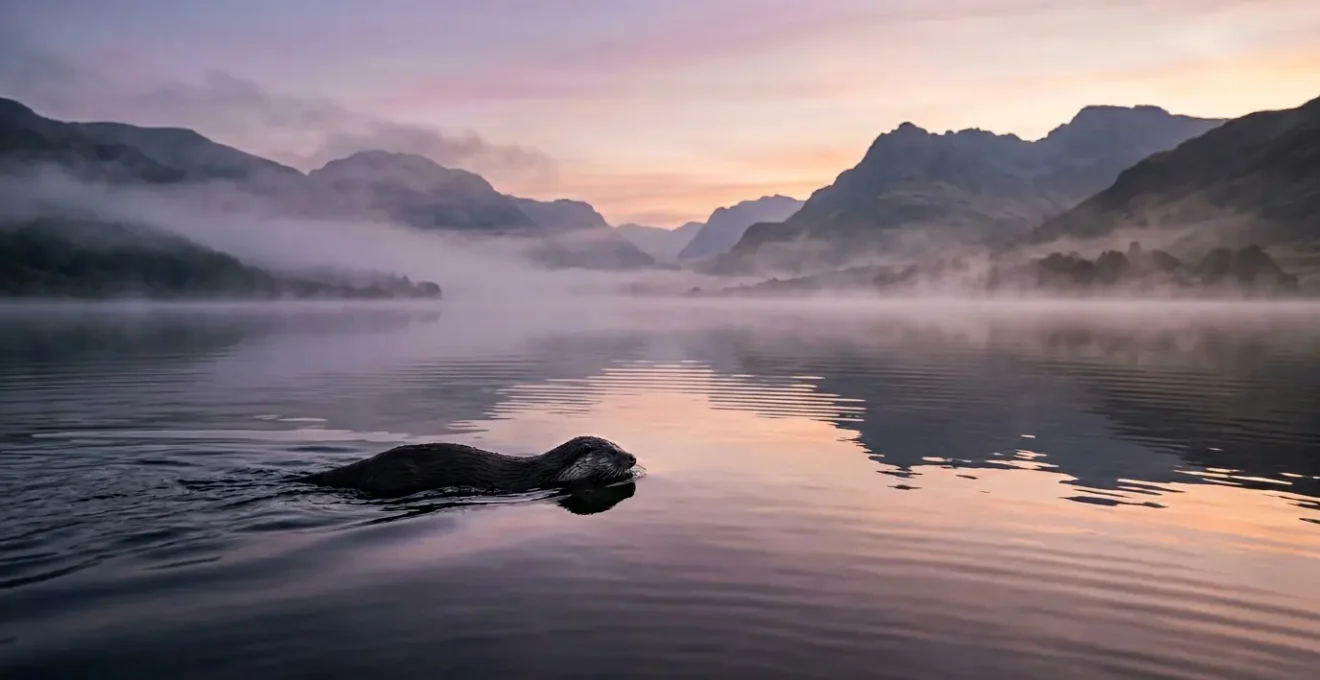
Spotting an elusive otter in Scotland isn’t about luck or simply waiting for hours at dawn. The key is to stop looking for the otter and start reading the entire ecosystem like a tracker. By understanding water health, the behaviour of other animals like ducks and salmon, and the legal landscape, you can predict where an otter is likely to be and observe it ethically without causing disturbance.
The scene is a familiar one for any wildlife enthusiast: the mist hangs low over a still Scottish loch, the air is thick with silence, and you’ve been waiting patiently for hours. You’ve followed all the common advice—be quiet, stay downwind, arrive at dawn or dusk—yet the water remains unbroken. This frustration of never seeing one of Scotland’s most charismatic mammals, despite your best efforts, can be profound. The internet is full of tips that boil down to “be patient and look for a V-shape in the water,” but this advice misses the fundamental point.
What if the secret to spotting an otter wasn’t about waiting, but about active investigation? What if the key wasn’t in just looking, but in seeing and interpreting the whole environment? The truth is, a successful wildlife tracker reads the landscape for clues. They understand that an otter’s presence is broadcast by a dozen subtle signs, from the health of the water itself to the nervous behaviour of a flock of ducks. This is the art of ecosystem reading—a skill far more potent than simple patience.
This guide will shift your perspective from that of a passive waiter to an active tracker. We will explore the interconnected signals within the Scottish lochs and rivers that point directly to otter activity. You will learn how to assess a habitat’s viability, use other species as your scouts, understand the legal and ethical boundaries of your search, and finally, recognize the subtle signs of an otter’s presence and distress. It’s time to learn how to read the story the landscape is telling you.
This comprehensive guide is structured to build your tracking skills layer by layer. The following sections will walk you through everything from identifying healthy habitats to choosing an ethical tour, providing a complete framework for your next wildlife adventure.
Summary: A tracker’s guide to spotting Scottish otters
- Blue-Green Algae: How to Identify Toxic Blooms Before Your Dog Swims?
- When and Where to Watch Salmon Leaping in Autumn?
- Divers vs Ducks: Identifying Waterfowl on Highland Lochs?
- Why You Can’t Just Fish in Any River You See?
- Why Are Some Lochs Brown and Others Clear?
- Red Deer or Golden Eagles: Which Species Is Easier to Spot Without Disturbing?
- What Are the Signs of Stress in Marine Wildlife You Must Ignore?
- How to Choose an Ethical Wildlife Tour Operator in Scotland?
Blue-Green Algae: How to Identify Toxic Blooms Before Your Dog Swims?
Before you even think about looking for an otter, your first assessment should be of the water itself. A healthy ecosystem is the foundation of the food chain, and otters are apex predators that rely on it. The presence of toxic blue-green algae (cyanobacteria) is a major red flag. These blooms can make fish and other prey scarce, and they are extremely dangerous to pets and humans. A loch covered in a thick, paint-like scum is not a viable hunting ground and is a sign of an unhealthy, unbalanced environment an otter would likely avoid.
Identifying these blooms is a critical first step. Look for dense concentrations of algae that form a green, blue-green, or brownish scum on the water’s surface, particularly in calm, sheltered bays. It can sometimes look like pea soup or spilled paint. Unfortunately, reports of water-borne illness are a serious concern, and UK dog deaths and water-borne illness reports increase each year, highlighting the importance of vigilance. Never let your dog swim in or drink from water you suspect is contaminated.
You can actively contribute to monitoring efforts. If you see a potential bloom, you can report it using the Bloomin’ Algae app. This not only protects other water users but also helps build a national picture of water health. The process is simple:
- Download the Bloomin’ Algae app from the UK Centre for Ecology & Hydrology.
- Submit a photograph of the suspicious bloom with its location.
- An expert will review your photo and provide feedback.
- Your record automatically notifies the Scottish Environment Protection Agency (SEPA) and local authorities.
- You can also check the app’s map to view verified bloom records in your area.
By learning to spot these warning signs, you’re not just protecting your pet; you’re starting to think like a tracker, immediately ruling out unproductive areas and focusing your search where life can thrive.
When and Where to Watch Salmon Leaping in Autumn?
Once you’ve established a habitat is healthy, the next step is to find the food. Otters are opportunistic but efficient hunters; they will congregate where there is a reliable and abundant food source. In Scotland, one of the greatest natural spectacles also serves as a dinner bell for otters: the autumn salmon run. From September to November, Atlantic salmon return from the sea to their native rivers to spawn, fighting their way upstream and leaping over waterfalls. This is a prime time for otter watching.
An otter on the hunt is a master of its environment. During these salmon runs, they will patrol the pools below waterfalls and fast-flowing rapids, waiting for fish to congregate before attempting a leap. This is where patience pays off, but it’s an informed patience. You aren’t just waiting in a random spot; you are positioned at a known feeding hotspot. The key is to find these natural obstacles on rivers known for their salmon populations, such as the Tweed, Tay, or Spey.
The connection between otter sightings and salmon movements is well-documented. A prime example comes from Loch Sunart on the west coast, which was once declared as having the highest density of otters in Scotland. In a case study from Otter Adventures, observations showed otters were most active around the island of Oronsay within the loch, with their diving and hunting patterns directly correlating with the movement of salmon during the autumn runs. This demonstrates a clear principle: find the food, find the otter.
Instead of scanning an entire, vast loch, focusing your efforts on these specific, food-rich locations dramatically increases your chances of a sighting. You are no longer hoping to get lucky; you are strategically placing yourself in a high-probability zone.
Divers vs Ducks: Identifying Waterfowl on Highland Lochs?
The best trackers use other animals as an early warning system. Otters are stealthy, but their presence rarely goes unnoticed by the local birdlife. Learning to read the behaviour of waterfowl on a loch can be the difference between a fleeting glimpse and a prolonged observation. Ducks, goosanders, and other diving birds are your “proxy species”—their reactions can alert you to a predator long before you see it yourself.
An otter moving underwater creates pressure waves and disturbances that birds are highly attuned to. A calm flock of ducks suddenly becoming alert, swimming rapidly in one direction while looking back over their shoulders, is a classic sign of an approaching otter. As The Wildlife Trusts guide points out, this behaviour is a significant clue. They may not even take flight, but their sudden, unified movement is a clear signal that something is happening beneath the surface. Learning to distinguish this nervous energy from normal flock movement is a key tracking skill.
A flock of ducks suddenly swimming rapidly one way, glancing over their shoulders, could be a sign of an otter nearby.
– The Wildlife Trusts, Where to see otters guide
While watching the water, it’s also crucial to avoid misidentification, a common source of frustration. From a distance, a swimming animal can be hard to identify. Seals are also common in coastal lochs and estuaries, but their swimming style is distinctly different from an otter’s. The following table breaks down the key differences:
| Feature | Otter | Seal |
|---|---|---|
| Swimming Pattern | Three humps (Nessie-style): head, body, tail | Single rounded shape, no tail visible |
| Diving Duration | 15-20 seconds maximum | 5-10 minutes |
| Diving Motion | Tail flicks up before diving | Slips down vertically |
| Surface Behavior | Active hunting, frequent diving | Often ‘bottles’ upright, watching |
By paying attention to the reactions of more visible wildlife and knowing how to distinguish an otter from a seal, you add another layer to your tracking ability, transforming the entire loch into a network of living signals.
Why You Can’t Just Fish in Any River You See?
Understanding the landscape of permission is as crucial for a wildlife tracker as understanding the landscape itself. In Scotland, the “right to roam” gives you broad access to land, but it does not give you the right to do whatever you want, wherever you want. Specifically, activities like fishing are tightly controlled, and this legal framework has a direct impact on wildlife watching. The very laws that manage fish stocks also help create quieter, less disturbed habitats where otters can thrive.
Scotland’s system is unique. Unlike in England and Wales, there is no state-run licensing system for fishing. Instead, fishing rights are private property, owned by landowners, angling clubs, or local estates. As Salmon Fishing Scotland states, it is mandatory under Scottish law to have a permit for fishing access on Scotland’s rivers for salmon, sea trout, or brown trout. This means you cannot simply walk up to any river and start searching its banks. Some of the most pristine and promising stretches of water are managed for angling and may have specific access rules or be entirely private.
This “landscape of permission” is actually a benefit for the otter spotter. Rivers managed with strict catch-and-release policies often have healthier fish populations, making them more attractive to otters. The permit system also means these areas are often less crowded than public-access beauty spots. By researching local angling clubs or estate fishing access, you can often find information on quieter, more promising locations. Respecting these rules is non-negotiable, both legally and ethically. It ensures that Scotland’s population of about 8,000 otters continues to have the protected habitats they need.
Before heading out, always check who owns the fishing rights for the river or loch you plan to visit. A quick online search for the local angling club or estate can save you from accidentally trespassing and helps maintain a positive relationship between wildlife watchers and landowners.
Why Are Some Lochs Brown and Others Clear?
Many visitors to the Highlands are struck by the colour of the water. Some lochs are crystal clear, while others are a deep, peat-stained brown, like weak tea. It’s a common assumption that this murky water would make it impossible for a visual hunter like an otter to find food. This is where understanding the otter’s specific adaptations becomes a game-changer. The colour of the water doesn’t deter an otter; it’s an environment they are perfectly evolved to master.
The brown colour comes from peat. Rainwater flows over peatlands, picking up tannins and other organic compounds, which then stain the loch water. While this limits visibility, otters have a secret weapon. As Wild Scotland explains, they don’t primarily hunt with their eyes in these conditions. Instead, otters use their long, sensitive whiskers (vibrissae) to detect the faintest vibrations made by fish moving through the water. They are essentially hunting by touch, feeling their prey long before they see it.
Otters use their long whiskers to feel the vibrations that a fish or eel makes as it swims through the water.
– Wild Scotland, Otter Behavior Guide
This sensory adaptation means that a dark, peaty loch can be just as productive a hunting ground as a clear one. In fact, it might even offer the otter an advantage, helping it to ambush prey. The key for the observer is to shift your own search image. Instead of scanning for an animal in clear water, you should be looking for more subtle signs: the tell-tale trail of bubbles as an otter exhales underwater, the characteristic ‘hump-hump-hump’ swimming motion, or the flick of a tail as it dives.
So, don’t be discouraged by a brown loch. See it instead as an opportunity to look for different signs, appreciating the incredible evolutionary tools that allow this predator to thrive in such a challenging environment.
Red Deer or Golden Eagles: Which Species Is Easier to Spot Without Disturbing?
While the title poses a question about deer and eagles, the underlying principle applies to all elusive wildlife, especially otters: the key is not just spotting the animal, but doing so without it ever knowing you were there. True success in wildlife watching is measured by the natural, undisturbed behaviour of the animal. An otter that suddenly dives and doesn’t resurface hasn’t been “spotted”—it’s been scared away. The techniques for minimal disturbance are universal, whether you’re watching a soaring eagle or a swimming otter.
Otters have an incredibly keen sense of smell and hearing. Your primary goal is to remain unseen, unheard, and un-smelled. This requires a conscious effort to manage your presence in the landscape. One of the most effective but often overlooked techniques is using your vehicle as a hide. Many animals, including otters, do not perceive a stationary car as a threat in the same way they do a human silhouette. Parking quietly by a promising loch or estuary and watching from inside your car can be far more successful than a stalk on foot.
When you are on foot, a strict code of conduct is essential to avoid disturbance. The goal is to become a “ghost” in the environment. This involves thinking about every aspect of your presence, from your distance to your scent.
Observer’s checklist for minimal disturbance
- Stay at least 50 meters away (about the length of a tennis court).
- Use binoculars or a zoom lens rather than trying to get closer.
- If in a boat or kayak, cut the engine well in advance and drift silently.
- Move only when the otter dives. You have about 15-20 seconds before it resurfaces.
- Avoid wearing strong perfumes, aftershaves, or scented detergents before you go out.
By adopting this disciplined approach, you are not only acting ethically but also increasing your chances of a truly rewarding sighting: watching an otter go about its natural business, completely unaware of your respectful presence.
What Are the Signs of Stress in Marine Wildlife You Must Ignore?
A successful wildlife encounter is one where the animal remains relaxed. Pushing the boundaries for a closer look or a better photo can cause significant stress, which is not only unethical but also illegal. Otters are a European protected species, and intentionally or recklessly disturbing them is a criminal offence. Part of being a responsible tracker is knowing when to back away. This means learning to recognize the subtle signs of stress that an animal displays when it feels threatened.
These signals can be easily missed if you don’t know what to look for. An otter that repeatedly peeps, whistles, or makes a high-pitched “chirp” is not communicating playfully; it is often a sign of alarm or a mother calling to her cubs to warn them of danger. As Fife Serve notes, “If you hear a high-pitched chirp or a soft growl, you’re too close.” This is your cue to stop, freeze, and slowly retreat. Continuing to approach an animal that is vocalizing its distress is a clear act of disturbance.
The legal protections are robust. Under Scottish law, both the otter and its resting places (holts) are protected. The case of Protected Species Licensing in Scotland is clear: it is illegal to disturb an otter in a way that is likely to affect the local population, impair their ability to survive, or damage a breeding site. Activities that require getting close, such as photography for commercial purposes or scientific surveys, require a specific license from NatureScot. For the average wildlife enthusiast, there is no ambiguity: your presence should not alter the animal’s behaviour. If the otter stops what it’s doing to watch you, you are too close.
Ultimately, the welfare of the animal must always come first. A fleeting glimpse from a respectful distance is infinitely more valuable than a close encounter that causes fear and stress, and it ensures these magnificent animals continue to grace our lochs for generations to come.
Key takeaways
- Otter spotting is a skill of “ecosystem reading,” not luck. It involves interpreting signs from the entire environment.
- Focus on high-probability areas: healthy water systems, food sources like salmon runs, and listen to the “alarm calls” of other species like ducks.
- Ethical observation is paramount. Understand the legal landscape, learn the signs of animal stress, and prioritize the animal’s welfare over getting a closer look.
How to Choose an Ethical Wildlife Tour Operator in Scotland?
For many, the best way to see an otter and other wildlife is to go with a professional guide. A good guide not only knows the best locations but also operates under a strict ethical code that puts the welfare of the wildlife first. However, not all tour operators are created equal. Choosing an ethical operator is the final and most important step in ensuring your desire to see wildlife contributes positively to its conservation.
A responsible operator will be transparent about their practices and their credentials. They should be able to answer questions about how they minimize disturbance and contribute to conservation. One of the most important credentials to look for is a license from NatureScot. As the ethical tour company Shetland Nature proudly states on their website, “We operate under a Schedule 2 license, authorized by NatureScot for the work we do on Otters.” This license is not a simple permit; it’s an indication that the guide has been assessed and is trusted to approach sensitive species without causing harm.
Before booking any tour, you should do your own due diligence. Think of it as an audit. A reputable guide will welcome your questions and have clear, confident answers. An operator who is vague, dismissive, or prioritizes a “guaranteed sighting” over animal welfare should be avoided.
Your audit plan: Questions to ask a wildlife tour operator
- What is your minimum approach distance for otters and other wildlife?
- Do you hold a NatureScot license for observing protected species like otters?
- What is your policy on geotagging photos on social media (which can lead to overcrowding)?
- Do you limit your group sizes to minimize pressure on the animals?
- What specific training in wildlife behaviour and ethics do your guides have?
Armed with this tracker’s mindset, your next trip to a Scottish loch can be an active investigation, not a passive wait. By learning to read the ecosystem, respect the legal and ethical boundaries, and choose guides who do the same, you transform your wildlife watching experience and become a steward of the very wildness you seek to enjoy.