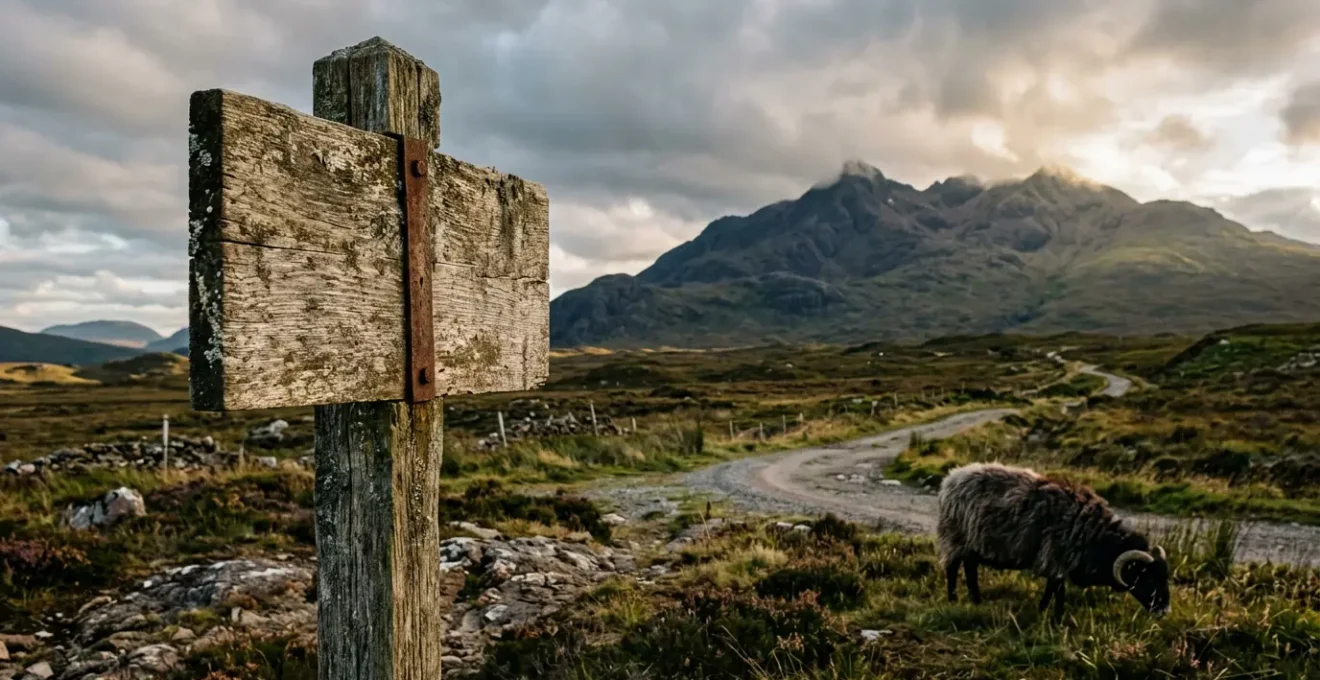
The biggest mistake visitors to Skye make isn’t mispronouncing Gaelic place names; it’s being too afraid to try.
- Each Gaelic name tells a story about the landscape, turning every signpost into a piece of history.
- Learning just a few key phrases shows a level of respect that is deeply appreciated by the community.
Recommendation: Focus on understanding the meaning and showing goodwill, not on flawless pronunciation. Your respectful attempt is the most important thing.
The car is pulled over, the map is out, and a simple question—”How do we get to Sligachan?”—feels impossible to ask. The fear of butchering a beautiful, ancient language is real. It can make you hesitant, quiet, and disconnected from the very culture you’ve come to experience. Many visitors resort to pointing silently or relying solely on the English names, missing a profound opportunity for connection.
You might have been told to look up phonetic guides or watch videos, and while those have their place, they often miss the heart of the matter. They teach you the “what” but not the “why.” They focus on technical accuracy, which can increase the pressure to be perfect. This approach often overlooks the soul of the language and the spirit in which it is shared.
But what if the goal wasn’t perfect pronunciation? What if the real key was understanding that ‘Sligachan’ isn’t just a random word, but a story—An t-Sligeachan, ‘The Shelly Place’? This guide is built on that principle. As a native speaker, I want to relieve your anxiety and reframe your goal. It’s not about linguistic perfection; it’s about respectful participation in a living culture.
We’ll explore the meaning behind the bilingual road signs, learn a few phrases that genuinely bring a smile, and discover how Gaelic music and media can tune your ear to the island’s true voice. This isn’t a grammar lesson; it’s an invitation to connect more deeply with the Isle of Skye by understanding the stories it tells through its native tongue.
Contents: A Traveler’s Guide to the Gaelic Soul of Skye
- Why Are There Two Names on Highland Road Signs?
- Tapadh Leat: The 5 Phrases That Will Make Locals Smile?
- Duolingo Gaelic: Is It Good Enough for Conversation?
- Why Is Gaelic Music So Sad?
- BBC Alba: How to Watch Scottish Gaelic TV Online?
- Why You Should Embrace the ‘No Signal’ Zones in the Highlands
- Scots vs Gaelic: What is the Difference in Dialect?
- Celtic Knots: What Do the Symbols Actually Mean?
Why Are There Two Names on Highland Road Signs?
Seeing two names on a road sign—one familiar, one seemingly unpronounceable—is your first immersion into the island’s living culture. This isn’t for tourist decoration; it’s a powerful statement of cultural identity and legal recognition. The bilingual signage is a direct result of a long campaign to give the Gaelic language the respect it deserves, culminating in official status that secured through the Gaelic Language (Scotland) Act in 2005.
The core objective, as stated in official Gaelic Language Plans, is to secure Gaelic’s status as an official language of Scotland commanding “equal respect” to English. According to data from the 2011 Census cited by the Highland Council, while only a minority have full Gaelic skills, the language’s presence is a vital part of Scotland’s heritage. The 87,100 people with some Gaelic language skills represent a culture that is actively being preserved and revitalized. Those signs are the most visible proof of that effort.
More importantly, the Gaelic name is almost always the older, more descriptive one. It’s a landscape story in a single phrase. Portree is fine, but Port-an-Rìgh tells you it means ‘King’s Port,’ hinting at a visit from King James V. The name you fear, An t-Sligeachan, simply describes the place as ‘The Shelly Place,’ a beautifully practical observation. Learning to recognize these names doesn’t just help with navigation; it helps you read the history and geography of the land itself.
Tapadh Leat: The 5 Phrases That Will Make Locals Smile?
Now that you understand the why behind the language’s visibility, let’s move to the most rewarding part: participation. You don’t need to be fluent. In fact, a simple, respectful attempt to use a few words of Gaelic can transform an interaction from transactional to personal. It shows you see the culture, you value it, and you’re making an effort. This small gesture speaks volumes and is far more memorable than perfect pronunciation.
Forget complex grammar. Focus on these five simple, high-impact phrases. They are your key to unlocking warmer welcomes, and they are easy enough to practice in the car before you arrive. This isn’t a test; it’s a way to share a moment of connection.
- Madainn mhath (MA-deen va): ‘Good morning’. Perfect for greeting a fellow walker on a quiet trail or the person serving you breakfast. It’s a wonderfully gentle start to the day.
- Tapadh leat/leibh (TA-pa let/leev): ‘Thank you’. This is the golden phrase. Use ‘leat’ for one person and the more formal ‘leibh’ for an elder, a group, or if you’re unsure. It’s always appreciated.
- Tha an sealladh àlainn (Ha an SHAU-lach A-linn): ‘The view is beautiful’. Say this at a viewpoint like the Quiraing or Neist Point, and you’ll likely find a local agreeing enthusiastically. It shares an appreciation for the land.
- Tha mi ag ionnsachadh (Ha mee ag OON-sa-chag): ‘I am learning’. This is the perfect follow-up if someone responds to you in Gaelic. It shows humility and is a wonderful ice-breaker.
- Slàinte mhath (SLAN-tcha va): ‘Good health’. The essential toast in any pub. It’s the sound of conviviality and is as fundamental to a Highland pub as the whisky itself.
Duolingo Gaelic: Is It Good Enough for Conversation?
For many aspiring learners, the green owl of Duolingo is the first port of call. With the launch of its Scottish Gaelic course, interest has soared. Data shows the course is a phenomenal success in terms of reach, hitting 1.8 million learners with 519,000 actively learning. But can an app truly prepare you for a real-life conversation in a Portree café? The answer is nuanced.
Duolingo is excellent for what it is: a gamified introduction. It will familiarize you with basic vocabulary, sentence structures, and, crucially, the patterns of Gaelic sounds. For the terrified driver, it’s a fantastic tool for building the confidence to simply try. However, it’s just one piece of the puzzle. For conversational skills, you need to hear the language spoken by humans. This is where other resources become vital.
Think of it as a spectrum of learning. Duolingo is the starting block, but to progress, you should look to platforms designed for conversation. The following table gives a clearer picture of where different resources fit:
| Resource | Best For | Format | Travel Focus |
|---|---|---|---|
| Duolingo | Basic pronunciation patterns | Mobile app | Limited |
| SpeakGaelic | Conversational skills | Multimedia platform | Strong |
| LearnGaelic.scot | Travel-specific vocabulary | Website with dictionary | Excellent |
| Sabhal Mòr Ostaig | Immersion experience | On-site courses on Skye | Complete immersion |
The Gaelic college on Skye, Sabhal Mòr Ostaig, recognizes the app’s value as a gateway. They see how it funnels enthusiastic learners toward deeper, more immersive experiences.
Gaelic on Duolingo has played a big part in the expansion of learning resources and opportunities across the board… At Sabhal Mòr Ostaig, we have had students come to us via Duolingo, starting with our An Cùrsa Inntrigidh or An Cùrsa Comais immersion courses and going on to study on our degree courses.
– Sabhal Mòr Ostaig, Gaelic College Statement
So, use Duolingo to build your confidence and learn the patterns. But don’t expect it to make you a fluent conversationalist overnight. Use it as the first step on a wider, richer journey into the audible culture of Gaelic.
Why Is Gaelic Music So Sad?
This is a common stereotype, often born from hearing a handful of slow airs or laments. While it’s true that Gaelic culture has a deep well of melancholic and beautiful music—often reflecting a history of hardship, loss, and emigration—to label it all as “sad” is to miss the vast, vibrant, and joyful majority of the tradition. It’s like listening only to classical adagios and declaring all orchestral music to be slow.
The reality is that Gaelic music is incredibly diverse and often powerfully rhythmic and uplifting. Much of it was functional, designed to make work lighter or to drive people to dance. This is the audible culture in its most energetic form, a world away from the stereotype of mournful ballads. To truly understand, you need to explore its different forms:
- Puirt à beul (mouth music): This is rhythmic, fast, and often nonsensical vocal music created to accompany dancing when instruments weren’t available. It’s pure, infectious energy.
- Òrain-luaidh (waulking songs): Sung by women while fulling cloth, these are energetic call-and-response work songs with a powerful, driving rhythm.
- Piping traditions: The Great Highland Bagpipe has a vast repertoire, from heartbreaking laments (pìobaireachd) to blistering marches, jigs, and reels designed for celebration and dancing.
- Contemporary fusion: Modern Gaelic is thrilling. Skye’s own bands like the Peatbog Faeries and Niteworks have masterfully blended traditional Gaelic sounds with electronic music, creating what The Scotsman called a unique ‘Gaelictronica’ sound born from Glasgow clubs.
Exploring this music is one of the best ways to get a feel for the language’s rhythm and flow. Listen to artists like Julie Fowlis or Mischa Macpherson. Tune into a local radio station. The energy, joy, and resilience you’ll hear will quickly dispel the myth of “sad Gaelic music” and replace it with a more accurate picture of a complex and vibrant musical tradition.
BBC Alba: How to Watch Scottish Gaelic TV Online?
If music is the heart of the Gaelic audible culture, then BBC Alba is its modern-day voice. The dedicated Gaelic-language television channel is an incredible resource for learners and anyone curious about contemporary Highland life. It’s available for free across the UK on platforms like Freeview, Sky, and Virgin Media, and most importantly, you can stream it live or watch programs on-demand via the BBC iPlayer app and website. This makes it accessible to anyone in the UK preparing for a trip.
For a visitor, BBC Alba is more than just entertainment; it’s a practical tool for language familiarization. Don’t worry about understanding every word. The goal is to listen to the sounds, the cadence, and the rhythm of the language as it is spoken today. It attunes your ear in a way that reading a book never can. By watching, you’ll start to recognize the phrases you’ve learned and hear place names spoken correctly in a natural context, which is invaluable for building your own confidence.
To get the most out of it, be strategic with your viewing. Certain types of programs are particularly helpful for someone planning a trip to Skye.
Your Action Plan: Using BBC Alba for Language Practice
- Watch weather forecasts to hear place names from all over Scotland pronounced correctly by native speakers.
- Seek out nature documentaries, like the ‘Allt an Fhuarain’ series, which showcase the landscapes you’ll be visiting, connecting the language directly to the land.
- Tune into children’s programs, which offer simple, clearly-spoken language and are perfect for picking up basic vocabulary and sentence structures.
- Watch news programs (An Là) to hear contemporary vocabulary and see how the language is used to discuss modern, everyday topics.
- Find traditional music shows to connect the spoken language with its powerful cultural and musical context, reinforcing the rhythms you’re learning.
Why You Should Embrace the ‘No Signal’ Zones in the Highlands
In our hyper-connected world, seeing “No Signal” on your phone can induce a mild panic. In the Highlands, however, it’s not a bug; it’s a feature. Embracing these digital blackouts is an invitation to connect with your surroundings in a more ancient, fundamental way. It forces you to lift your head from the screen and rely on different tools: a map, a compass, and your own observations. This is where your journey into the Gaelic language truly pays off.
When your GPS fails, the Gaelic place names on your Ordnance Survey map become your guide. The landscape story embedded in each name suddenly becomes a practical navigation tool. If you know that beinn means ‘mountain’, glen means ‘valley’, and allt means ‘stream’, you can orient yourself by matching the names on the map to the features you see around you. This is how people have navigated this terrain for centuries. The poetic name for Skye, Eilean a’ Cheò (‘Isle of the Mist’), is a perfect example of a name born from direct observation of the landscape.
Losing your signal is also the perfect excuse to engage in the most reliable form of navigation: asking a human. That moment of fear you had about asking for directions? This is your chance to face it, armed with a newfound purpose and a respectful phrase or two. Approaching someone to ask the way to ‘the shelly place’ is far more engaging than just asking for Sligachan. Prepare for these moments with an analog toolkit.
- Download offline maps for your phone before you leave your accommodation.
- Buy a physical Ordnance Survey map; it’s a beautiful souvenir and a vital tool.
- Learn basic compass skills to orient the map with the land.
- Familiarize yourself with key Gaelic landscape terms: beinn (mountain), glen (valley), loch (lake/sea-inlet), abhainn (river).
- See asking for directions as an opportunity to practice your ‘Tapadh leat’.
Scots vs Gaelic: What is the Difference in Dialect?
One common point of confusion for visitors is the distinction between Scotland’s native languages. It’s easy to hear a thick Scottish accent and assume it’s related to Gaelic, but they are, in fact, completely different languages from separate linguistic families. The title’s use of “dialect” is a common misunderstanding; thinking of Gaelic and Scots as dialects of each other is like saying French is a dialect of German. They are not mutually intelligible.
This is crucial for context. Scottish Gaelic is a Celtic language, brought over from Ireland around the 6th century. Its closest relatives are Irish and Manx. Scots, on the other hand, is a Germanic language, which evolved from the same Middle English roots as Modern English. It’s the language of Robert Burns, and its words like ‘wee’, ‘bairn’, and ‘kirk’ pepper the everyday English spoken across much of Scotland.
On Skye, you’ll hear both, but in different ways. You’ll hear Gaelic spoken as a community language, especially in northern parishes like Kilmuir, which remains a stronghold where, even after declines, 46% of the population were Gaelic speakers in 2011. You will hear Scots vocabulary influencing the local English accent and dialect everywhere. The table below clarifies the fundamental differences.
| Feature | Scottish Gaelic | Scots | English |
|---|---|---|---|
| Language Family | Celtic (Goidelic) | Germanic | Germanic |
| Origin | From Irish (6th century) | From Middle English | From Anglo-Saxon |
| Word for ‘house’ | taigh | hoose | house |
| Word for ‘church’ | eaglais | kirk | church |
| Speakers on Skye | Community language in some areas | Influences local English | Universal |
Recognizing this difference is another sign of respect. It shows you’ve taken the time to understand the unique cultural tapestry of the island. You are here to connect with Gaelic, a proud and distinct Celtic tongue.
Key Takeaways
- Gaelic place names are not just labels; they are descriptive stories about the landscape’s history and geography.
- The goal for a visitor is not flawless pronunciation, but a respectful attempt that shows appreciation for a living culture.
- Engaging with Gaelic music and media like BBC Alba is a powerful way to tune your ear to the language’s natural rhythm and flow.
Celtic Knots: What Do the Symbols Actually Mean?
Just as Gaelic place names are stories about the land, the Celtic knots you see on jewellery, stonework, and art across Skye are visual metaphors for the interconnectedness of life. They are not a secret alphabet with a one-to-one meaning, but rather a symbolic art form. The most defining feature of Celtic knotwork is its use of endless, interwoven lines. They have no beginning and no end, symbolizing eternity, loyalty, faith, and the cyclical nature of life, death, and rebirth.
This concept of interwovenness is the perfect metaphor for your journey into Gaelic culture. Think of the language, the landscape, the music, and the people. They are not separate threads but are all part of one beautiful, complex knot. When you learn a word, you’re touching one part of the pattern; when you recognize a name’s meaning in the landscape, you’re following another. It’s all connected.
This connection is even reflected in the island’s geography. One theory for the origin of ‘Skye’ is an old Celtic word for ‘winged’, which perfectly describes how the island’s many peninsulas radiate out from the mountainous centre of the Cuillin hills. As the most dramatic mountain terrain in Scotland, with peaks like the Inaccessible Pinnacle, the Cuillins form the knot at the heart of the island, from which everything else flows. The lines of the landscape and the lines of a Celtic knot tell the same story of a complex, unified whole.
So when you see a Celtic knot, don’t ask “What does it mean?” in a literal sense. Instead, see it as a reminder of the beautiful, unbreakable connections between all the elements of Skye’s culture you are experiencing. It’s a living language woven into a living landscape.
So the next time you see a name like ‘An t-Sligeachan,’ take a breath, remember the story of the shelly place, and give it a go. Your journey through Skye will be all the richer for it.