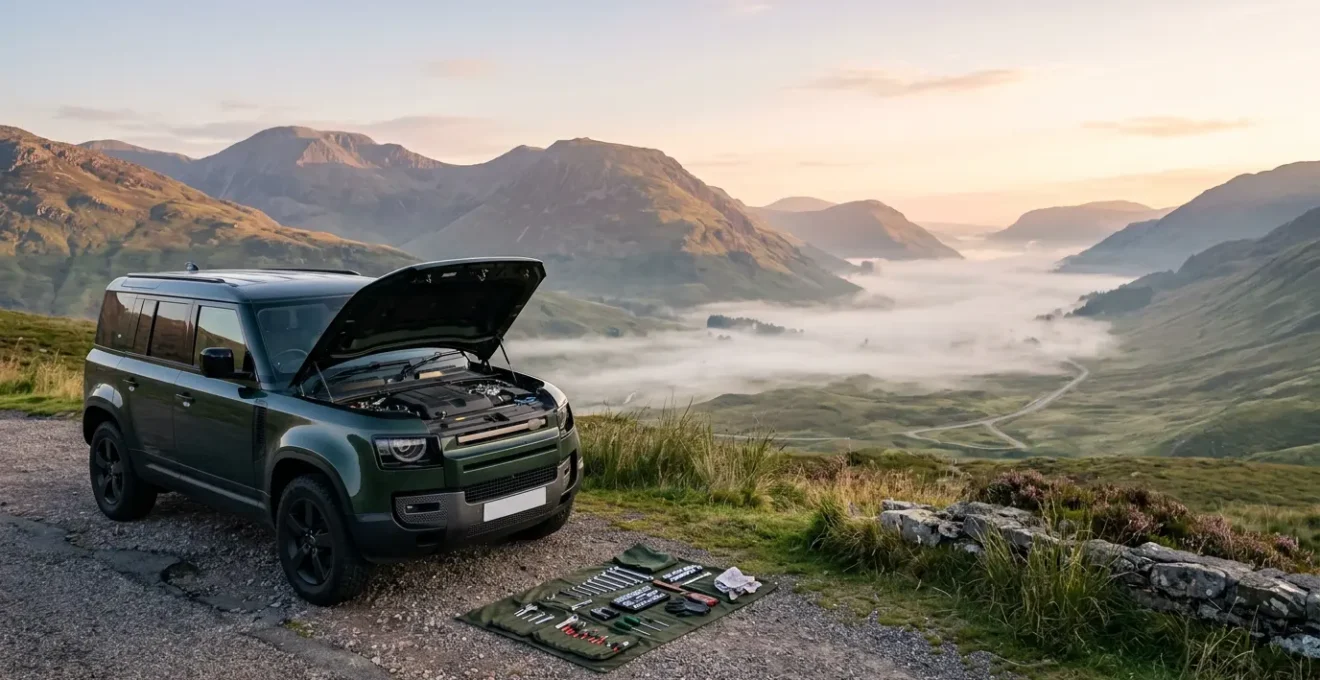
Underestimating the North Coast 500’s mechanical toll is the single biggest cause of trip-ruining breakdowns; preparation must go far beyond a basic fluid check.
- The route’s steep gradients and single-track roads subject brakes, tyres, and transmissions to continuous, extreme stress not seen in normal driving.
- Fuel and recovery logistics are fundamentally different in the Highlands, with significant gaps in service and coverage that can leave you stranded.
Recommendation: Treat your vehicle preparation as a mission-critical part of your plan. Assess it not for a 500-mile drive, but for a 500-mile endurance event.
The allure of the North Coast 500 is undeniable: a ribbon of road twisting through some of the most epic scenery on the planet. For drivers, it’s a bucket-list journey. But from my workshop’s perspective, it’s something else entirely: a 500-mile mechanical stress test. Many drivers prepare for the views but not for the vehicle. They’ll hear the usual advice to “check your oil and tyres” and assume they’re covered. This is a profound and potentially trip-ending mistake.
The reality is that the NC500 subjects a standard road car to conditions it rarely, if ever, experiences. The constant, steep ascents and descents, the abrasive road surfaces, and the relentless stop-start nature of single-track driving generate immense heat and strain. It’s not about whether your car can *make* the trip; it’s about whether its core components can *survive* the cumulative fatigue. This guide isn’t about the best photo spots. It’s a mechanic’s briefing, focused on the physics of the journey to ensure the only thing that stops you is a stunning viewpoint, not a smoking engine or a recovery truck.
This article will dissect the specific mechanical challenges the NC500 presents and provide expert, actionable strategies to fortify your vehicle against them. We’ll move beyond the basics and into the critical details of component choice, driving technique, and logistical planning that make the difference between a dream drive and a roadside disaster.
Summary: Your Car’s Survival Guide for the North Coast 500
- All-Season vs Summer Tyres: What Do You Need for Scottish Coastal Roads?
- How to Descend Steep Hills Like Bealach na Bà Without Overheating Brakes?
- Does Your AA/RAC Cover Include Recovery from Remote Islands?
- Low Bridges and Overhangs: The Hazards for Motorhomes on Coastal Routes?
- Why Mileage Drops Drastically on Highland Hills?
- The Empty Tank Risk: Where are the Fuel Gaps in Northwest Scotland?
- The Reverse-Gear Skill You Need for Hebridean Single Tracks
- How to Drive on Single-Track Roads in Scotland Without Annoying Locals?
All-Season vs Summer Tyres: What Do You Need for Scottish Coastal Roads?
Your tyres are the only part of your car in contact with the road, a fact that becomes critically important on the NC500. The route’s surfaces are a mix of smooth A-roads and coarse, gravel-strewn single tracks. Add Scotland’s famously unpredictable weather—where you can experience sunshine, torrential rain, and even sleet in a single afternoon—and the tyre question becomes paramount.
Summer tyres, made from a harder compound, provide excellent grip in warm, dry conditions. However, their performance plummets dramatically when the temperature drops below 7°C. The compound stiffens, reducing grip on cold, damp tarmac—a common scenario in the Highlands. All-season tyres are the superior choice for this journey. Their softer compound and more intricate tread pattern are designed to remain pliable in colder temperatures and effectively channel away water, providing consistent, reliable grip when you need it most.
Before you leave, ensure your tyres have a minimum tread depth of 3mm, well above the 1.6mm legal limit. This extra depth is crucial for water displacement and preventing aquaplaning. Also, check your pressures when the tyres are cold, adjusting for the extra weight of luggage. A heavily loaded car requires slightly higher pressures to maintain stability and prevent excessive tyre wall flex in the corners. This isn’t just about safety; it’s about maintaining control and confidence through every twist and turn.
How to Descend Steep Hills Like Bealach na Bà Without Overheating Brakes?
The descent from Bealach na Bà is legendary, and for your brakes, it’s a trial by fire. The mistake 99% of drivers make is “riding the brakes”—maintaining constant, light pressure on the brake pedal all the way down. This is the fastest way to induce brake fade, a terrifying situation where your brakes become unresponsive due to extreme heat. Under this kind of sustained pressure, brake materials can heat up to 232°C (450°F), boiling the brake fluid and drastically reducing stopping power.
The professional technique is to use your gearbox to control your speed. Select a low gear (second or even first) before you begin the descent. The engine’s natural resistance, known as engine braking, will keep your speed in check without you ever touching the brake pedal. Your brakes are then reserved for short, firm applications to scrub off excess speed when needed, giving them ample time to cool in between.
As guidance from professional drivers suggests, a proper braking technique for long descents is methodical. You should apply the brakes firmly until your speed is about five mph below a safe, manageable speed. Then, release the brakes completely, allowing them to cool. Let the car’s speed build back up to that safe speed before repeating the process. This “on-off” method is far more effective at managing heat than constant pressure. Mastering this skill is non-negotiable for tackling the NC500’s most challenging passes safely.
Does Your AA/RAC Cover Include Recovery from Remote Islands?
Breaking down on a motorway is an inconvenience. Breaking down on a single-track road west of Durness with no mobile signal is a genuine emergency. Before you set off, you must treat your breakdown cover policy not as a document in your glovebox, but as a critical piece of your safety equipment. A standard policy that works perfectly well in urban England may be entirely inadequate for the realities of the Scottish Highlands.
Many policies have hidden limitations regarding remote or “non-standard” locations. Recovery from an unpaved track or a remote island ferry terminal might not be covered, or it may involve exorbitant extra charges. The promise of “onward travel” is another potential pitfall. A hire car is of little use if the nearest depot is a 4-hour, £200 taxi ride away in Inverness, a scenario that is not uncommon. You must be proactive and call your provider before you travel. Do not rely on the policy document alone; speak to a human and ask pointed questions about your specific itinerary.
Verify exactly what “remote” means in their terms and confirm that recovery from single-track roads is explicitly included. Ask about average wait times in the IV and KW postcode areas and what their contingency plan is if a local recovery agent isn’t available. A little time spent on the phone now can save you from a very long, very cold wait later.
Checklist: Key Questions for Your Breakdown Provider
- Ask specifically about recovery from single-track roads, especially those without mobile signal.
- Verify if “onward travel” provisions, like hire cars or accommodation, are practically available in remote Highland areas.
- Check if your policy covers unpaved access tracks to viewpoints or accommodation.
- Confirm the policy on recovery wait times in remote locations and what happens if they can’t meet them.
- Understand the limitations or complete lack of hire car availability in rural areas and what the alternative is.
Low Bridges and Overhangs: The Hazards for Motorhomes on Coastal Routes?
Driving a larger vehicle like a motorhome or a van with a roof box on the NC500 introduces a third dimension to your planning: height. While the main A-roads are generally fine, venturing onto the smaller, more scenic loops can present significant challenges. The idyllic image of a coastal drive can quickly turn into a stressful and expensive nightmare if you ignore the suitability of certain sections for larger vehicles.
The routes around Drumbeg (the “mad little road”) and the infamous Bealach na Bà pass are particularly notorious. They are not just steep and narrow; they feature tight, unsighted hairpin bends that are simply not navigable for vehicles with a long wheelbase. As experienced NC500 traveler Robbie Roams notes, “I’ve seen a few brave souls try to take on the NC500 in big motorhomes, but there are some roads you really need to think twice about if you’re driving something bulky.” It’s not about your driving skill; it’s about the physical impossibility of maneuvering a large box through a small, twisting gap.
Before you even start the engine, you must plan your route meticulously, using a dedicated motorhome sat-nav or cross-referencing against up-to-date resources. Many of the most iconic sections are best experienced by parking the larger vehicle at a campsite and exploring in a smaller car, on a bike, or by foot.
The following table, based on information from seasoned travelers, provides a quick reference for planning your journey if you’re in a larger vehicle.
| Route Section | Large Vehicle Suitability | Key Hazards |
|---|---|---|
| Drumbeg Loop | Not Recommended | Narrow winding roads, tight turns |
| Bealach na Bà | Avoid | Steep gradients, hairpin bends |
| A9 East Coast | Suitable | Main road, well maintained |
| Applecross coastal road | Challenging | Single track, passing places |
As this comparative analysis shows, choosing the right path is essential.
Why Mileage Drops Drastically on Highland Hills?
One of the biggest shocks for drivers on the NC500 is how quickly their fuel gauge plummets. A car that easily achieves 50 MPG on the motorway might struggle to get 30 MPG in the Highlands. This isn’t a sign of a mechanical fault; it’s a straightforward lesson in physics. Pushing a one-and-a-half-tonne vehicle up a steep gradient requires a huge amount of energy, and that energy comes directly from your fuel tank.
The two main factors are gravity and load. Every time you climb, your engine is fighting gravity. The steeper the incline, the more throttle is needed, and the more fuel is injected. This is compounded by the weight of your vehicle. That roof box, those extra suitcases, and the full cool box all add up. In fact, automotive experts confirm that every extra 50kg reduces fuel economy by up to 2%. On the flat, this is barely noticeable. On the relentless hills of the NC500, it’s a significant drain.
To mitigate this, pack smart and pack light. Do you really need five pairs of shoes? Can some supplies be bought locally? Every kilogram you save will translate into more miles from your tank. Also, adopt a smooth driving style. Look ahead, anticipate the hills, and build momentum on the flat sections before you start a climb, rather than trying to accelerate aggressively up the slope. Understanding this relationship between weight, terrain, and fuel consumption is key to avoiding an empty tank in the middle of nowhere.
The Empty Tank Risk: Where are the Fuel Gaps in Northwest Scotland?
Running out of fuel on the M6 is an embarrassing mistake. Running out of fuel on the A838 between Durness and Tongue is a potentially dangerous ordeal. The fuel infrastructure in the far north-west of Scotland is sparse, and assuming you can just “fill up at the next one” is a recipe for disaster. There are significant stretches of road, sometimes over 50 miles long, with no fuel stations whatsoever.
The problem is exacerbated by limited opening hours. Many rural stations are small, independent businesses that are not open 24/7. As one Highland travel expert warns, ” After 4 PM in the far Northwest, the next petrol station is not guaranteed to be open.” Some may not open at all on a Sunday. Furthermore, you can’t always rely on credit or debit cards. Unmanned pumps are common, but so are card reader failures due to weather or poor connectivity. Always carry an emergency cash reserve.
The only safe strategy is to adopt the ‘Half-Tank Rule’. The moment your gauge hits the halfway mark, your primary objective becomes finding the next petrol station. Fill up in the major towns like Ullapool, Thurso, and Wick, even if you think you have plenty of fuel. Think of these towns as logistical hubs, not just overnight stops. Topping up your tank here is as important as stocking up on food and water. It’s about building resilience into your journey and removing ‘range anxiety’ from your experience.
The Reverse-Gear Skill You Need for Hebridean Single Tracks
Navigating the single-track roads of the NC500 is a unique driving challenge, and the most crucial skill is not going forwards, but backwards. You will, inevitably, meet another vehicle—a tractor, a timber lorry, or another tourist—between passing places. The rule is simple: whichever driver is closest to a passing place on their side of the road (or has the easiest reverse) is the one who moves. Often, that driver will be you.
Reversing for several hundred yards on a narrow, winding road with a soft verge and a steep drop-off is not a skill you want to be learning under pressure. Before your trip, find a quiet industrial estate or an empty car park and practice reversing. Get a feel for the turning circle of your car and, crucially, learn how to use your mirrors effectively. For single-track driving, angle your passenger-side mirror downwards so you can clearly see the position of your rear wheel in relation to the edge of the tarmac. This is your lifeline to avoid dropping a wheel onto the soft, and potentially collapsing, verge.
Develop a calm, methodical approach. Don’t rush. If you need to reverse, signal your intention early. If another driver is waiting for you, a quick, clear hand signal or a flash of your hazards shows you are co-operating. Remember that many locals use these roads for their daily commute and are extremely adept at reversing quickly. Being a confident and courteous reverser is one of the biggest signs of a well-prepared and considerate NC500 driver.
Key Takeaways
- Your NC500 preparation must account for mechanical stress, not just mileage. Brakes, tyres, and suspension will be pushed to their limits.
- Effective thermal management of your brakes through low-gear driving is more important than the quality of the brakes themselves.
- Logistics are a mechanical issue: a lack of fuel or inadequate breakdown cover will stop your car as surely as a failed engine.
How to Drive on Single-Track Roads in Scotland Without Annoying Locals?
The single-track roads are the heart and soul of the NC500 experience, but they are also working roads used by local residents, farmers, and delivery drivers. Driving them with courtesy and efficiency is paramount. The number one source of frustration for locals is tourists who misunderstand the etiquette of the passing place. These are not parking bays for taking photos; they are essential for keeping traffic flowing.
The cardinal rule is to keep your eyes up and check your mirrors frequently. If you see a vehicle approaching, pull into the next passing place on your left. If the passing place is on your right, stop opposite it to allow the other vehicle to pull in. If a faster car comes up behind you—and it will—pull into the next available passing place and let them by. They may be a doctor on call or a local trying to get home. A friendly wave to acknowledge another driver who has pulled in for you is customary and goes a long way.
Driving in a convoy of multiple tourist cars is another major faux pas, as it creates a “blockage” that is impossible for oncoming traffic or faster vehicles to pass. Maintain a good distance from the car in front to allow others to overtake you one by one. The goal is to be a smooth, considerate, and almost invisible presence on the road. The following table, summarizing advice from experienced drivers, is an excellent guide to single-track etiquette.
| DO | DON’T |
|---|---|
| Pull in early to passing places | Park in passing places for photos |
| Give ‘thank you’ wave when others pull in | Drive in tight convoys |
| Flash headlights to signal you’re waiting | Rush local traffic behind you |
| Check mirrors frequently for faster traffic | Stop suddenly without checking behind |
| Let locals pass promptly | Block passing places while deciding |
This advice, based on common mistakes seen on the route, is a solid foundation for courteous driving, as confirmed by sources like this guide on NC500 driving etiquette.
By treating your vehicle with the mechanical respect it deserves and driving with the courtesy the landscape demands, you ensure your North Coast 500 adventure is memorable for all the right reasons. The next logical step is to book your car in for a thorough pre-trip inspection with a trusted mechanic, using this guide as your checklist.