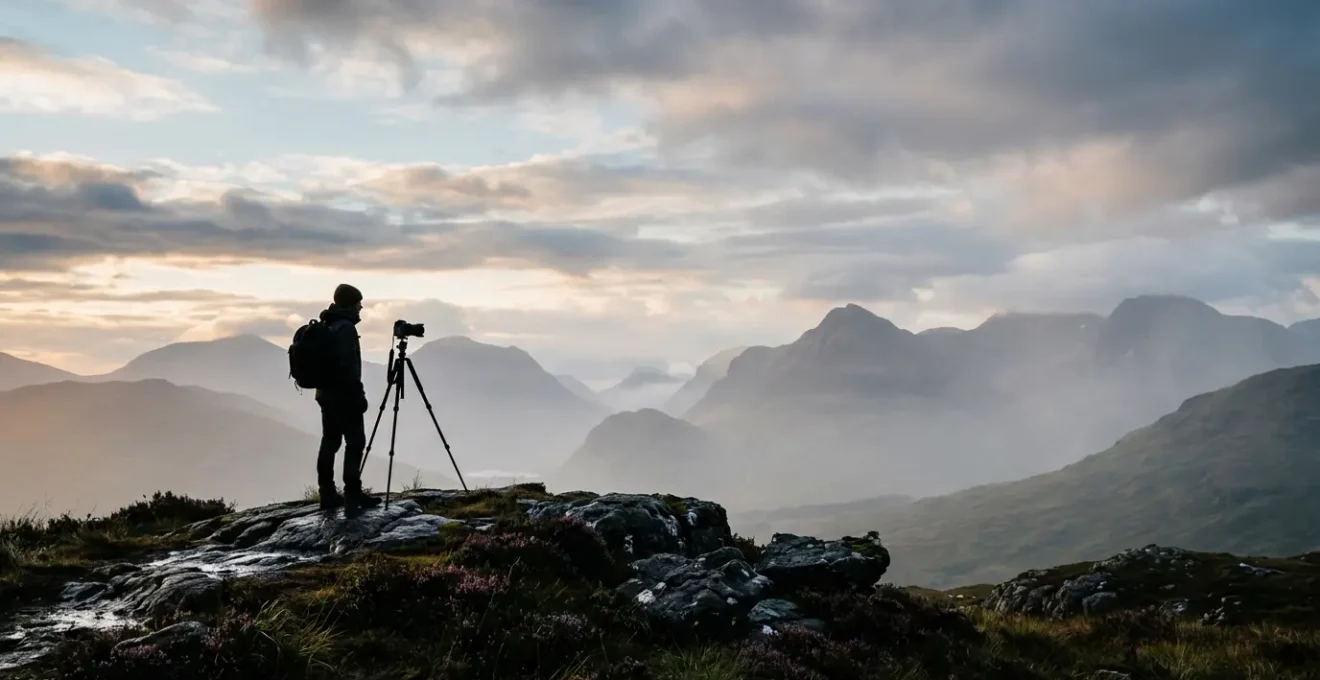
The secret to grain-free low-light photos in the Highlands isn’t a better camera—it’s mastering Scotland’s uniquely hostile environment and unpredictable light.
- Standard “Golden Hour” rules fail here; the usable light window is dangerously short and often an illusion created by surrounding peaks.
- Your biggest risk isn’t technical error, but “compositional creep” towards a ridge edge while distracted by the viewfinder.
Recommendation: Prioritise environmental awareness and tactical planning over chasing fleeting light. Your best shot is the one you come home safely from.
Every photographer who comes to the Highlands brings the same ambition: to capture that dramatic, ethereal light painting the glens and ridges. And many leave with the same frustration: a memory card full of grainy, flat, or underwhelming images. You’ve followed the rules—you brought a sturdy tripod, you shot at base ISO, you used a fast lens. Yet the magic you saw with your eyes is lost in translation. The raw, brooding power of the landscape seems to defy the textbook techniques of landscape photography.
The common advice often misses the point entirely. It focuses on gear and settings, assuming all mountains are created equal. But the Scottish Highlands play by their own rules. Here, the weather can turn on you in minutes, a ‘moderate’ trail feels like a hard slog with 15kg of kit, and the geology under your feet can be the difference between a stable tripod and a disastrous slip. The challenges are as much about mountaineering as they are about photography.
What if the key to unlocking those breathtaking, grain-free images isn’t in your camera bag, but in your head? What if it’s about developing a form of ‘environmental intelligence’ specific to these peaks? This guide moves beyond the generic advice. It’s built from years of leading workshops out of Fort William, of making mistakes and learning the hard way. It’s about understanding the *why* behind the fleeting Scottish light, anticipating the terrain’s treachery, and making strategic choices that keep you both safe and creatively fulfilled.
We’ll deconstruct the myths, from the overrated golden hour to the real-world performance of your camera in a downpour. We will explore how to choose your location, not just for its beauty, but for its accessibility and risk profile. By the end, you’ll have a new framework for planning and executing your Highland photography, one that produces dramatic, clean images by putting mountain craft first.
Summary: Mastering Low-Light Photography in the Scottish Highlands
- Why the Golden Hour in Scotland Is Shorter Than You Think?
- DSLR vs Mirrorless: Which Camera System Survives Scottish Rain Best?
- Glencoe or Torridon: Which Offers Better Dramatic Landscapes for Beginners?
- The Composition Error That Leads to Falls on Highland Ridges
- When to Capture Purple Heather on the Peaks: A Month-by-Month Guide
- Why ‘Moderate’ in Scotland Is ‘Hard’ Elsewhere?
- Granite vs Schist: Which Rock Offers Better Grip for Scrambling?
- How to Start Munro Bagging Safely in Winter as a Beginner?
Why the Golden Hour in Scotland Is Shorter Than You Think?
The classic photographer’s mantra to “chase the golden hour” can be a dangerous trap in the Scottish Highlands. Our northern latitude creates extreme variations in daylight; daylight statistics from the Scottish Highlands show a swing from over 17 hours in summer to as little as 6-7 hours in deep winter. But the raw number of hours is misleading. The real challenge is the phenomenon I call ‘topographic shadow’, where the sun disappears behind a neighbouring peak or ridge 30-60 minutes before the official sunset time. That coveted golden light doesn’t fade gently; it gets switched off.
This leaves you with a ‘compressed’ golden window that might only last 15-20 minutes, creating a frantic rush to get the shot. Instead of chasing this fleeting moment, the smarter strategy is to plan for the Blue Hour—the 40-60 minutes *after* the sun has vanished. During this period, the light is soft, even, and incredibly stable. It allows you to use longer exposures without the harsh dynamic range of direct sunlight, resulting in rich, low-noise images that are often more atmospheric than their golden hour counterparts.
To master this, you must shift your planning. Use topographic mapping apps like PhotoPills or The Photographer’s Ephemeris not just for the sun’s direction, but to visualize the surrounding terrain. See where the sun will actually set from your chosen vantage point. Often, the best plan is to get your composition locked in during the golden hour, and then patiently wait for the calm, predictable magic of the blue hour to begin. This deliberate approach yields better, cleaner images and prevents a panicked descent in rapidly failing light.
DSLR vs Mirrorless: Which Camera System Survives Scottish Rain Best?
When you’re being battered by horizontal rain in the Cairngorms, the debate between DSLR and mirrorless stops being about pixels and becomes about survival. The key question is: which system will keep functioning when it’s soaked and your fingers are numb? While modern weather-sealing is impressive on both, their design philosophies create different failure points in typically Scottish conditions.
The main advantage of a professional DSLR lies in its physical controls and optical viewfinder. Large, tactile dials can be operated with thick, wet gloves, which is a significant benefit when a mirrorless camera’s touchscreen becomes unresponsive with a single drop of water. Furthermore, the optical viewfinder consumes almost no power, giving DSLRs a huge battery advantage in the cold, where a mirrorless camera’s Electronic Viewfinder (EVF) can drain a battery in a fraction of the time. However, that same EVF is a mirrorless camera’s superpower, allowing you to see your exposure in real-time, which is invaluable in the rapidly changing low-light conditions we face here.
This table summarises the practical differences when the weather turns against you.
| Feature | DSLR Advantage | Mirrorless Advantage |
|---|---|---|
| Controls in Rain | Physical dials work with wet gloves | Touchscreen fails when wet |
| Battery Life (Cold) | 2000+ shots optical viewfinder | 300-500 shots with EVF drain |
| Low Light Preview | No preview advantage | EVF shows real-time exposure |
| Operating Temperature | -10°C to +40°C standard | -10°C to +40°C (varies by model) |
Case Study: Professional Rugby Photographer’s 4-Hour Rain Test
The real-world limits of weather-sealing were highlighted in a case where a photographer shot a rugby match for 3-4 hours in constant, heavy rain. Their professional gear was completely drenched. While the camera continued to shoot, it later failed to switch off, requiring battery removal to reset. After a thorough drying, it returned to normal. This shows that even top-tier gear has its limits and can exhibit strange behaviour under prolonged exposure, a critical lesson for any Highland photographer. Even if the camera survives, a temporary malfunction at a crucial moment on a mountain can have serious consequences.
Ultimately, both systems can work if you take precautions. Use a proper rain cover, carry multiple spare batteries (kept warm in an inside pocket), and know your gear’s physical controls by heart. The best system is the one you can operate instinctively when you can no longer feel your fingers.
Glencoe or Torridon: Which Offers Better Dramatic Landscapes for Beginners?
For photographers new to the Highlands, the choice between Glencoe and Torridon is often a choice between two types of drama: accessible grandeur and earned wildness. Both offer world-class landscapes, but they demand very different levels of effort and mountain sense. Understanding this distinction is key to a successful and safe trip.
Glencoe is the epitome of accessible grandeur. Iconic views like the Buachaille Etive Mòr or the Three Sisters are literally by the roadside. You can park your car, walk a few hundred metres, and set up your tripod to capture scenes of immense scale and history. This makes it an ideal location for those with limited time, fitness, or experience in the mountains. The downside is the crowds. In peak season, finding a unique composition without another photographer in your frame can be a challenge.
Torridon, on the other hand, offers earned wildness. Its mountains, like the formidable Liathach and the majestic Beinn Eighe, are formed from 1-billion-year-old Torridonian sandstone and feel more primeval. While some stunning views are available from the road, the true heart of Torridon requires hiking. It’s here, away from the crowds, that you can find true solitude and capture the raw, untamed spirit of the Highlands. As the experts at Highland Wildscapes note when discussing the area’s appeal to climbers, it holds a unique allure:
Some of Scotland’s most famous and dramatic mountains are found in this area, such as Liathach (The Grey One) in Glen Torridon, or Slioch (The Spear) beside Loch Maree, which are a magnet to those who enjoy the challenge of climbing Scotland’s highest peaks.
– Highland Wildscapes, Scotland Landscape Photography Locations Guide
For a beginner, Glencoe is the logical starting point to build confidence. Torridon is the reward you work towards, a place where your growing mountain skills unlock a deeper and more personal connection with the landscape.
| Aspect | Glencoe | Torridon |
|---|---|---|
| Accessibility | Roadside views, easy parking | Requires hiking, remote access |
| Unique Features | Buachaille Etive Mòr, multiple lochs for reflections | 1-billion-year-old sandstone, Caledonian pines |
| Crowd Factor | High in summer, moderate off-season | Low year-round, true solitude |
| Drama Type | Accessible grandeur | Earned wildness |
| Best Mountains | Buachaille Etive Mòr | Liathach, Beinn Eighe |
The Composition Error That Leads to Falls on Highland Ridges
The single most dangerous moment for a landscape photographer in the mountains is not during a difficult scramble or a river crossing. It’s the moment you put your eye to the viewfinder on an exposed ridge. This is when a cognitive bias known as “compositional creep” takes over. Focused intently on framing the perfect wide-angle shot, you take a small step back for a better foreground, then another, completely losing awareness of your proximity to the edge. This is not a hypothetical risk; according to Scottish mountain rescue data, a significant number of accidents involve people getting too close to edges, a scenario to which photographers are uniquely susceptible.
Wide-angle lenses exacerbate this problem by creating a ‘proximity bias’—they make distant objects seem further away, tempting you to get closer to the foreground and the edge to create a sense of scale. The solution is not to avoid these shots, but to implement a rigid safety protocol *before* you even think about composition. The goal is to create physical and mental barriers that override the brain’s tendency to tune out its surroundings.
Three techniques are non-negotiable for ridge-top photography:
- Mark Your Zone: Before composing, place a physical marker like your tripod bag a safe distance (at least 2 meters) from any drop. This becomes a hard boundary you do not cross.
- Use Telephoto Compression: Often, a more dramatic and safer shot can be achieved from 50+ meters back using a telephoto lens (e.g., 70-200mm). This compresses the background, making the peaks look larger and more imposing than a risky wide-angle shot from the edge.
- Implement a Buddy Check: If you are with someone, have them physically watch your position while you are looking through the viewfinder. Their only job is to be your spatial awareness and stop you from unconsciously creeping backwards.
Action Plan: Your Pre-Ridge Composition Safety Audit
- Points of contact: Identify every potential hazard—cornices, loose rock, slippery grass—within a 10-meter radius of your intended shooting spot.
- Collecte: Place your bag or a brightly coloured object 2-3 meters back from the edge. This is your non-negotiable “do not cross” line.
- Cohérence: Check your footing. Is the ground stable? Is it angled towards the drop? Stamp your feet to test for solidity before setting up your tripod.
- Mémorabilité/émotion: Take a “mental snapshot” of your safe zone *before* looking through the viewfinder. Remind yourself that no photo is worth the risk.
- Plan d’intégration: Verbally state your plan to your partner, or to yourself if alone. “I will not step behind my bag. I will use my zoom lens to adjust composition.”
When to Capture Purple Heather on the Peaks: A Month-by-Month Guide
Photographing the Highlands cloaked in a carpet of purple heather is a quintessential goal, but timing is everything. The bloom is not a single event but a three-act play, each with its own character and photographic potential. Arriving too early or too late can lead to disappointment, so understanding this progression is crucial for planning a successful trip.
The heather season generally kicks off in late July and peaks through August. However, the quality of the display varies significantly within this window. A circular polarising filter (CPL) is an essential tool throughout this period, as it cuts through atmospheric haze and glare on the waxy leaves of the heather, revealing its true, deep saturation.
The visual evolution of the bloom can be broken down into three distinct photographic stages, each offering unique opportunities for composition:
| Period | Visual Character | Best For | CPL Filter Effect |
|---|---|---|---|
| Early August | Vibrant purple, sparse coverage | Isolated color pops | Removes 30% glare |
| Late August | Peak density, uniform carpet | Wide landscape shots | Reveals deep saturation |
| Mid-September | Russet tones, moody atmosphere | Autumn transitions | Cuts atmospheric haze |
Late August is the sweet spot for those classic, sweeping vistas of entire hillsides painted purple. This is when the density is at its maximum, creating a uniform blanket of colour that works perfectly for grand, wide-angle landscapes. In early August, the coverage is more sparse, which is better for more intimate compositions, focusing on isolated pops of vibrant colour against the green and grey of the landscape. By mid-September, the vibrant purple gives way to muted, russet tones. This isn’t a failed opportunity; it’s a chance to capture a different mood, one that speaks of the coming autumn and the transient nature of the seasons. This period is perfect for creating moodier, more atmospheric images, especially when combined with morning mist.
Why ‘Moderate’ in Scotland Is ‘Hard’ Elsewhere?
One of the most common and dangerous misconceptions for visiting photographers is underestimating Scottish trail gradings. A route described as ‘moderate’ in a guidebook can feel brutally ‘hard’ for one simple reason: the guidebook assumes you’re a hiker, not a photographer. The extra burden you carry, both physically and mentally, transforms the experience entirely.
The first factor is weight. A standard hiker might carry a 3kg daypack. As a photographer, your bag with a camera body, multiple lenses, a sturdy tripod, filters, and wet weather gear can easily weigh over 10kg. In fact, photography gear weight statistics show the average kit is often around 15kg. Carrying this weight fundamentally changes your energy expenditure and balance, especially on steep or boggy terrain. The second factor is the nature of a Scottish ‘path’, which can often mean a faint, unmarked track across a waterlogged bog. Navigating these sections requires constant concentration and adds significant time and effort to any journey.
To plan safely, you must apply a ‘photographer’s multiplier’ to any stated timings. A simple, three-factor assessment can help you create a more realistic itinerary:
- Apply a 1.5x time multiplier. A ‘3-hour moderate’ route for a hiker immediately becomes a 4.5-hour minimum for you. This accounts for the extra weight and slower pace.
- Add a ‘bog tax’ of 30 minutes per hour. For any section described as a pathless or boggy traverse, add this time to account for difficult navigation and energy-sapping ground.
- Build in a 60-minute weather buffer. Conditions can change with terrifying speed. A sunny, moderate walk can become an expert-level battle against wind and rain in under 30 minutes. This buffer is your safety net.
Ignoring these factors is a recipe for being caught out on the mountain in darkness and bad weather. Always plan for the photographer’s reality, not the hiker’s ideal.
Granite vs Schist: Which Rock Offers Better Grip for Scrambling?
For a photographer, the geology of the Highlands is not just an academic detail; it’s a critical factor for both safety and composition. The type of rock under your boots determines your grip when scrambling to a vantage point, and the stability of the ground under your tripod. Understanding the difference between granite, schist, and sandstone is essential mountain craft.
Granite and Gabbro, found in areas like the Cairngorms and the Black Cuillin of Skye, are your best friends in wet conditions. These igneous rocks are made of rough, interlocking crystals that provide excellent friction, even when damp. They offer superb grip for your boots and a solid, stable base for your tripod. As Nature TTL describes the iconic Black Cuillin, these mountains are remnants of a volcano, with “ragged ridges and sharp peaks that offer a glimpse into the earth’s primordial past.” This ruggedness is what gives you security. Photographically, their dark, menacing character catches low-angle light beautifully.
Schist, common in the Southern Highlands around peaks like Ben Lui, is the opposite. This metamorphic rock is formed in layers. When wet, these layers become incredibly slippery, like wet slate. It provides very poor grip and can be treacherous underfoot. Tripod legs can easily slip on its smooth, angled surfaces. While its mirror-like reflections can be photographically interesting in the right light, it demands extreme caution.
Torridonian Sandstone, which defines the mountains of Torridon, offers a middle ground. It’s a textured rock that provides moderate grip when wet and good stability for a tripod on its many flat, blocky surfaces. Its signature reddish-brown colour glows with a warm, magical light at sunrise and sunset, making it a photographic favourite.
| Rock Type | Grip Level (Wet) | Tripod Stability | Light Interaction | Color Palette |
|---|---|---|---|---|
| Granite/Gabbro (Cuillins) | Excellent – rough crystals | Very stable | Catches low-angle light | Dark, menacing |
| Schist (Ben Lui) | Poor – slippery layers | Unstable on layers | Mirror-like reflections | Grey, layered |
| Torridonian Sandstone | Moderate – textured | Good on flat surfaces | Warm glow at sunset | Reddish-brown |
Key Takeaways
- Mastery of Highland photography is 90% mountain craft and 10% camera settings. Prioritise safety and planning above all else.
- Distrust generic advice. The “golden hour” is a trap; the blue hour is your most reliable friend for clean, atmospheric shots.
- Your gear’s most important feature isn’t its sensor size but its ability to function when wet, cold, and operated with numb fingers.
How to Start Munro Bagging Safely in Winter as a Beginner?
Taking your camera into the Scottish mountains in winter is entering a different world. The sublime beauty of snow-dusted peaks comes with a set of non-negotiable risks that can be fatal if ignored. For a beginner looking to start capturing winter landscapes while ‘bagging’ Munros (peaks over 3,000 feet), the mindset must shift entirely from photography to survival.
The primary challenge is the severely limited daylight. As winter daylight data confirms, you have only 6-7 hours of usable light to get up, get the shot, and get down safely. This tiny window forces a difficult choice: do you aim for the summit, or do you aim for the golden hour light? Attempting both as a beginner is a classic recipe for disaster, as it almost guarantees you’ll be descending in darkness and plummeting temperatures.
Before you even think about packing your camera for a winter Munro, a strict safety protocol is essential. These are not suggestions; they are the absolute minimum requirements:
- Get Certified: Your first priority must be to complete a certified Winter Mountain Skills course. Organisations like Glenmore Lodge provide essential training in ice axe and crampon use, avalanche awareness, and winter navigation. This is not optional.
- Manage Your Gear: Simple tasks become difficult in the cold. Use camera clip systems (like Peak Design’s Capture Clip) to keep your camera accessible without constantly taking off your pack. Use high-quality insulated and waterproof photography gloves to prevent ‘photographic fumbling’, which can lead to dropped gear or, more seriously, frostbite.
- Choose Summit OR Golden Hour: As a beginner, you cannot have both. If your goal is the summit, plan to be heading down by early afternoon. If your goal is the golden hour light, choose a lower, easily accessible vantage point where you are not at risk of a complex descent in the dark.
Winter in the Highlands is breathtakingly beautiful, but it is utterly unforgiving. Respect the environment, invest in the right skills, and your reward will be not just incredible photographs, but the experience of having earned them safely.
The journey to becoming a competent Highland landscape photographer is long, but it starts with a single decision. The next step is not to buy a new lens or a filter, but to invest in your own safety and mountain craft. Start by researching and enrolling in a certified Winter Mountain Skills course. This is the single best investment you will ever make in your photography.