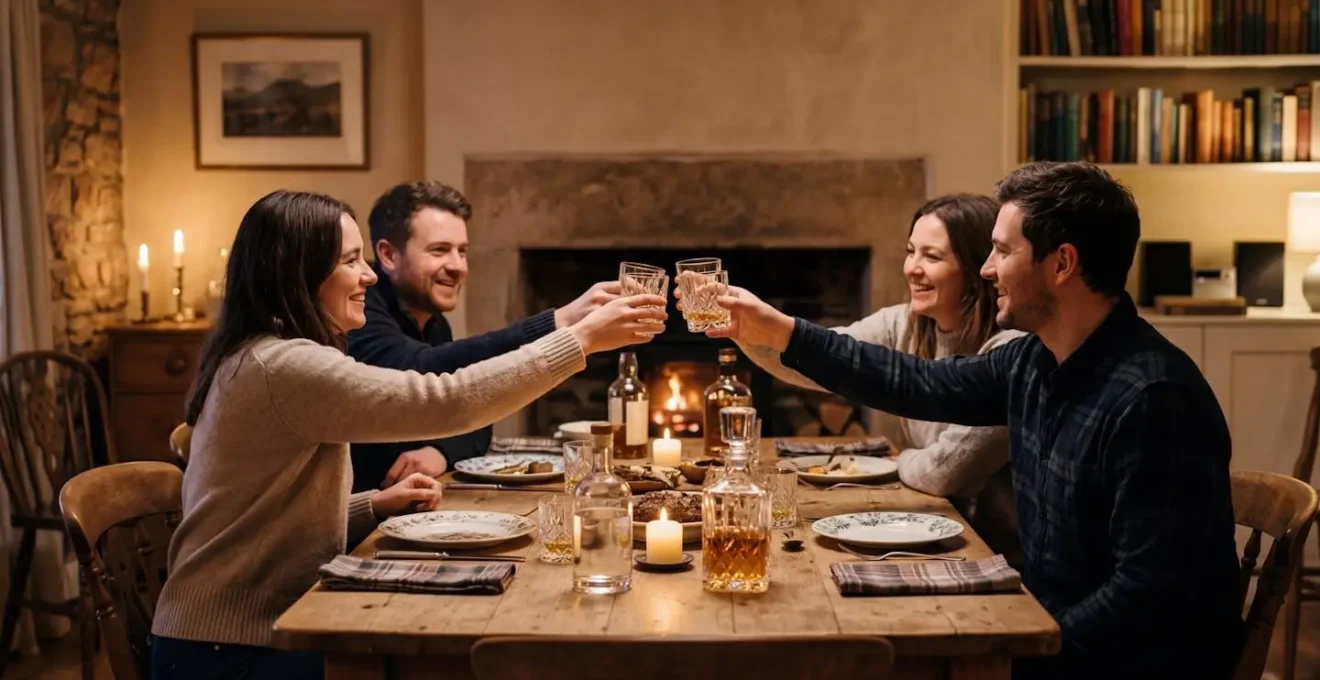
The secret to a successful Burns Supper at home is focusing on atmospheric authenticity, not rigid imitation.
- Prioritize the comfort of your guests and your own poise over slavish adherence to formal scripts.
- Adapt traditions by understanding their original intent: to create drama, connection, and warmth.
Recommendation: Use the tools in this guide to make conscious, confident choices that translate the formal into the familiar, ensuring your celebration is heartfelt, not historical re-enactment.
Every January, a familiar anxiety settles upon Scots abroad and enthusiasts of the culture alike: the desire to host a Burns Supper. The impulse is a good one, born of a wish to connect with a rich, vibrant tradition. But it’s quickly followed by a daunting fear. The fear of getting it wrong. The fear of it feeling… staged. You’ve seen the formal guides, the long lists of proceedings, the intimidating Gaelic phrases, and you wonder how you could possibly replicate that in your living room without it feeling like a school play.
Let me, as someone who has presided over dozens of these gatherings, from grand halls to my own kitchen, put your mind at ease. You do not need to be Scottish to celebrate Burns Night. You simply need to appreciate the spirit of it. The traditional running order—the piping in of the guests, the Selkirk Grace, the Address to a Haggis, the various toasts and replies—is a magnificent framework, but it is not a cage. The greatest mistake a host can make is to chase a flawless performance at the expense of genuine connection. Your goal is not imitation, but interpretation.
This guide is built on a single principle: intent over imitation. We won’t just list the traditions; we will explore the *why* behind them. Understanding the intent allows for confident adaptation. It’s the key to unlocking an evening that feels less like a stiff costume drama and more like the warm, raucous, and heartfelt gathering of friends that Robert Burns himself would have cherished. We will move through the key moments of the evening, not as a checklist of obligations, but as a series of opportunities to create memorable experiences for you and your guests.
This article provides a practical roadmap for each key element of the evening, from speeches to style. The following summary outlines the simple, adaptable solutions we will explore to ensure your Burns Supper is a resounding success.
Summary: A Guide to a Heartfelt Burns Supper at Home
- The Immortal Memory: How Long Should the Main Speech Be?
- Do You Need to Memorize the Poem or Can You Read It?
- Bagpipes or Playlist: What Works for a Small Living Room?
- Slàinte Mhath: How to Pronounce the Toast Correctly?
- Formal Kilt or Touch of Tartan: What to Wear to a Burns Supper?
- Cheese or Chocolate: Which Pairs Better with Islay Malts?
- Prince Charlie or Tweed: Which Jacket Style Suits a Day Event?
- Celtic Knots: What Do the Symbols Actually Mean?
The Immortal Memory: How Long Should the Main Speech Be?
The “Immortal Memory” is the centerpiece speech of the evening, a tribute to Robert Burns. The very name can feel weighty and academic, conjuring images of a long, scholarly lecture. This is often the first point of anxiety for a host. As one events group noted when researching toasts, the traditional examples can be daunting. In a piece on crafting these speeches, they observed:
The examples I came across were certainly amusing but very formal, quite long, and decidedly scholarly: not exactly an attainable objective at last minute, nor particularly enjoyable for all guests.
– Guildencrantz Events, Burns Night: Toasts to the Lassies and Laddies
This highlights the core challenge: balancing respect for tradition with the reality of a home setting. For a private supper, the answer is simple: keep it short, personal, and heartfelt. A five-minute tribute is more than sufficient. The goal is to connect your guests to Burns, not to deliver a university thesis. Focus on a single theme from his work that resonates with you—friendship, humanity, social justice—and share why it still matters today. Your genuine enthusiasm is far more powerful than forced scholarly rhetoric. This approach prioritizes atmospheric authenticity over a stuffy, formal performance.
Your 5-Minute Framework for the Immortal Memory
- Minute 1: Welcome & Theme. Welcome your guests and introduce a single, universal Burns theme you’ve chosen (e.g., friendship, humanity).
- Minutes 2-3: Quotes & Connection. Share two or three short quotes from Burns that relate to your theme, briefly explaining what they mean to you personally.
- Minute 4: Modern Relevance. Give one specific, modern example of how Burns’ ideas are still relevant in the world today.
- Minute 5: The Toast. Conclude by raising your glass and leading the toast: “To the Immortal Memory of Robert Burns!”
By keeping the speech concise and personal, you set a tone of relaxed sincerity that will carry through the rest of the evening, making the tradition accessible and enjoyable for everyone.
Do You Need to Memorize the Poem or Can You Read It?
The “Address to a Haggis” is a moment of high drama and fun. It is not, however, an exam. The pressure to memorize eight verses of 18th-century Scots can turn a highlight into a source of intense dread for the host. The fear of fumbling a line can overshadow the entire event. Here, we must firmly apply the principle of intent over imitation. The purpose of the Address is to celebrate the haggis with theatrical flair, not to prove your rote memorization skills. Even professional performers focus on creating an authentic feeling for the audience, which doesn’t always mean performing without a script.
The solution is not to just read it woodenly, but to prepare a script that empowers a confident, dramatic reading. An annotated script is the professional’s secret weapon. It frees you from the tyranny of memory and allows you to focus on performance: the gestures, the pauses, the dramatic brandishing of the knife. Your guests will be captivated by your confident delivery, not checking if you are reading. This is the essence of achieving the host’s poise; you are in control and enjoying the moment, which in turn allows your guests to relax and enjoy it with you.
As the image above suggests, holding a script can look commanding and professional, not weak. Use a large font, mark your pauses, and note the key actions. Underline words for emphasis and even add phonetic notes for trickier Scots words. When you get to the line “An’ cut you up wi’ ready slicht,” you’ll be focused on the theatrical slice, not on remembering the next word. This is confident adaptation in action, and it transforms the experience for both you and your audience.
Ultimately, a powerful reading from a well-prepared script is infinitely more effective than a halting, nervous recitation from memory. Choose confidence. Choose drama. Choose the script.
Bagpipes or Playlist: What Works for a Small Living Room?
The sound of the Great Highland Bagpipe is magnificent, stirring, and… incredibly loud. In a grand hall, it’s essential. In your 40-square-meter flat, it can be overwhelming and frankly, inconsiderate to your neighbours. Choosing the right music is fundamental to creating your desired atmosphere. As experts from The Whisky Exchange wisely advise, the goal is warmth and welcome:
Steer clear of an all too formal feel. Rather, create a warm, wintery atmosphere with the space, one that feels inviting, welcoming and cosy.
– The Whisky Exchange, How to Host a Burns Night Supper
This ethos should guide your musical choices. A carefully curated playlist is almost always the best option for a home setting. It allows for complete control over volume and mood. You can use a traditional recording of bagpipes for the one key moment—the piping in of the haggis—and then switch to a more subtle mix of Scottish folk music, contemporary Celtic artists, or even just instrumental classical music for the remainder of the meal. The key is dynamic volume management; the music should support conversation, not dominate it.
The following table provides a clear comparison of options, helping you make a choice that fits your specific space and guest list, ensuring the soundscape enhances, rather than overwhelms, your evening of atmospheric authenticity.
| Option | Best For | Volume Strategy | Equipment Needed |
|---|---|---|---|
| Single Bluetooth Speaker | Intimate gatherings (4-8 people) | Keep at conversation level, raise only for haggis entrance | One quality portable speaker |
| Acoustic Guitar/Fiddle | Musical friends present | Natural acoustic level | Instrument only |
| Curated Playlist | All home settings | 30% volume for arrival, 50% for ceremony, 20% for dinner | Phone + speaker |
If one of your guests plays the fiddle or guitar, inviting them to perform a few tunes is a wonderful, intimate alternative. It’s personal, acoustic, and creates a unique moment of connection. The choice, again, is about what fosters a feeling of warmth and community.
Slàinte Mhath: How to Pronounce the Toast Correctly?
Few moments in a Burns Supper are as unifying as the toast. Raising a glass of whisky together is a powerful symbol of friendship and shared experience. But for many non-Scots, the traditional Gaelic toast, “Slàinte Mhath,” is a source of anxiety. Mispronouncing it can feel awkward and break the spell of the moment. As a host, your role is not to test your guests, but to lead them with warmth and welcome.
The correct pronunciation is roughly “SLAN-juh-VAH.” However, simply saying it correctly isn’t enough. The key is to make it an inclusive, shared moment. Don’t just spring it on your guests. Instead, take 30 seconds to be their guide. Explain what it means (“Good Health” in Scottish Gaelic), break it down phonetically for them, and have everyone practice it together slowly a couple of times. This simple act transforms a moment of potential embarrassment into a fun, collective activity. It removes the pressure and reinforces the idea that you are all in this together.
When you lead the toast, do it with confidence. Make eye contact with your guests, raise your glass high, and deliver the line with warmth. The power of the moment comes from the shared intention, not from perfect phonetic accuracy. By turning the pronunciation into a mini-lesson, you demonstrate excellent host’s poise and create a stronger sense of camaraderie. It’s a small detail that has a huge impact on the overall feeling of the evening, making everyone feel included and at ease.
Your Guide to a Confident Toast
- Explain the Meaning: Briefly tell your guests it means “Good Health” in Scottish Gaelic.
- Break it Down: Say it slowly for them: “SLAN-juh-VAH.”
- Practice Together: Have everyone say it out loud slowly, maybe twice. This turns it into a fun, shared moment.
- Make Eye Contact: As you raise your glass, look around at your guests to create a connection.
- Deliver with Warmth: Lead the toast with a clear, confident, and warm voice. The feeling matters more than perfection.
This approach ensures that what could be an awkward hurdle becomes a memorable highlight, perfectly embodying the spirit of convivial friendship that Burns himself championed.
Formal Kilt or Touch of Tartan: What to Wear to a Burns Supper?
The question of attire is often fraught with uncertainty. Does hosting a Burns Supper mean you must invest in a full, formal kilt outfit? And what do you tell your guests to wear? The answer lies in the host’s primary duty: to make guests feel comfortable. A host arriving in a Prince Charlie jacket and full regalia while guests are in casual shirts can create an immediate sense of unease. As the kiltmakers at Lochcarron advise, clarity and context are key:
Lochcarron’s Modern Approach to Burns Night Attire
When hosting your own Burns Supper, be sure to let your guests know how formal or informal the occasion is so that they can dress accordingly. As their guidance suggests, with a few simple styling ideas, you can create a more relaxed, everyday look while still celebrating Scottish culture. This empowers the host to set a comfortable tone from the outset.
The most effective strategy is to encourage a “touch of tartan.” This is an inclusive and low-pressure way for everyone to participate. As a host, you can lead by example by wearing a tartan tie, a waistcoat, or even just a simple pocket square with a nice shirt and trousers. This signals respect for the occasion without creating an intimidatingly formal atmosphere. An excellent and welcoming gesture is to provide the tartan yourself. A simple basket by the door with inexpensive tartan ribbons, brooches, or scrunchies and a sign that says “Add a touch of tartan!” is a wonderfully inclusive idea. It turns the dress code into a fun, optional activity, not a requirement, perfectly capturing the spirit of warmth and welcome.
This approach of confident adaptation ensures that the focus remains on the celebration and the company, rather than on a strict and potentially alienating dress code.
Cheese or Chocolate: Which Pairs Better with Islay Malts?
While the haggis, neeps, and tatties are the undeniable main course, the host’s quiet expertise can shine in the details that follow. Offering a dram of a peaty Islay single malt is a classic part of a Burns Supper, but pairing it thoughtfully elevates the experience from a simple drink to a moment of sensory discovery. This is where you can demonstrate a subtle mastery that will delight your guests. The question often arises: what stands up to the powerful smoke and brine of an Islay whisky? Both cheese and chocolate can work, but the key is to match intensity with intensity.
A heavily peated, medicinal malt like an Ardbeg or Laphroaig needs a partner that won’t be bullied. A strong, salty blue cheese like Roquefort creates a magnificent clash of titans, where the salt in the cheese amplifies the smoky notes of the whisky. For chocolate, you must go dark and complex; an 85% dark chocolate with sea salt provides the bitterness and salinity to complement the peat. Conversely, a less aggressive, more balanced Islay malt like a Bowmore or Lagavulin offers more flexibility. The citrus notes in a 70% dark chocolate with orange can cut through the brine, while the nutty sweetness of a milk chocolate with hazelnuts can beautifully complement the gentler smoke.
Presenting one or two well-chosen pairings shows immense care without any ostentation. It’s a quiet nod to the complexities of Scottish produce and an invitation for your guests to slow down and savour the moment. This table, inspired by expert pairing guides, offers a clear starting point for your selection.
| Islay Malt Profile | Best Cheese Pairing | Best Chocolate Pairing | Why It Works |
|---|---|---|---|
| Heavily Peated (Ardbeg) | Roquefort or aged blue | 85% dark with sea salt | Salt and intensity match smoke |
| Maritime/Briny (Bowmore) | Aged cheddar | 70% dark with orange | Citrus cuts through brine |
| Balanced Smoke (Lagavulin) | Smoked gouda | Milk chocolate with hazelnuts | Complementary smoke and sweetness |
This is not about creating a formal tasting course, but about offering one final, thoughtful touch that demonstrates the depth of your hospitality and your commitment to creating a rich, authentic experience.
Prince Charlie or Tweed: Which Jacket Style Suits a Day Event?
While most home-based Burns Suppers are evening affairs, the question of jacket style speaks volumes about the desired level of formality. The Prince Charlie is the quintessential evening jacket, the equivalent of a tuxedo. It’s sharp, formal, and magnificent. However, for a home event, it can be overkill. Wearing one can make the host look more like a caterer than a friend, creating a barrier between you and your guests. The most important factor in your attire is your own comfort and poise. A host who is comfortable and relaxed puts their guests at ease.
For a home setting, tweed is almost always the superior choice. A tweed waistcoat, or ‘weskit’, worn over a nice shirt is the perfect solution. It is unmistakably Scottish, smart, and celebratory, but it remains relaxed and approachable. It signals that the evening is special without being stuffy. Furthermore, it’s practical. As the host, you’ll likely be moving between the kitchen and the dining area. Forgoing a full jacket in favour of a waistcoat keeps you comfortable while serving and mingling. This is about smart, confident adaptation of tradition to suit your environment.
Remember, your outfit sets the tone. By choosing an attire that is both respectful of the tradition and comfortable for your role as host, you communicate a sense of relaxed authority. You are honoring Burns, but you are doing it in your own home, on your own terms. The “Good, Better, Best” guide below offers a simple, pressure-free way to think about your own attire, ensuring your focus remains on hosting, not on upholding an overly formal dress code that doesn’t fit the venue.
- Good: A nice, collared shirt with dark trousers or chinos.
- Better: A good shirt paired with a quality wool V-neck sweater or cardigan.
- Best: A crisp shirt worn with a tweed waistcoat. This strikes the perfect balance of special and comfortable.
- Smart Touch: Add a tartan pocket square or tie for a splash of pattern without committing to a full kilt.
Your goal is to be the host of a warm gathering of friends, and your clothing should reflect that role: approachable, comfortable, and effortlessly in command.
Key Takeaways
- Authenticity comes from the host’s confidence and warmth, not from perfect adherence to a formal script.
- Adapt traditions by understanding their intent; the goal is connection and enjoyment, not historical re-enactment.
- Small, thoughtful details—like music, pairings, and inclusive dress codes—have a bigger impact on atmosphere than grand, formal gestures.
Celtic Knots: What Do the Symbols Actually Mean?
As you plan the small details of your evening, from place cards to menus, you might be tempted to use Celtic imagery like knots. This is a fine idea, but it’s an opportunity to practice intent over imitation. These ancient symbols are more than just pretty decorations; they are imbued with meaning. Using them thoughtfully can add a subtle layer of depth to your evening, connecting the decor to the very themes of the celebration.
Instead of just printing a random knot, take a moment to understand its symbolism and link it to the spirit of Burns. The Trinity Knot (Triquetra), with its three interconnected loops, can be explained on a place card as a symbol of eternity and endlessness, echoing the “Immortal Memory” of Burns. The Sailor’s Knot, two ropes intertwined, is a powerful and simple symbol of friendship and affection, a perfect visual to accompany the singing of “Auld Lang Syne.” In fact, the very act of crossing arms with your neighbours during that song creates a human Celtic knot, a chain of friendship binding everyone in the room.
The key is to use these symbols sparingly and to connect them explicitly to Burns’ own themes of brotherhood, friendship, and humanity. A brief, one-sentence explanation on the back of a menu or mentioned by the host can turn a simple design element into a meaningful conversation starter. As a guide from Clan.com on Burns Suppers suggests, this is about enriching the experience. Their list of ideas on using symbols as conversation starters is a great source of inspiration. This approach ensures that every element of your evening, no matter how small, contributes to the overall atmosphere of warmth and thoughtful connection.
By embedding these small, meaningful details, you demonstrate a deep level of care and consideration that your guests will notice and appreciate, making the entire experience richer and more cohesive.