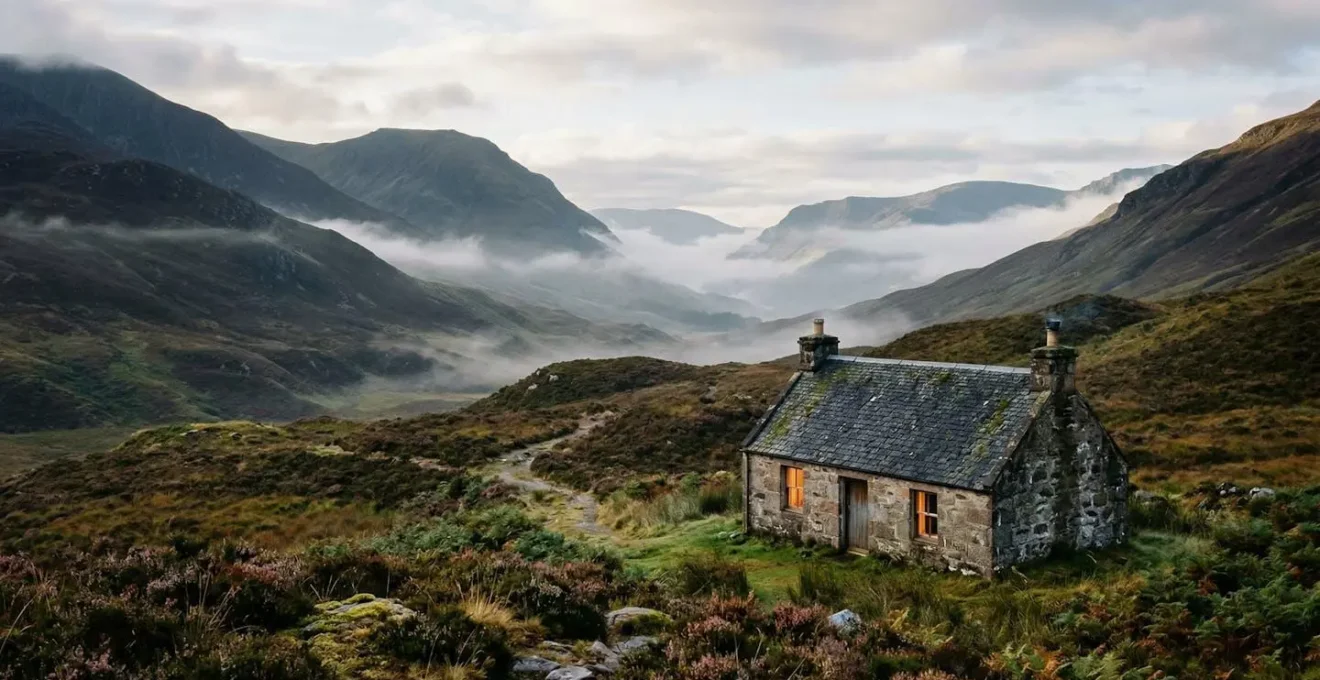
True Highland hospitality isn’t a commodity you purchase; it’s a social contract you earn by understanding the culture’s unwritten rules.
- Genuine connection is found not in tourist hotspots, but in embracing moments of disconnection and participating in the local rhythm.
- Every interaction, from shopping locally to pub etiquette, is a chance to build ‘social currency’ which is valued far more than money.
Recommendation: Shift your mindset from a consumer to a respectful guest. Observe, listen, and participate in the community fabric to transform your trip from a transaction into a meaningful exchange.
The dream of a Scottish Highland holiday often conjures images of crackling fires in cozy pubs, misty lochs, and a warm welcome from a local with a story to tell. Travellers arrive seeking something more than just stunning scenery; they’re in search of authentic hospitality. Yet, many leave with a collection of standard tourist experiences—a distillery tour, a B&B stay, a photo of a castle—feeling that the genuine soul of the Highlands remained just out of reach. The common advice is to “talk to the locals” or “stay off the beaten path,” but this guidance is vague and rarely addresses the cultural nuances that truly define the Highland welcome.
The mistake is viewing hospitality as a service to be bought. It’s easy to confuse a friendly transaction with a genuine connection. But what if the key to unlocking true Highland hospitality wasn’t about where you go, but *how* you show up? What if it’s less about finding the right places and more about understanding the unwritten social contract that governs life in these tight-knit communities? The real experience lies not in the service you receive, but in the reciprocal exchange you participate in.
This guide moves beyond the platitudes. As a cultural anthropologist living here in Inverness, I’ve seen firsthand how visitors can either skim the surface or become, even briefly, part of the community fabric. We will explore the subtle codes of communication, the economic realities of remote villages, and the social rituals that differentiate a tourist from a welcome guest. By understanding the ‘why’ behind the local way of life, you’ll learn to navigate the Highlands not as a consumer, but as an informed and respectful participant, ready to experience the profound warmth that lies beneath the surface.
This article provides a roadmap to understanding these cultural nuances. The following sections break down the key social and cultural dynamics that will help you move from a mere visitor to a participant in the authentic Highland experience.
Summary: Unlocking the Social Fabric of the Highlands
- Why You Should Embrace the ‘No Signal’ Zones in the Highlands
- Highland Games: Tourist Show or Local Tradition?
- The Sunday Shutdown: What to Expect in Remote Highland Villages?
- Supermarket vs Community Shop: Why Your £10 Matters More Here
- What Locals Mean When They Say ‘It’s a Bit Fresh’
- Tapadh Leat: The 5 Phrases That Will Make Locals Smile?
- Service Charge Included: Do You Need to Tip in Rural Pubs?
- Celtic Knots: What Do the Symbols Actually Mean?
Why You Should Embrace the ‘No Signal’ Zones in the Highlands
In our hyper-connected world, losing your phone signal can feel like a crisis. In the Highlands, it’s an opportunity. The dreaded “No Service” message is not an inconvenience to be endured but an invitation to engage with your surroundings on a deeper, more human level. These digital blackouts are a fundamental part of the Highland experience, forcing a shift in pace and perception. Instead of relying on a GPS, you might stop at a community shop for directions, sparking a conversation that reveals a hidden viewpoint or a local’s favourite cafe. This isn’t just about finding your way; it’s about re-learning the art of direct, face-to-face interaction.
This forced disconnection actively strengthens the community fabric. When digital communication fails, traditional social networks thrive. A fascinating example of this is seen in the village of Strontian, where the community’s response to infrastructure challenges relied on in-person organization rather than digital platforms. An analysis of Highland community co-operatives shows that innovative solutions are often born from face-to-face meetings when digital connectivity is limited. This proves that ‘no signal’ zones aren’t a lack of infrastructure but the very condition that fosters stronger, more resilient community bonds.
Embracing these moments means being prepared. Download offline maps before you set off. Carry a paper map not just as a backup, but as a sign of respect for the terrain. Most importantly, see this time as a gift. It’s a chance to observe the subtle non-verbal cues of Highland life: the single-finger wave from a passing driver, the patient queue at the village post office, the unhurried pace of conversation. True hospitality begins when you stop looking at your screen and start looking around.
Highland Games: Tourist Show or Local Tradition?
At first glance, a Highland Games event can seem like a spectacle staged for tourists: a sea of tartan, the thud of the caber, and the skirl of bagpipes. While they are undeniably a major visitor attraction, to dismiss them as a mere “tourist show” is to miss their core purpose. These gatherings are the vibrant, beating heart of local communities, a living tradition that powerfully expresses Highland identity, strength, and camaraderie. They are, first and foremost, for the locals. The tourist presence is welcome, but it’s secondary to the event’s role as a social and cultural anchor.
The proof lies in their organisation. These events aren’t run by faceless corporations; they are powered by the community itself. According to VisitScotland, an incredible 92% of events rely on local volunteers to even exist. This isn’t a paid performance; it’s a collective effort of friends, families, and neighbours who spend months planning, setting up stalls, and managing the day’s events. The athletes are often local farmers, builders, and teachers competing for pride, not prize money. Understanding this transforms your perspective from that of a passive spectator to an appreciative guest at a massive family gathering.
To experience the games as a local would, you must look beyond the main field. The real magic happens on the periphery. Seek out the smaller, village-run games over the large, internationally famous ones. Stay for the evening ceilidh (a traditional social dance) that follows, where the formal barriers of the day melt away. This is where you’ll share a dance, a drink, and a laugh not with a performer, but with a person. The games are a genuine expression of a culture that values strength, resilience, and, above all, community.
The Sunday Shutdown: What to Expect in Remote Highland Villages?
For a visitor accustomed to 24/7 convenience, arriving in a remote Highland village on a Sunday can be a shock. The shops are closed, the streets are quiet, and the usual hum of activity has ceased. This “Sunday shutdown” is not a sign of a struggling economy or a lack of service; it is a deeply ingrained cultural rhythm. Historically rooted in the observance of the Christian Sabbath (Sabbatharianism), it has evolved into a secular day of rest, family, and community decompression. It’s a collective pause button that prioritizes human connection over commercial transaction.
Expecting a Highland village to operate like a city is the first mistake. Instead of seeing closed doors as an inconvenience, view them as a window into the local value system. Sunday is the day for family dinners, for long walks in the hills, for visiting neighbours. The silence isn’t empty; it’s filled with the unseen activities that weave the social fabric together. For a traveller, this requires a simple but profound shift in planning and perspective. Your Sunday entertainment isn’t something you buy; it’s something you create. It’s the day for that long hike you planned, for reading a book by the loch, or for simply slowing down.
Respecting this rhythm is a powerful form of non-verbal communication. It signals that you understand you are in a place with its own pace and priorities. Plan ahead: do your grocery shopping on Saturday, fill up your car, and have a plan for your Sunday that doesn’t rely on open businesses. By doing so, you are not just accommodating the local schedule; you are honouring it. This simple act of foresight demonstrates a level of awareness that is the cornerstone of being a welcome guest rather than a demanding tourist.
Supermarket vs Community Shop: Why Your £10 Matters More Here
In a city, choosing where to buy a bottle of milk is a matter of convenience. In the Highlands, it’s an economic and social statement. The decision between a large supermarket on the edge of a town and the small, independently-run community shop in a village has a vastly disproportionate impact. That £10 you spend in a community shop is not just a transaction; it is an act of reciprocal exchange that directly supports the local ecosystem in a way that supermarket spending cannot.
This is because of a concept known as the “local multiplier effect.” Money spent in a locally-owned business circulates within the community multiple times before “leaking” out to national or international corporations. The shop owner uses it to pay a local employee, who then buys meat from the local butcher, who in turn pays a local farmer. This principle of ‘Community Wealth Building’ is not just an academic theory; it’s a conscious strategy. A recent study highlighted that 92 per cent of Highland businesses actively engage in actions that strengthen their local economy. When you choose the community shop, you are casting a vote for local jobs, services, and the very survival of that village.
These shops are also vital social hubs. They are the post office, the newsagent, the social centre, and the information point, all rolled into one. The person behind the counter knows everyone, provides updates on road conditions, and is the keeper of local knowledge. By shopping there, you are not just buying goods; you are investing in the social infrastructure that makes the community viable. You are ensuring that this vital hub continues to exist for residents and visitors alike. Your £10 is a small price for a loaf of bread, but it is a significant investment in the heart of a village.
What Locals Mean When They Say ‘It’s a Bit Fresh’
In the Highlands, language is often a tool of magnificent understatement. If a local steps outside into a biting, horizontal sleet storm and remarks, “Aye, it’s a bit fresh out,” they are not simply providing a weather report. This is a piece of cultural shorthand, a coded communication that carries far more weight than its literal meaning. Understanding these nuances is crucial for moving beyond superficial interactions and connecting with the local mindset. The phrase is a complex blend of dry humour, a stoic acceptance of nature’s power, and an implicit test of character.
On one level, it’s a display of resilience. The weather in the Highlands can be brutal and unpredictable. To complain about it is seen as pointless and weak. By downplaying its severity, a local demonstrates that they are hardy, unfazed, and in tune with their environment. It’s a way of saying, “This is normal, and we can handle it.” When a visitor responds not with a complaint but with a knowing smile and an agreement—”Just a bit!”—they signal that they share this resilient spirit. They show they are a fellow stoic, not a fragile outsider.
On another level, it’s an invitation to shared experience. The comment isn’t just a statement; it’s a conversational opening. It creates an instant, common ground. Both of you are experiencing the same “fresh” conditions. It’s a subtle way of including you in the collective ‘we’ who are enduring the elements together. Responding appropriately—with humour and without complaint—is a small but significant rite of passage. It shows you ‘get it’. And in a culture that values quiet understanding over loud proclamation, ‘getting it’ is everything.
Tapadh Leat: The 5 Phrases That Will Make Locals Smile?
Learning a few words of the local language is standard tourist advice everywhere. In the Scottish Highlands, however, the intent behind the effort matters more than perfect pronunciation. The goal isn’t just to be polite; it’s to signal genuine curiosity. As one local tour guide noted, visitors who show an active interest in the culture, including its linguistic heritage, are the ones who forge the most meaningful connections. Using a little Gaelic or Scots is not about showing off; it’s about showing respect for a culture that has fought to keep its language alive. It’s a small gesture that says, “I see you, and I value your heritage.”
While “Tapadh leat” (TA-pah let), meaning “Thank you,” is the essential starting point, moving beyond it shows a deeper level of engagement. It’s not about having a full conversation, but about using the right word at the right time. The smile you receive isn’t just for the word itself, but for the respect it implies. Here are five phrases that demonstrate that extra layer of awareness:
- Slàinte mhath (SLAN-ja vah): Literally “good health,” this is the universal toast. Using it when you raise a glass in a pub is a simple way to join in a shared ritual.
- Madainn mhath (MA-teen vah): “Good morning.” A warm and respectful greeting to use when entering a shop or meeting someone on a morning walk.
- Aye: A simple Scots word for “yes.” It’s ubiquitous in conversation. Using it in response to a question (“Are you enjoying the walk? Aye, it’s beautiful.”) shows you’re listening to the local cadence.
- A wee dram: “A small whisky.” Asking for “a wee dram” instead of “a whisky” is a nod to the local vernacular that will be instantly recognized and appreciated.
- Haste ye back: A traditional Scots farewell meaning “come back soon.” Hearing it is a sign of a warm farewell; saying it back as you leave a B&B or shop is a charming way to close an interaction.
These phrases are not magic words. They are tools of connection. Their power lies not in their definition, but in the genuine curiosity and respect they signal to the person you are speaking with.
Service Charge Included: Do You Need to Tip in Rural Pubs?
The question of tipping is a source of anxiety for many travellers. In a rural Highland pub, the etiquette is different from that of a city restaurant and is deeply rooted in the local culture of social relationships. The short answer is no, tipping is not expected for standard service. Bar staff are paid at least the national minimum wage, and the price of a pint is the price of a pint. Leaving a few coins on the bar can even feel awkward or transactional in a setting that prizes community over commerce.
However, this doesn’t mean appreciation isn’t welcome; it just takes a different form. The key is to shift from a mindset of monetary reward to one of building social currency. If you’ve had a good conversation with the bartender and want to show your appreciation, the correct local etiquette is to say, “and get one for yourself.” This simple offer to buy the bartender a drink for them to enjoy later completely changes the dynamic. It moves the interaction from a service transaction to a social exchange between equals. You are no longer a customer tipping an employee; you are two people sharing a moment in a pub.
For truly exceptional table service over a full meal, a small cash tip (around 10%) is appreciated but still not obligatory. But more valuable than cash is a genuine, human connection. Engaging in conversation, asking about the local area, complimenting the selection of whiskies, or simply returning the next evening and being remembered—these are the things that build relationships. Rural pubs often function as the living rooms of the community. Being a good guest—friendly, respectful, and engaged—is valued far more than the size of your tip. In the Highlands, your good character is the best currency you have.
Key Takeaways
- Authentic hospitality is a reciprocal exchange, not a service to be bought. Your attitude and actions matter more than your budget.
- Embrace disconnection. ‘No signal’ zones and Sunday shutdowns are cultural rhythms to be respected, offering opportunities for genuine human interaction.
- Your spending is a powerful tool. Choosing a community shop over a supermarket directly invests in the local social and economic fabric.
Celtic Knots: What Do the Symbols Actually Mean?
Celtic knots are one of the most visible symbols of Scottish culture, adorning everything from jewellery to souvenir tea towels. To many visitors, they are simply beautiful, intricate patterns. But to understand them merely as decoration is to miss their profound symbolism, which is deeply connected to the core themes of Highland life: interconnectedness, eternity, and the unbreakable bonds of community. These are not just designs; they are a visual language that communicates the values of the culture.
At their heart, most Celtic knot designs are based on a single, unbroken line that weaves in and out of itself with no beginning and no end. This represents the eternal nature of life, the cycles of seasons, and the unending spirit. As a Highland Folk Museum Curator noted in the Scottish Cultural Heritage Report:
The Celtic knot represents the interconnected nature of Highland communities – unbroken lines symbolizing bonds that have sustained remote villages through centuries
– Highland Folk Museum Curator, Scottish Cultural Heritage Report
This is the key. The knot is a perfect metaphor for the community fabric itself—a network of families and neighbours so tightly interwoven that the individual is inseparable from the whole. Each loop and turn represents a relationship, a shared history, or a bond of loyalty that holds the community together through hardship.
Action Plan: How to Buy Authentic Celtic Art
- Look for artisan signatures or workshop marks; mass-produced items rarely have these personal touches.
- Ask about the specific meaning the craftsperson attributes to the design, showing your interest goes beyond the aesthetic.
- Check if the seller can name the local workshop or artist, confirming a connection to the local craft community.
- Verify materials. Authentic pieces often use traditional materials like Scottish silver, slate, or wood from the region.
- Support shops that feature rotating local artists, as this signals a commitment to the living craft community rather than static, imported inventory.
When you buy a piece of Celtic art from a local artisan, you are doing more than acquiring a souvenir. You are participating in a tradition that stretches back centuries and supporting the individual who is keeping that tradition alive. You are holding a piece of the community’s story in your hand.
Your next step isn’t to book a generic tour, but to shift your mindset. Approach your Highland journey not as a consumer hunting for a product called “authenticity,” but as a respectful guest entering a vibrant, living community. Observe, listen, and participate with awareness, and the true hospitality you seek will find you.