In summary:
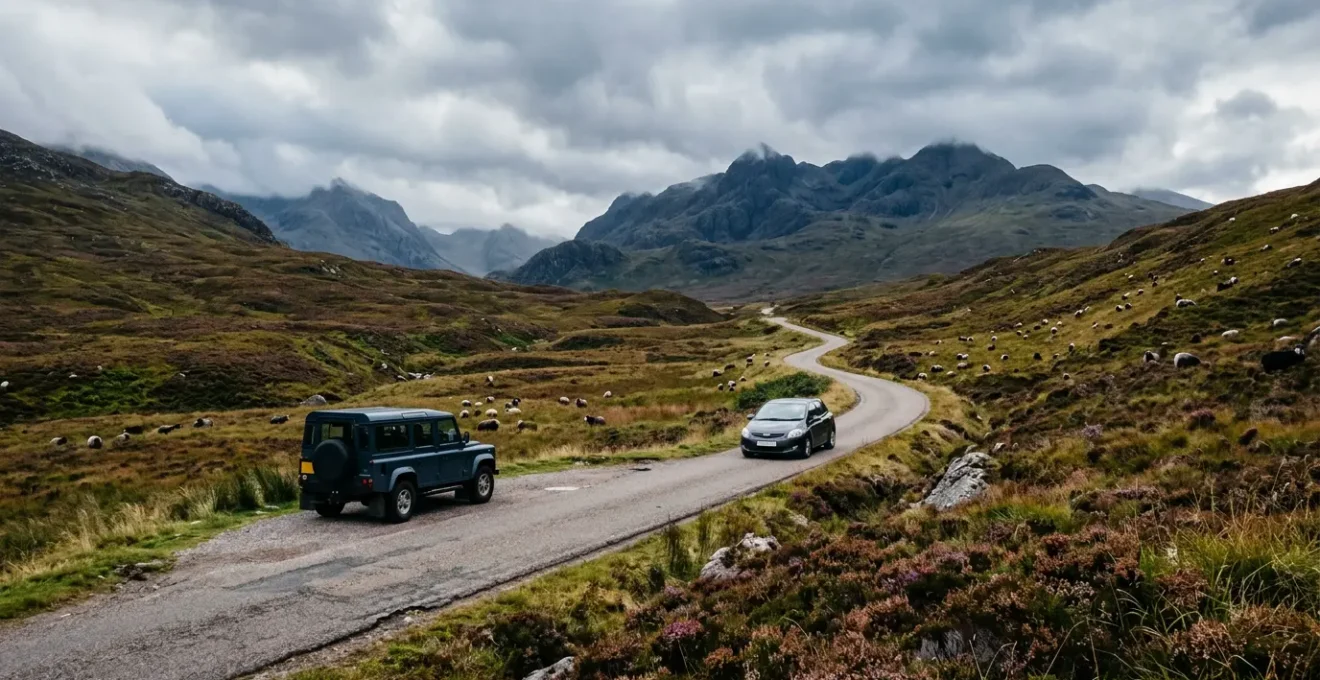
- Passing places are strictly for managing oncoming traffic and faster vehicles; never use them for parking or photos.
- Real-world journey times are 1.5 to 2 times longer than Google Maps estimates; plan for significant buffer time.
- A compact car is vastly superior to a large campervan for navigating the narrowest and most iconic sections of routes like the NC500.
- Adopt the “Highland Half-Tank Rule”: refuel at any available station once your gauge drops below 50%, as services are scarce.
- Mastering low-gear engine braking for descents and confident reversing are non-negotiable skills for safety and courtesy.
The image of driving through the Scottish Highlands is one of epic landscapes and open roads. For many visitors, especially those from countries with vast, multi-lane highways like the US or Canada, the reality can be a shock. You arrive to find a winding ribbon of tarmac, barely wide enough for one car, shared by tractors, lorries, and locals who navigate it with an unnerving, fluid grace. The fundamental rule, of course, is to drive on the left. But that’s merely the entry ticket. Surviving, and indeed enjoying, these roads requires more than just following the highway code.
Many guides will give you the basic tips: watch for sheep, be prepared for all weather. This is sound advice, but it barely scratches the surface. It fails to address the core of Highland driving. The truth is, navigating this network isn’t about a set of rigid rules; it’s about understanding an unwritten social contract. It’s a dance of courtesy, patience, and kinetic awareness that keeps rural life, from farm deliveries to emergency services, moving. The biggest mistake a tourist can make is to see these roads as a personal racetrack or a private viewpoint, forgetting they are vital arteries for the communities who live there.
This guide is built on decades of experience patrolling these very roads. It’s not just about what to do; it’s about *why* you do it. We will move beyond the platitudes to give you the practical, operational mindset you need. We’ll cover the one absolute law of the passing place, how to translate a Google Maps fantasy into a realistic schedule, why your vehicle choice can make or break your trip, and the specific driving skills that separate a competent visitor from a hazardous obstruction. The goal is simple: to help you drive with the confidence and consideration of a local, ensuring your journey is memorable for all the right reasons.
This article provides a comprehensive framework for mastering the unique challenges of Highland driving. The following sections break down everything you need to know to travel safely and respectfully.
Summary: Your Guide to Highland Driving Etiquette and Safety
- Why You Must Never Park in a Passing Place for Photos?
- Google Maps vs Reality: How Much Buffer Time to Add for Highland Drives?
- Campervan vs Compact Car: Which Is Better for the NC500?
- The Empty Tank Risk: Where are the Fuel Gaps in Northwest Scotland?
- What to Do If You Break Down in a Mobile Signal Dead Zone?
- The Reverse-Gear Skill You Need for Hebridean Single Tracks
- How to Descend Steep Hills Like Bealach na Bà Without Overheating Brakes?
- How to Prep Your Car for the North Coast 500 to Avoid Breakdowns?
Why You Must Never Park in a Passing Place for Photos?
Let’s be unequivocal: a passing place is not a parking bay, a picnic spot, or a photo opportunity. Its sole purpose is to allow the free flow of traffic on a single-track road. Using it for anything else is the cardinal sin of Highland driving. It’s not just inconsiderate; it is profoundly dangerous and obstructs the lives of everyone from local residents to emergency services. The logic is simple: if you are stopped, the entire system grinds to a halt. A doctor can’t reach a patient, a farmer can’t move their livestock, and two-way traffic becomes an impassable gridlock.
The driver heading uphill generally has right of way, but the guiding principle is always to pull into the first passing place you can safely access, which will be on your left. If the passing place is on your right, you must stop opposite it to allow the other vehicle to pull in. Acknowledge other drivers with a quick lift of the hand—the famous ‘Highland Wave’. This isn’t just a quaint custom; it’s a vital part of the non-verbal communication that makes the system work. It’s an acknowledgement of shared space and mutual respect.
The consequences of misuse are severe. Consider the all-too-common scenario where a vehicle strays onto the soft verge to get past a car parked in a passing place. As one professional driver found out, this can lead to disaster. In a well-known incident, a coach driver’s attempt to navigate past an obstacle resulted in the soft verge collapsing, tipping the vehicle into a ditch and blocking the road for a full 24 hours. This single act of obstruction required a crane for recovery and caused massive disruption. Safe alternatives for stopping, such as designated laybys or old road sections, are the only acceptable options. If none exist, you must keep moving.
Google Maps vs Reality: How Much Buffer Time to Add for Highland Drives?
Your satellite navigation is a useful tool, but in the Highlands, it’s a liar. Not a malicious one, but one that operates on a fundamentally flawed premise. It calculates your journey time based on an idealised world of clear roads and consistent speed limits. It has no concept of a tractor hauling hay, a flock of sheep deciding the middle of the road is the perfect spot for a nap, or a convoy of campervans driven by hesitant tourists. Relying solely on a Google Maps ETA is the surest way to find yourself rushing, making poor decisions, and arriving hours late.
The reality of Highland driving requires a complete recalibration of your concept of time. A journey isn’t measured in miles, but in potential obstacles. You must add a significant ‘Highland Buffer’ to any digital estimate. For standard two-lane Highland roads, a good starting point is to add 50% to the suggested time. For single-track sections, that multiplier should increase to 100%—effectively doubling the estimate. A one-hour single-track journey on your screen will realistically take you two hours.
This table illustrates a more realistic approach to journey planning, based on real-world experience. A thorough analysis of NC500 travel times provides a stark contrast between digital estimates and on-the-ground reality.
| Route Type | Google Maps Estimate | Realistic Multiplier | Actual Time |
|---|---|---|---|
| Standard Highland roads | 2 hours | x 1.5 | 3 hours |
| Single-track sections | 1 hour | x 2.0 | 2 hours |
| Notoriously tricky (B869) | 1.5 hours | x 2.0-2.5 | 3-3.75 hours |
| Tourist season | Any estimate | Add 30% | Variable |
This isn’t about slow driving; it’s about infrastructure sympathy. You are a guest in a landscape with physical limitations. Rushing puts yourself, your passengers, and locals at risk. Build in time for spontaneous stops at designated viewpoints and accept that the journey itself, not just the destination, is the experience. Trying to ‘make good time’ is a fool’s errand here.
Campervan vs Compact Car: Which Is Better for the NC500?
The dream of a campervan trip around the North Coast 500 is powerful, but it often collides with the hard physics of Highland roads. While a motorhome offers freedom and convenience, its size can become a significant liability on the route’s most iconic and challenging sections. For many parts of the NC500, a smaller, more nimble compact car is not just a better choice; it is the only sensible one. The key is to match your vehicle to the infrastructure, not the other way around.
The two most notorious sections, the Bealach na Bà (Pass of the Cattle) and the B869 Drumbeg Loop, are fundamentally unsuitable for large vehicles. The Bealach na Bà features terrifyingly steep gradients and a series of tight hairpin bends that a long-wheelbase vehicle simply cannot negotiate without performing three-point turns, blocking the entire road. The B869 is a rollercoaster of blind summits, sharp dips, and extremely narrow stretches where confident reversing for several hundred yards is not a possibility, but a certainty.
This comparative table shows how vehicle suitability plummets on these specific, yet highly desirable, parts of the route.
| NC500 Section | Compact Car Rating | Campervan Rating | Key Challenge |
|---|---|---|---|
| Bealach na Bà | 8/10 | 3/10 | Hairpin bends, steep gradients |
| B869 Drumbeg Loop | 7/10 | 2/10 | Extremely narrow, frequent reversing |
| East Coast (A99) | 10/10 | 9/10 | Wide roads, easy driving |
| Applecross Peninsula | 6/10 | 4/10 | Single-track with blind corners |
| Caithness coastal roads | 9/10 | 7/10 | Moderate width, exposed to wind |
Official guidance is clear on this matter. The NC500 organisation explicitly advises that drivers of larger motorhomes should use alternative routes. As they state, if you are not capable of accurately reversing your vehicle several hundred yards on a narrow road, you have no business being on these sections. A smaller campervan (like a VW T5 conversion) may be manageable for an experienced driver, but for the average tourist, a compact car offers a safer, less stressful, and more considerate way to experience the entirety of the route.
The Empty Tank Risk: Where are the Fuel Gaps in Northwest Scotland?
In the remote expanses of the Northwest Highlands, a petrol station is not a convenience; it’s an oasis. Running out of fuel here isn’t an inconvenience that results in a short walk to a service station. It’s a critical situation that can leave you stranded for hours in an area with no mobile signal and very little traffic. The distribution of fuel stations is sparse, and their opening hours, especially on Sundays, can be unpredictable. This creates significant “fuel gaps”—stretches of road where no fuel is available for many miles.
The most dangerous mindset is “I’ll get it at the next one.” There may not be a next one for 50 miles, and it might be closed when you get there. The longest confirmed stretch on the NC500 between fuel stops is 46 miles from Brora to Wick, but other sections feel just as precarious. This requires a proactive, defensive approach to fuel management. You must unlearn the urban habit of running your tank down to the warning light.
The only safe strategy is to adopt what is known as the “Highland Half-Tank Rule.” This simple but non-negotiable principle will prevent you from ever facing an empty-tank crisis. It is a discipline that must be followed rigorously throughout your journey in remote Scotland. It turns fuel management from a gamble into a routine.
Your action plan: Implementing the Highland Half-Tank Rule
- Constant Monitoring: Make a habit of checking your fuel gauge as frequently as you check your mirrors. Never allow it to drop below the half-way mark.
- Opportunistic Refuelling: The moment your tank is below 50% capacity, you must fill up at the very next open petrol station you encounter, regardless of price.
- Verify Opening Hours: If travelling on a Sunday or late in the evening, check station opening hours online or by phone before you set off on a long stretch. Do not assume they will be open.
- Carry Emergency Fuel: If you are driving a classic car, a motorcycle, or any vehicle with a known small tank or poor fuel economy (under 200-mile range), carrying a full, approved emergency fuel can is mandatory.
- Budget for a Premium: Note that fuel at remote, independently-owned stations will be significantly more expensive (often 15-20p per litre more) than at supermarket pumps in larger towns like Inverness or Thurso. This is the price of availability.
What to Do If You Break Down in a Mobile Signal Dead Zone?
A flashing warning light on your dashboard is an unwelcome sight anywhere. In a mobile signal “dead zone” in the Scottish Highlands, it’s a serious problem. These areas, particularly along the western and northern coasts, can stretch for miles. Without a signal, you cannot call for breakdown assistance. This is a scenario that demands careful preparation and a calm, methodical response. Your first duty is to ensure the safety of yourself and other road users.
If your vehicle fails, your immediate priority is to get it off the road if at all possible. Try to coast into a passing place or a safe layby. Do not leave it parked in the main carriageway of a single-track road under any circumstances. Once you are safely stopped, make your vehicle as visible as possible. Put on your hazard warning lights and, if it is safe to do so, raise the car bonnet. This is the universal, unspoken signal for “breakdown” in the UK. A passing local will often stop to ask if they can help or drive to a place with a signal to call for assistance on your behalf.
Your pre-trip preparation is your best defence. Before you leave a town with signal, download offline maps of your entire route area (e.g., on Google Maps or MAPS.ME). This ensures your phone’s GPS can still pinpoint your location even without a data connection. An even more precise tool is the what3words app, which can give a unique three-word address for any 3-meter square on the planet. Note your what3words location while you still have a signal or as soon as you break down. If you must leave your vehicle to walk for help, leave a note on the windscreen with the time you left, your intended direction, and your precise location details.
The Reverse-Gear Skill You Need for Hebridean Single Tracks
The ability to reverse your vehicle confidently and accurately for a significant distance is not an optional extra for Highland driving; it is a fundamental, non-negotiable skill. You will be required to do it. The question is not if, but when. On encountering another vehicle, the unwritten rule is that the driver who is closest to a passing place, or for whom it is easier, performs the manoeuvre. This often means reversing several hundred yards around bends or over blind summits. Hesitation or inability to do so causes frustration and dangerous stand-offs.
The primary danger in reversing is not hitting the other car, but misjudging the edge of the road. The verges on many Highland and Hebridean roads are not solid shoulders of hard-packed gravel. They are often soft, unsupported peat, which can collapse under the weight of a wheel. Straying just a few inches too far can result in your car becoming bogged down or, in the worst case, slipping into a ditch. This is why a slow, controlled, and guided approach to reversing is paramount.
The safest method involves teamwork. If you have a passenger, they should become your co-pilot. They must exit the vehicle and guide you from a safe position ahead of the car, where they are always visible in your side mirror. Agree on simple, clear hand signals beforehand. As the driver, your focus should be almost entirely on your side mirrors, not your interior rear-view mirror. Use the white line or the edge of the tarmac in your mirror as a straight guide, maintaining a constant, safe distance from the treacherous verge. The key is to move at a snail’s pace—no more than walking speed—to allow for constant correction.
How to Descend Steep Hills Like Bealach na Bà Without Overheating Brakes?
Certain Highland roads are as famous for their descents as their climbs. The southern approach to the Bealach na Bà is a prime example: a long, punishingly steep descent with tight hairpins that puts immense strain on a vehicle’s braking system. The amateur driver’s instinct is to “ride the brakes”—maintaining constant, light pressure on the brake pedal all the way down. This is a catastrophic mistake. It will quickly lead to brake fade, a terrifying situation where the brake fluid boils and the pads overheat, causing a dramatic loss of stopping power precisely when you need it most.
The professional technique for managing a steep descent is called engine braking. It involves using the engine’s natural resistance to control your speed, saving your brakes for short, sharp applications. Before you even begin the descent, you must select a low gear—either first or second in a manual car, or the ‘L’ or ‘1/2’ setting in an automatic. This will keep the engine’s RPMs high and force the car to a slow, controlled speed without you ever touching the brake pedal.
As sources familiar with the pass confirm, there’s a sign at the bottom that reads ‘not advised for learner drivers‘ for a very good reason. The combination of narrow roads, blind corners, and steep edges requires full control. Here is the correct procedure for using your brakes in conjunction with a low gear:
- Select a Low Gear: Before the descent begins, shift into 1st or 2nd gear. Your car should be holding a slow speed on its own.
- Listen to Your Engine: The engine will sound loud; this is normal. Optimal engine braking occurs when RPMs are high (around 3000-4000 RPM).
- Brake Firmly and Briefly: When you need to slow down further (e.g., for a hairpin), apply the brakes firmly for 3-5 seconds to scrub off speed.
- Release Completely: Immediately release the brake pedal completely. This allows the discs and pads to cool for 10-15 seconds before the next application.
- Heed Warning Signs: If you smell burning or the brake pedal feels spongy, you have overheated them. Pull over at the next safe spot and let them cool for at least 30 minutes. Do not continue driving.
Key takeaways
- The fundamental principle of single-track driving is to maintain traffic flow; your convenience is secondary to the needs of the system.
- Your vehicle choice directly impacts safety and access; a large motorhome will be excluded from the most iconic and challenging Highland routes.
- Proactive management of time, fuel, and vehicle condition is not optional but essential for self-reliance in remote areas.
- Driving in the Highlands is a physical skill that requires mastery of reversing and engine braking to handle the unique terrain safely.
How to Prep Your Car for the North Coast 500 to Avoid Breakdowns?
The final element in a safe Highland journey is ensuring your vehicle is fit for the task. The remote nature of the roads means that a simple mechanical issue, like a puncture or a failed windscreen wiper, can escalate into a major problem. Help can be hours away, and local garages have limited capacity. A thorough pre-trip inspection is not a suggestion; it’s your first line of defence against becoming a roadside statistic.
This inspection goes beyond the standard fluid level checks. You need to think about the specific challenges the Highlands will throw at your car. Your tyres are critical. Check the pressure on all four, plus the spare. Ensure the tread is well above the legal limit and inspect the sidewalls for any cuts or bulges. Know how to use your jack and make sure the locking wheel nut key is in the car. Your horn will be used to give a gentle toot before blind corners, so test it. Heavy rain is a certainty, so verify your windscreen wipers are effective and top up your screenwash with a high-concentration mix to deal with road grime and insects.
If you are in a rental car, your preparation is about documentation. Before leaving the rental lot, conduct a slow video walk-around of the entire vehicle, paying close attention to every panel, wheel, and the windscreen. Take timestamped photos of any existing scratches or dents, no matter how minor. This evidence is your protection against unsubstantiated damage claims upon return. A breakdown on the NC500 is one thing; an expensive, unfair bill at the end of it adds insult to injury.
Finally, assemble a simple but vital emergency kit. At a minimum, this should include a torch, a high-visibility jacket, a first-aid kit, a blanket, and water. Given the high likelihood of punctures, carrying tyre sealant and a portable air compressor is also a very wise investment. This preparation isn’t pessimistic; it’s professional.
By shifting your perspective from that of a tourist to one of a considerate and prepared road user, you not only ensure your own safety but also earn the respect of the local communities. It is this mindset, more than any single skill, that will make your Highland driving experience a success.