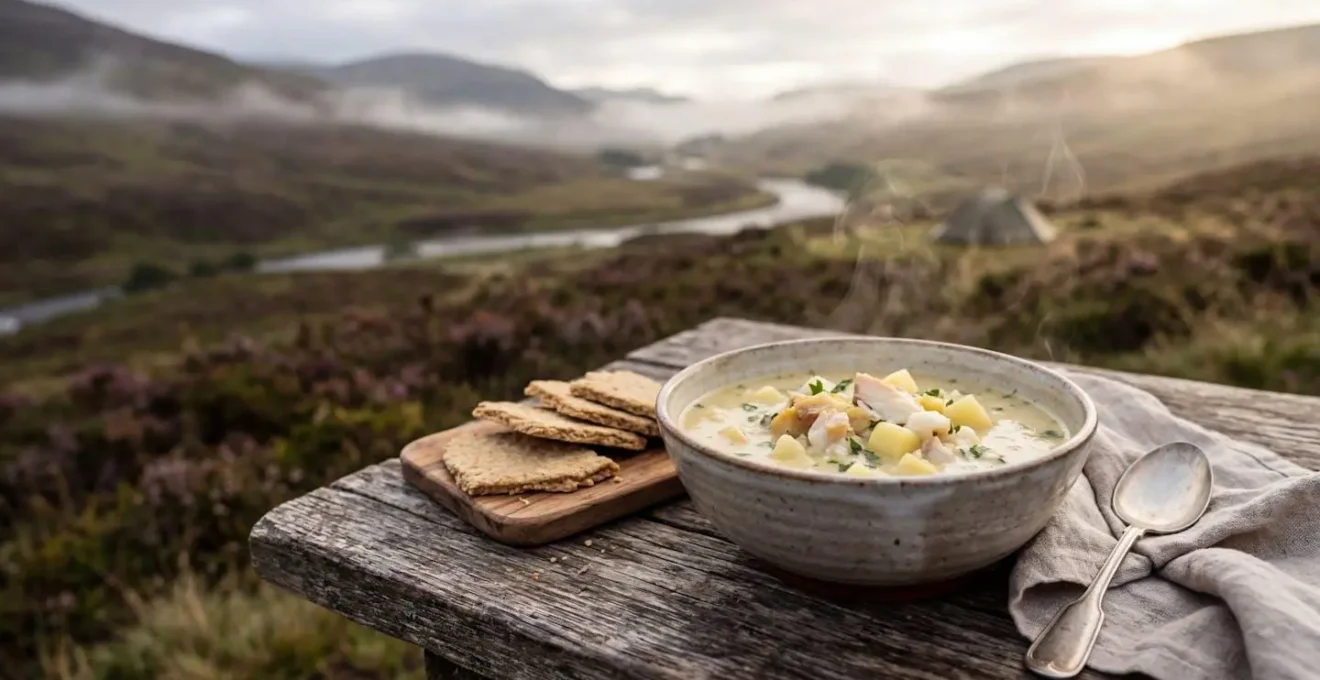
The common belief that Cullen Skink is merely a ‘Scottish fish chowder’ is a profound misunderstanding; its soul lies in specific, non-negotiable judgements.
- True Skink demands naturally smoked haddock (Finnan Haddie), never artificially dyed substitutes.
- Authentic texture comes from the starch of broken-down potatoes, not a floury, gloopy base.
- The choice of accompaniment and the method of preservation are as critical as the soup itself.
Recommendation: Adopt a judge’s palate. Scrutinise every ingredient and technique not as part of a recipe, but as a defining choice that elevates the dish from a simple soup to a championship-worthy experience.
From my seat at the judging table of the Cullen Skink World Championships, I’ve witnessed a recurring tragedy: the dilution of a masterpiece. Too often, what is presented as Cullen Skink is little more than a generic fish chowder, a pale imitation that misses the very essence of this iconic Scottish soup. The name itself, rooted in the small fishing village of Cullen on the Moray Firth, speaks to a specific heritage. “Skink” is a Scots word for a shin or knuckle of beef, which originally formed the basis of the soup before local ingenuity replaced it with the readily available smoked haddock. This history is the first clue; this is not just any fish soup.
The common approach is to follow a simple recipe: poach fish, add potatoes and onions, maybe some cream. This is the source of the “Chowder Fallacy”—the belief that the ingredient list alone defines the dish. It does not. An authentic Cullen Skink is an exercise in restraint and judgement. It is defined by the quality of its smoke, the engineering of its texture, and the respect for its tradition. The difference between a passable soup and an award-winning Skink lies in a series of critical decisions that a simple recipe cannot convey.
This guide abandons the notion of a mere recipe. Instead, we will adopt a championship palate, dissecting the key junctures where a Skink either achieves greatness or descends into mediocrity. We will explore the soul of the smoke in the haddock, the science of achieving a creamy body without resorting to gloop, and the vital role of its traditional accompaniments. By the end, you will not just have a method; you will have a standard. You will understand how to distinguish the authentic from the amateur and appreciate this dish for the culinary monument it truly is.
This article will guide you through the critical judging points that define an authentic Cullen Skink, providing a clear framework for creating and identifying a truly superior soup.
Summary: The Definitive Guide to Judging True Cullen Skink
- Dyed or Undyed Haddock: Which Makes the Better Soup?
- Hot Smoked or Cold Smoked: Which Texture Suits Your Palate?
- Potato Starch or Flour: How to Thicken Skink Without Gloopiness?
- Can You Make Dairy-Free Cullen Skink That Tastes Good?
- Does Smoked Haddock Soup Split When Reheated from Frozen?
- Oatcakes or Crusty Bread: What is the Traditional Accompaniment?
- Why the ‘Double Crust’ is Essential for Structural Integrity?
- Mutton or Beef: What is Inside a Traditional Scotch Pie?
Dyed or Undyed Haddock: Which Makes the Better Soup?
The first and most crucial judgement concerns the very soul of the dish: the haddock. A common and unforgivable error is the use of haddock dyed a lurid, artificial yellow. This is a clear signal of an inferior product, where colour is used to mask a lack of genuine, deep smoke flavour. True Cullen Skink demands undyed, naturally smoked haddock. The colour of a traditionally smoked fish is a subtle cream or beige, a testament to its time in a real smokehouse, not a dye vat. The flavour should be smoky and slightly salty, a complex profile that infuses the entire soup.
The gold standard is Traditional Grimsby Smoked Fish, which has held Protected Geographical Indication (PGI) status since 2009. This designation guarantees that the fish has been cold-smoked using traditional methods, with no artificial colourings. It’s not just about avoiding chemicals; it’s about embracing a process. As a judge, the difference is immediate. The natural smoke imparts a delicate but pervasive flavour that becomes the backbone of the Skink. An artificially dyed fillet offers only a superficial smokiness and often a bitter aftertaste from the dye.
Case Study: The Alfred Enderby 100-Year-Old Smoking Process
At Alfred Enderby, a traditional Grimsby smokehouse, haddock is cold-smoked in kilns that are over a century old. These kilns, blackened with decades of tar and resin, contribute a unique and inimitable flavour. The process uses a secret blend of smouldering sawdust, and the smoking time is adjusted based on fish size, ambient temperature, and humidity. The result is a fish with a characteristically dry texture and a deep, nuanced smoke flavour—the perfect foundation for a championship-level Cullen Skink.
So, the verdict is clear: for an authentic Cullen Skink, undyed haddock is non-negotiable. Opting for dyed fish is the first step towards the Chowder Fallacy, sacrificing the soul of the smoke for mere appearance.
Hot Smoked or Cold Smoked: Which Texture Suits Your Palate?
Beyond the fundamental choice of natural versus dyed, a more nuanced decision awaits: the type of smoke. Haddock can be either cold-smoked or hot-smoked, and this choice fundamentally alters both the cooking process and the final texture of the soup. Cold-smoked haddock, traditionally known as “Finnan Haddie”, is the purist’s choice. This fish is smoked at a low temperature, which cures it without cooking it. Consequently, it must be gently poached in the milk or stock, a process that allows its smoky essence to infuse the entire liquid base, creating a deeply integrated flavour profile.
Hot-smoked haddock, by contrast, is cooked during the smoking process. It is ready to eat and should only be flaked into the soup at the very end of cooking, just to heat through. While this is a safer and quicker option, particularly for camping, the flavour remains more distinct from the broth. The fish presents as firm, meaty flakes rather than silky, integrated strands. From a judge’s perspective, a Skink made with Finnan Haddie often displays a more cohesive and complex character. The texture, when poached correctly, is exquisitely silky, melting on the palate.
As the Pitmaster Club notes in its historical overview, the name itself carries the weight of tradition:
Finnan Haddie is thought to have originated in or near the town of Findon (which is also called Finnan) but some sources say it originated in Findhorn.
– Pitmaster Club, Cullen Skink – Scottish Fish Soup Recipe
The choice is a matter of textural preference and convenience, but for ultimate authenticity and flavour integration, cold-smoked Finnan Haddie remains the championship standard. Hot-smoked haddock produces a very good soup, but it is a different experience—more of a soup *with* smoked fish than a soup *of* smoked fish.
Potato Starch or Flour: How to Thicken Skink Without Gloopiness?
The body of a Cullen Skink is as important as its flavour. It should be creamy and substantial, but never, ever “gloopy.” This is where many aspiring cooks fall, reaching for flour or cornflour as a quick fix, a shortcut that a discerning palate will detect instantly. This is a critical failure in textural engineering. A flour-thickened base has a pasty, dull mouthfeel that coats the tongue and masks the delicate flavour of the haddock. True thickness comes from a far more elegant and traditional source: the potatoes themselves.
The secret is to use a floury potato variety, like a Maris Piper or King Edward. The “Purist’s Method” involves cooking about half the potatoes in the soup until they completely collapse, releasing their natural starch. This process thickens the soup organically, creating a velvety consistency that is in perfect harmony with the other ingredients. Another technique is to remove a portion of the cooked potatoes, mash them thoroughly, and return them to the pot. This adds body while retaining some textural variation with the remaining potato chunks.
As you can see, the natural breakdown of the potato provides a far superior texture. While a cornflour slurry (mixed with cold liquid first to prevent lumps) can be used as a last resort to rescue a thin soup, it should be seen as an emergency measure, not a primary method. A well-judged Skink has a thickness that feels inherent, not added. This natural creaminess allows the soul of the smoke and the sweetness of the onions to shine through without being smothered.
Your Action Plan: Achieving Perfect Thickness
- Select a starchy potato variety (e.g., Maris Piper, Russet) for optimal breakdown.
- Use the “Purist’s Method”: Dice all potatoes, but cook one-third until they dissolve completely into the soup base before adding the rest.
- Assess consistency before adding the fish; the soup should be naturally creamy from the potato starch alone.
- Avoid flour entirely. If emergency thickening is needed, use a minimal cornflour slurry, adding it sparingly off the heat.
- Aim for a final texture that coats the back of a spoon but remains fluid, not a thick, porridge-like consistency.
Can You Make Dairy-Free Cullen Skink That Tastes Good?
In a world of evolving dietary needs, the question of a dairy-free Cullen Skink is a valid one. Purists may balk, but from a judge’s standpoint, a successful adaptation is a mark of skill, provided it respects the soup’s core character. The challenge is twofold: finding a milk alternative that doesn’t overpower the delicate haddock, and ensuring it doesn’t split or curdle when heated. Many nut milks, for example, are unsuitable as their strong flavours compete with the smoke, and they are prone to separating.
The key lies in selecting an alternative with a neutral flavour and stable chemical structure. Unsurprisingly, potato milk is a strong contender, as it complements the existing flavours naturally. However, the champion in this category is undoubtedly oat milk. Its inherent creamy texture and slightly sweet, neutral profile work in harmony with the soup. Furthermore, research on plant-based milk stability shows that oat milk’s composition, with less protein and more carbohydrates, makes it significantly less likely to split under heat compared to soy or almond varieties. This makes it a reliable choice for achieving a stable, creamy broth.
For those seeking extra richness without dairy, a clever trick is to add a tablespoon of canned full-fat coconut cream at the very end of cooking, with the heat off. Used sparingly, it adds luxurious body without imparting a noticeable coconut flavour. A well-executed dairy-free Skink can be surprisingly delicious, proving that tradition can be thoughtfully adapted. The goal is not to create a replica, but an interpretation that honours the balance and texture of the original.
- Best Choice: Oat milk – offers complementary sweetness and is the least likely to curdle.
- Good Alternative: Potato milk – enhances the natural potato flavour and has a neutral taste.
- Acceptable: Soy milk – but it has a higher protein content, making it more prone to splitting and requiring very gentle heating.
- Avoid: Almond and other nut milks – they tend to split easily and their strong flavours can overwhelm the delicate haddock.
Does Smoked Haddock Soup Split When Reheated from Frozen?
The longevity of a Cullen Skink is a practical concern, especially for those making a large batch. The soup freezes well, but with one critical caveat: dairy, particularly cream, has a tendency to separate or “split” upon thawing and reheating. This results in a grainy, unappetizing texture that no amount of stirring can fully repair. This happens because freezing and reheating can break the delicate protein emulsion in the milk. In fact, scientific analysis reveals that milk’s pH drops when heated excessively, causing the casein proteins to clump together and separate from the whey.
The solution, as any seasoned competitor knows, is a matter of process. If you plan to freeze your Skink, you must hold back the cream. Prepare the full soup base—onions, potatoes, milk, and haddock—and freeze that. Once thawed and gently reheated, you can then stir in the cream just before serving. This simple step completely prevents the dreaded separation and preserves the luxurious, velvety texture of the final dish. This method ensures your soup tastes as fresh and perfectly emulsified as the day it was made.
The Camp-Ready Freezing Method
For campers and batch-cookers, the optimal strategy is to prepare the soup base (onions, potatoes, and milk) and freeze it. The smoked haddock can be frozen separately or, even better, added fresh during reheating to preserve its delicate texture. Once the base is defrosted and gently simmering, the fresh haddock is poached, and the cream is stirred in at the very end. This modular approach guarantees a perfect, non-split Cullen Skink even days or weeks later.
But what if disaster strikes and a soup splits during reheating? An emergency technique exists. Remove the pot from the heat immediately. Whisk vigorously for 30 seconds. In a separate bowl, make a slurry of one tablespoon of cornflour and two tablespoons of cold water. Slowly whisk this slurry into the soup while it’s off the heat. Return to a very low heat, stirring constantly, but do not let it boil again. This can often help re-emulsify the proteins, saving the soup from ruin.
Oatcakes or Crusty Bread: What is the Traditional Accompaniment?
A soup of this calibre deserves an accompaniment that complements, rather than competes with it. The modern, and often lazy, choice is a chunk of crusty bread. While pleasant for soaking, bread lacks both the historical authenticity and the textural sophistication required to truly elevate the Skink experience. From a judge’s perspective, the only correct answer is the Scottish oatcake. This isn’t mere tradition; it’s a deliberate pairing based on structural integrity and flavour contrast.
Oatcakes provide a rugged, nutty, and slightly salty crunch that cuts through the creaminess of the soup, cleansing the palate with each bite. Unlike bread, which quickly becomes a soggy mass, an oatcake holds its form. Historically, oatcakes were even crumbled into soups and stews to act as a thickener, a tradition known as “brose.” This highlights their integral role in Scottish cuisine. For practical purposes, like camping, their superiority is undeniable. They are durable, packable, and remain crisp for days, whereas bread becomes stale and crushed almost immediately.
The following comparison makes the choice clear:
| Feature | Oatcakes | Crusty Bread |
|---|---|---|
| Durability | Excellent – stays crisp for days | Poor – stales within 24 hours |
| Packability | Compact and stackable | Bulky and crushable |
| Traditional Use | Can be crumbled into soup as historical thickener (brose tradition) | Primarily for soaking liquid |
| Texture Contrast | Nutty, rugged texture cuts through creaminess | Soft, absorbs liquid quickly |
| Camping Suitability | Multi-day friendly | Day one luxury only |
While an artisan sourdough loaf is a fine thing, its place is not beside a championship Cullen Skink. The humble oatcake is not just an accompaniment; it is the other half of the dish. It provides the texture, the history, and the practicality that makes the entire experience complete. As the Love to Visit Scotland guide rightly affirms, oatcakes are the perfect partner for this satisfying soup.
Key Takeaways
- Authenticity Demands Judgement: True Cullen Skink is defined by critical choices—like using undyed, cold-smoked haddock—not just by following a recipe.
- Texture is Engineered, Not Faked: The creamy body must come from the natural starch of potatoes, not from a floury slurry which dulls the flavour.
- Preservation Requires Technique: To freeze Skink successfully, the cream must be omitted and added only after reheating to prevent the soup from splitting.
Why the ‘Double Crust’ is Essential for Structural Integrity?
To fully grasp the Scottish culinary emphasis on ‘structural integrity’, we must briefly step away from soup and look to another icon: the Scotch Pie. While seemingly unrelated, the engineering of this humble pie offers a profound lesson applicable to our Skink’s accompaniment. A Scotch Pie is not defined by its filling alone, but by its unique hot water crust pastry. This pastry is designed for a specific purpose: to be a robust, hand-held vessel. The pie’s distinctive ‘double crust’—a straight-sided shell with a recessed lid—is a marvel of food architecture.
This isn’t a flaky, delicate puff or shortcrust pastry. It’s a stiff, mouldable dough made by mixing boiling water and lard into flour. The result is a firm, almost biscuity shell that can be eaten cold, by hand, on a windswept football terrace without disintegrating. This is the essence of structural integrity in Scottish food: it must be practical, portable, and withstand its own filling. The raised rim of the pie is not merely decorative; it’s a well, designed to hold gravy, beans, or other accompaniments.
This principle loops back directly to our choice of oatcakes over bread for Cullen Skink. The oatcake, like the Scotch Pie’s crust, is chosen for its resilience. It doesn’t fall apart when introduced to liquid. It provides a firm, reliable platform for the creamy soup. It embodies the same pragmatic, no-nonsense approach to food. The lesson from the Scotch Pie is that in traditional Scottish fare, the container is often as important as the contained. The double crust provides the pie’s character, just as the rugged oatcake provides the essential textural counterpoint to the Skink.
Mutton or Beef: What is Inside a Traditional Scotch Pie?
Continuing our brief but insightful detour, we must address the heart of the Scotch Pie: its filling. Just as Cullen Skink has its non-negotiable haddock, the traditional Scotch Pie has a specific soul. Historically, and for the purists, the filling should be minced mutton. Mutton, with its richer, slightly gamier flavour, provides a depth that beef cannot replicate. It’s seasoned assertively with spices like nutmeg and black pepper, creating a savoury, aromatic filling that is perfectly encased by the sturdy hot water crust.
Today, minced beef or lamb is more common for commercial reasons, but the mutton pie remains the benchmark for authenticity. This devotion to a specific ingredient is a parallel to our Skink. To substitute cod for haddock in a Skink would be a culinary crime; similarly, to ignore the role of mutton in the history of the Scotch Pie is to miss a crucial part of its identity. These dishes are monuments to a specific time, place, and resource—mutton in the pastoral inland, haddock on the fishing coast.
Your Action Plan: Field Guide to Heating a Scotch Pie
- Assess your heat source: Embers are best; direct flame will scorch the pastry.
- Select your method: A grill grate for a quick char, or double-wrapped in foil nestled near the embers for a slower, more even heat.
- Monitor temperature: The pie is ready when the centre is steaming hot, ideally reaching 75°C (165°F).
- Utilise the design: Fill the recessed lid with gravy, sauce, or even a dollop of mashed potato for a complete meal.
- Serve with confidence: Remember, this is hand-held food, designed for convenience and resilience.
This pie is more than just a snack; it’s a cultural institution, with statistics from Scottish venues showing millions are consumed by football fans each season alone. By understanding the core components of both the Scotch Pie and Cullen Skink—mutton and smoked haddock, hot water crust and potato-thickened broth—we see a shared philosophy: the celebration of a primary, high-quality ingredient, supported by a structure that is both practical and delicious. Now, armed with this broader understanding of Scottish culinary principles, we can return to our Skink with a renewed appreciation for its specific genius.