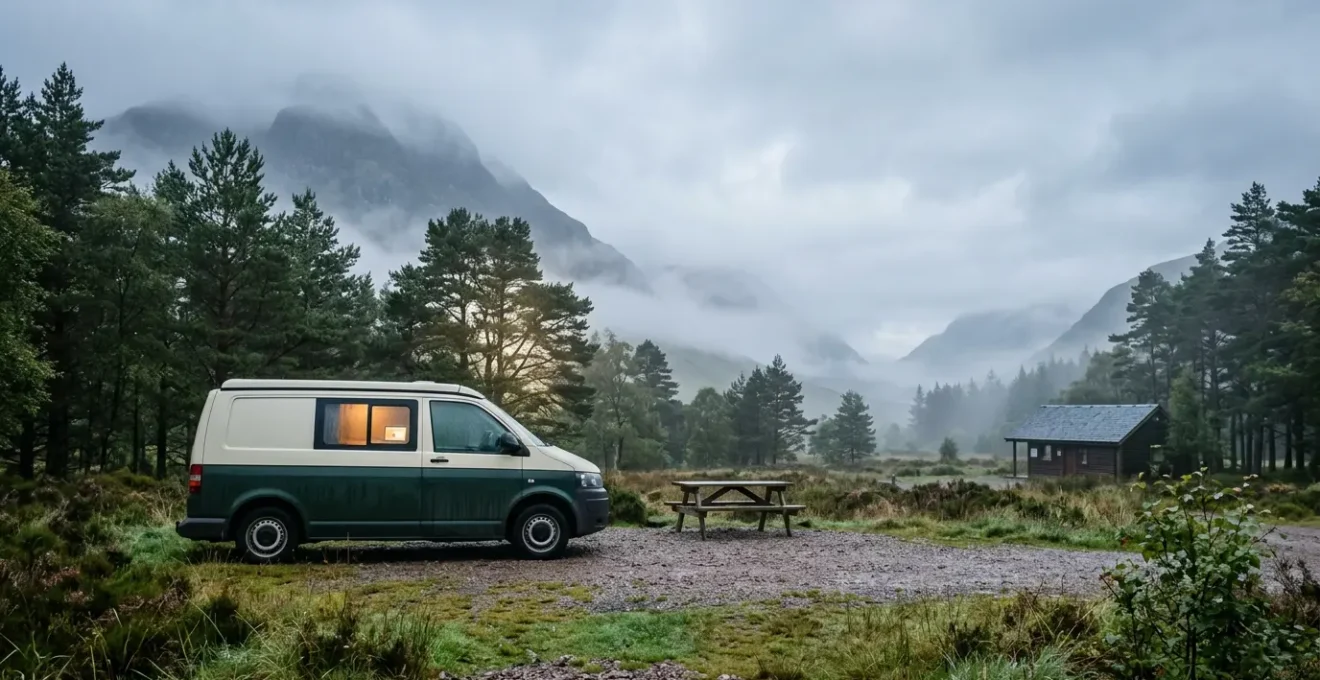
The “WiFi Available” icon on a Scottish campsite’s website is the beginning of your research, not the end. True connectivity for remote work depends on a strategic triangulation of campsite infrastructure, mobile signal strength, and your own power management.
- Your physical pitch (hardstanding vs. grass, location on-site) has a massive impact on comfort and your ability to work effectively, especially in the rain.
- Understanding your own electricity consumption is non-negotiable to avoid tripping the common 10-amp hook-ups found across the UK.
Recommendation: Prioritise campsites that are transparent about their facilities and mobile coverage, and always have a plan B that doesn’t rely on the campsite’s WiFi alone.
The dream is intoxicating, isn’t it? Closing your laptop after a productive morning, stepping out of your van, and being greeted by a view of a misty Scottish loch or a dramatic Highland glen. As a remote worker touring in a van, Scotland seems like the ultimate office. I bought into that dream completely. Then I tried to join a critical Zoom call from a “WiFi-enabled” campsite near the coast, only to watch my connection drop every 30 seconds while the wind howled outside. That’s when the real work began: figuring out how to find a campsite in Scotland where the promise of connectivity isn’t just a marketing gimmick.
Most advice you’ll find is frustratingly generic. “Look for the WiFi symbol,” they say. Or “get a good mobile data plan.” This advice fails to grasp the reality of the Scottish Highlands, where a campsite’s WiFi might only work if you’re standing next to the reception building, and vast swathes of beautiful landscape are complete mobile data blackspots. People often think they can just wild camp, but for a working trip, you need reliable power and facilities. The truth is, that little WiFi icon tells you nothing about speed, reliability, or signal reach across the site.
But what if the key isn’t just finding a campsite *with* WiFi? What if the real solution is a form of connectivity triangulation? This is the approach I’ve learned to rely on. It’s about strategically assessing three things at once: the quality of the campsite’s own infrastructure, the verifiable mobile signal strength at that specific location, and your own van’s power capabilities. It’s a shift from passively hoping for a connection to actively engineering one, no matter where you are.
This guide will walk you through that exact process. We’ll break down the critical decisions you need to make before you even book a pitch, from the ground you park on to the appliances you plug in. It’s the real-world manual I wish I’d had when I started, designed to ensure your Scottish workcation is productive and stress-free.
Summary: Finding a Scottish Campsite With WiFi That Works: My Van Life Guide
- Hard Standing vs Grass Pitch: Which to Choose for Scottish Rain?
- Club Sites vs Independent Sites: Where Do You Get Better Shower Facilities?
- When to Book Isle of Skye Campsites to Guarantee a Spot?
- The Roadside Mistake That Ruins Sleep at Popular Campsites
- How to Calculate Your Amp Usage to Avoid Tripping Campsite Electrics?
- Why You Cannot Use a Hairdryer in an Off-Grid Pod?
- Booking.com or Direct: Which Gets You the Better Room?
- Booking Ahead vs Winging It: What Works Best for the NC500?
Hard Standing vs Grass Pitch: Which to Choose for Scottish Rain?
Before we even talk about internet, let’s talk about the ground beneath your wheels. This choice seems trivial, but in Scotland, it’s fundamental to your comfort and ability to work. A grass pitch might look idyllic, but after 24 hours of classic Scottish “drizzle,” it can turn into a mud pit. Getting stuck is a real risk, and the damp, soggy environment isn’t exactly conducive to a productive mindset. Hardstanding pitches—gravel or paved surfaces—are your best friends for most of the year. They offer a stable, clean base, meaning you’re not tracking mud into your living/working space and you can use levelling ramps easily.
The myth is that hardstanding is only for huge motorhomes in winter. The reality is that for a working trip of more than a couple of nights, especially between September and May, it’s a non-negotiable for any vehicle. It means you can set up an awning without it turning into a swamp and have a solid spot for a chair to take a break. Some grass pitches are excellent, with sandy soil that drains well, but it’s a gamble. A waterlogged pitch can ruin a week’s stay, forcing you to be cooped up inside and potentially move on early.
Case Study: The Ardtower Advantage
Ardtower Caravan Park near Inverness is a prime example of the hardstanding advantage. They invested in high-quality, well-drained hardstanding pitches, and it has paid off with near-constant business. Visitors frequently report being able to use their full setup, including outdoor furniture, even after heavy Highland rain. Meanwhile, nearby sites with only grass pitches often show as “fully booked” online, when the reality is their pitches are simply too waterlogged to be used. Ardtower maintains an incredible 95% occupancy even in November, proving that the quality of your pitch surface is a direct driver of business success in Scotland’s climate.
Don’t just take the campsite’s word for it. Your ability to work depends on a stable, comfortable base, so a little pre-booking research is essential. The following checklist is my go-to process before committing to any pitch, grass or hardstanding.
Your Action Plan: 5 Essential Checks When Booking a Scottish Campsite Pitch
- Check the soil type: Look for descriptions. Highland peat can hold water for days, while coastal sandy soil might drain in just a few hours.
- Analyse recent photos: Check Google Maps and recent visitor photos to see how pitches look after it has rained. Look for standing water.
- Search reviews for keywords: Use the search function on review sites for terms like “waterlogged,” “muddy,” or its positive opposite, “well-drained.”
- Call the site directly: Ask the owner about the recent weather’s impact on grass pitches. From my experience, most Scottish site owners are refreshingly honest about the conditions.
- Default to hardstanding: If you’re staying for more than two nights anytime between September and May, book hardstanding. The ground saturation is at its highest during these months.
Club Sites vs Independent Sites: Where Do You Get Better Shower Facilities?
As a remote worker on the road, a good shower isn’t a luxury; it’s a critical piece of your daily routine that resets you for a productive day. In Scotland, you’ll generally encounter two types of campsites: large club sites (like those from The Camping and Caravanning Club) and smaller, often family-run independent sites. The debate over which is “better” is endless, but when it comes to facilities like showers, it’s a question of predictability versus potential.
Club sites are all about standardisation and predictability. You know you’re going to get a certain level of quality. The shower blocks are cleaned multiple times a day on a strict schedule, hot water is almost a certainty, and everything just works. The downside is that they can feel a bit impersonal and are often larger, meaning more people per facility. Independent sites are a wild card. They can range from a single, slightly dated portable cabin to a spa-like facility that surpasses anything a club site offers. The quality is incredibly variable, and this is where recent, detailed reviews are your best friend. A great independent site is a gem, often with a better shower-to-pitch ratio and unique character.
The good news is that the baseline for Scottish campsites is surprisingly high. Forget stories of coin-operated, lukewarm trickles. According to recent camping data, 100% of Scottish campsites surveyed had hot water showers with no time limits or payment systems. The difference lies in the details: water pressure, cleanliness during peak times, and the number of hooks to keep your towel off the wet floor.
This table breaks down my general experience of the trade-offs. Use it as a guide to decide what matters most to you: the guaranteed 7/10 experience or the hunt for a 10/10.
| Aspect | Club Sites | Independent Sites |
|---|---|---|
| Average Facilities Quality | Standardised, predictable 7/10 | Variable, ranges 3/10 to 10/10 |
| Refurbishment Cycle | Every 5-7 years, scheduled | As needed or when competing |
| Shower:Pitch Ratio | Typically 1:15-20 | Can be 1:10 (premium) or 1:30 (budget) |
| Hot Water Reliability | 99% guaranteed | 95% but check reviews |
| Cleaning Frequency | 3x daily minimum | 1-4x daily depending on site |
When to Book Isle of Skye Campsites to Guarantee a Spot?
The Isle of Skye is the crown jewel of many Scottish road trips, but for the unprepared digital nomad, it can be a connectivity nightmare and a logistical headache. Here, the “winging it” approach fails spectacularly. Demand for pitches, especially those with an electric hook-up (EHU), is so high during peak season (June to August) that booking months in advance is not just recommended; it’s essential. Many of the best sites open their bookings on New Year’s Day, and the prime waterfront spots are gone within weeks.
This is where the first part of our connectivity triangulation comes into play: you must secure a pitch at an established site because reliable mobile data is not guaranteed. While the situation is improving, with Ofcom’s 2024 report confirming 89% of Scotland’s geography now has 4G from at least one operator, Skye has notorious blackspots. You cannot rely on your mobile hotspot alone. Booking a site with advertised WiFi (which you’ll vet later) and EHU gives you a baseline to work from. To secure that baseline, you need a booking strategy.
This image of planning a trip is the reality for Skye. You need to be organised and deliberate. I treat booking Skye like booking a flight for a major holiday.
The key is to align your booking timeline with the travel season. If you want to visit in July or August, you need to be booking in January. If you have more flexibility, the shoulder seasons of May, June, and September offer a better balance of availability and decent weather. For last-minute trips, your only real hope is to watch campsite social media pages like a hawk for cancellation announcements.
Here’s a rough timeline I follow for planning a trip to a high-demand area like Skye:
- January 1st: Set a calendar reminder. This is when most Skye sites open their summer bookings.
- January 15th: Book now if you’re planning a July/August visit. The best pitches will be sold out by the end of the month.
- March 1st: This is your last realistic chance for a peak-season hardstanding pitch with an electric hook-up.
- May 15th: If you’ve missed the boat, start checking daily for cancellations on site websites and social media pages.
- September 1st-20th: A great window for booking more spontaneously. This shoulder season can have 70% availability with a good chance of stable weather.
The Roadside Mistake That Ruins Sleep at Popular Campsites
You’ve found a site with great reviews and a hardstanding pitch. But there’s a subtle factor that can sabotage your productivity more than a bad WiFi signal: noise. A lack of sleep due to noise is a concentration killer. The most common mistake I see people make is choosing a pitch that looks great on the site map but is horribly exposed to noise, either from roads, on-site facilities, or the most relentless culprit in Scotland: the wind.
The concept of pitch geography is crucial here. Unlike many North American campgrounds with huge, private, separated spaces, Scottish campsites are often more compact. Your neighbours are closer, and your pitch’s specific location matters immensely. A pitch right by the entrance means hearing every late arrival and early departure. A spot next to the toilet block means a constant stream of foot traffic and chattering from 6 am until midnight. And a pitch exposed to the prevailing westerly winds can mean a night spent listening to your awning flapping violently, feeling like you’re trying to sleep inside a crisp packet during a hurricane.
Choosing a quiet pitch is an active, not passive, process. You need to become a bit of a detective before you arrive, using tools like Google Maps and reviews to identify potential noise sources. It’s a key part of ensuring you get the rest you need to be effective at your job the next day.
Case Study: The West Highland Wind Tunnel
A study of two adjacent pitches at a popular West Highland campsite highlighted the dramatic impact of location. Pitch A, sheltered by a small hill and a line of trees, had average nighttime noise levels of 35-40 decibels, even during high winds. Pitch B, just 50 metres away but fully exposed, experienced noise levels of 55-65 decibels from the tent and awning flapping alone—that’s the volume of a normal conversation. Campers in Pitch B reported an average of 3.2 sleep interruptions per night, compared to just 0.4 for those in the sheltered pitch. This proves that a few metres can make the difference between a restful night and total exhaustion.
When you book, especially if it’s over the phone, don’t be afraid to make a specific request. “Could we please have a quiet pitch, away from the road and the main facilities?” is a perfectly reasonable question. Most site owners will do their best to accommodate you. This simple request can be the difference between a productive work trip and a tiring holiday.
How to Calculate Your Amp Usage to Avoid Tripping Campsite Electrics?
This is where many aspiring van-life remote workers hit a literal wall of darkness. You’ve found the perfect pitch, your laptop is charged, but the moment you switch on the kettle while your heater is running, everything goes dead. You’ve fallen into the Amp Trap. Understanding your power consumption isn’t just a technical exercise; it’s the final, critical pillar of self-sufficient remote working in a van. Tripping the electrics is not only embarrassing but also disrupts your work and can sometimes require a call to the site owner to reset it.
The key thing to know is that most UK campsites provide an electric hook-up (EHU) with a 10-amp or sometimes 16-amp supply. According to European campsite electrical data, 10 amp connections (providing 2300W of power) are standard at 75% of UK campsites. This is significantly less than what you have at home. You cannot run multiple high-power appliances at the same time. The simple formula is Watts / Volts (230V in the UK) = Amps. Your job is to make sure the total amps of the devices you’re using at any one time stays below the limit (usually 10A).
High-wattage “heat-creating” appliances are the main culprits: kettles, toasters, microwaves, electric heaters, and especially hairdryers. A typical fan heater can use up to 8.7A on its own, leaving you almost no headroom for anything else. This is where you need to be strategic. Use a low-wattage camping kettle. Run your heater on its lowest setting. And never, ever run the microwave and the electric kettle at the same time. It’s a balancing act that quickly becomes second nature.
This table is an essential reference. I have a laminated version of something similar stuck to the inside of a cupboard in my van. It helps you quickly calculate what combinations of appliances are safe to use together.
| Appliance | Typical Wattage | Amps at 230V | Can Use Together on 10A? |
|---|---|---|---|
| Camping Kettle | 750-900W | 3.3-3.9A | Yes with most items |
| Microwave (700W) | 1000-1200W | 4.3-5.2A | Yes but limited |
| Small Fan Heater | 1000-2000W | 4.3-8.7A | Only alone or with lights |
| Phone/Laptop Charger | 20-100W | 0.1-0.4A | Yes with everything |
| Caravan Water Heater | 850W | 3.7A | Yes with low-power items |
| Hair Dryer | 1200-2000W | 5.2-8.7A | Use alone only |
Why You Cannot Use a Hairdryer in an Off-Grid Pod?
The “Amp Trap” becomes even more critical when you’re not connected to the grid. Many charming and remote Scottish campsites offer “off-grid” glamping pods. They’re a fantastic option, often located in the most beautiful spots, but they come with a crucial limitation: their power is supplied by a battery and inverter system, not the national grid. This is where the hairdryer question becomes a perfect lesson in power management.
A standard hairdryer can draw up to 2000 watts. An off-grid pod’s electrical system, typically built around a leisure battery and an inverter (which converts 12V DC battery power to 230V AC for your plugs), is simply not designed for such a massive, sudden power draw. It’s not just about draining the battery quickly; it’s about exceeding the safe continuous discharge rate of the battery and the maximum load of the inverter. As battery manufacturers recommend, a typical 200Ah battery system can only safely discharge 50A continuously without risking damage. A 2000W hairdryer attempts to pull nearly 9 amps at 230V, which translates to a massive draw on the 12V battery side, easily overloading the system.
The result? At best, a safety fuse will blow or the inverter will shut down. At worst, you could cause permanent damage to the pod’s expensive electrical system. The owners put “No Hairdryers” on the rules list for a very good reason. It’s the same principle as in your own van if you’re running off-grid. High-wattage heating appliances are the enemy of battery-powered systems. This doesn’t mean you have to give up on looking presentable, it just requires a change in strategy.
Here are the practical solutions I use when I’m staying off-grid or want to conserve power:
- Option 1: Use the main campsite facilities. Most sites, even those with off-grid pods, have a central toilet block with standard power points designed for these appliances.
- Option 2: Invest in a 12V travel hairdryer. These typically run at 150-200W. They’re much weaker and slower, but they won’t overload the system.
- Option 3: Embrace heatless styling. Braids, twists, or simply air-drying can work surprisingly well, especially with a bit of anti-frizz product.
- Option 4: Use cordless appliances. Cordless straighteners or curlers that were charged at your previous powered location are a great solution.
- Option 5: Plan your hair washes. Schedule them for days when you know you’ll be at a fully-serviced site or visiting a town with a leisure centre.
Booking.com or Direct: Which Gets You the Better Room?
You’ve found a potential site, and now it’s time to book. You see it listed on Booking.com or Pitchup, and it’s also got its own website. Which route should you take? For a casual one-night stay, a booking platform is fine. But for a remote worker who has specific needs—a quiet pitch, a spot with a known good 4G signal, proximity to the WiFi antenna—booking direct is almost always superior. I call the reliance on platforms the “Booking.com Mirage”: it gives the illusion of comprehensive choice, but you lose the most powerful tool you have: direct communication.
When you book through a third-party platform, you are often just a number in a system. The “special requests” box is frequently ignored by small, busy campsite owners. When you call or email the site directly, you are a person. You can have a conversation. You can ask, “I’m a remote worker and need a reliable connection. Do you have a specific pitch you’d recommend for the best mobile signal?” This question is impossible to ask on a booking platform, but I’ve had incredible success with it when talking to owners. They know their land. They know that pitch 7 gets a solid EE signal while pitch 12 is a total dead zone.
This human touch becomes even more valuable when things go wrong. A direct relationship with the owner can lead to flexibility that platforms simply cannot offer, not to mention it’s often cheaper as the site avoids paying a 10-15% commission.
Case Study: The Human Touch at Glen Nevis
Glen Nevis Holidays, a family-run site near Ben Nevis, perfectly illustrates this. When storm warnings led to mass cancellations, the owners personally called customers who had booked direct to offer free date changes or even pod upgrades. Those who booked via platforms received automated emails referring to standard cancellation policies. One family who booked direct reported, “The owner remembered us from last year, moved us to a more sheltered pitch, and even provided extra storm straps for our awning.” This personal service resulted in 78% of the direct bookers rebooking for the following year, compared to just 23% of the platform users. That’s the power of the human connection.
While platforms are useful for initial discovery and checking last-minute availability, I always make the final booking directly with the site if my work depends on the quality of my stay. It’s a small extra step that pays huge dividends in securing the right spot for your needs.
Key Takeaways
- True connectivity in rural Scotland is a blend of campsite WiFi, your own mobile data, and a power source. Relying on just one is a recipe for failure.
- The physical aspects of your pitch—hardstanding vs. grass, exposure to wind and noise—are just as important as the digital ones for a productive work environment.
- Booking well in advance for popular areas and directly with the campsite owner gives you the best chance of securing a pitch that meets your specific needs as a remote worker.
Booking Ahead vs Winging It: What Works Best for the NC500?
So, let’s bring it all together for the ultimate Scottish road trip: the North Coast 500. This iconic route is a perfect test of your remote working strategy. Can you really “wing it” and find a spot each night, or do you need a meticulously planned itinerary? From my experience, the answer is a hybrid approach I call the “Anchor & Flex” method. It combines the security of advance booking at known bottlenecks with the flexibility to adapt in between.
The NC500’s popularity means certain areas are almost impossible to book last-minute in high season. These are your “anchors.” Places like Applecross, Durness, and the area around John o’ Groats have limited campsite capacity. You must book these pitches months ahead. This guarantees you a place to stay and, crucially, a reliable power source and a base for your “signal scavenging.” While Ofcom’s latest data shows 65% of Scotland now has 4G coverage from all four mobile operators, the NC500 route weaves through some of the remaining 35%. Your anchor sites are your guaranteed work hubs.
Between these anchors, you have flexibility. The stretches along the east coast or parts of the north coast have more campsite options. This is where you can use apps like Pitchup to check real-time, same-day availability. This “flex” part of the plan allows for spontaneity. If you fall in love with a particular beach or want to spend an extra day hiking, you have the freedom to do so, knowing your next essential stop is secured.
Case Study: The NC500 Hybrid Strategy in Action
Travel bloggers Tom and Sarah successfully used the “Anchor & Flex” approach on the NC500 in peak season. They pre-booked their anchor sites at Applecross (3 months ahead) and Durness (2 months ahead). For the stretches in between, they relied on finding last-minute spots, succeeding on 4 out of 5 attempts. Their key insight was that “Tuesday and Wednesday afternoons around 2 pm were the golden hour for securing same-day bookings.” Trying to find a spot on a Friday or Saturday without a booking was impossible. This hybrid strategy allowed them to complete the route with a mix of planning and spontaneity.
This balanced strategy is the culmination of everything we’ve discussed. It respects the logistical realities of popular routes while leaving room for the adventure that’s at the heart of van life. It is the ultimate expression of connectivity triangulation, balancing planned infrastructure with opportunistic signal finding.
Now that you’re armed with these strategies, you can plan your Scottish road trip with the confidence that you won’t just see the country, but you’ll be able to work effectively from its most beautiful corners. Start evaluating potential campsites not just on their WiFi icon, but on their pitch quality, power supply, and location within the mobile coverage map.
Frequently asked questions on How to Choose a Campsite in Scotland That Actually Has Reliable WiFi?
Can I request a specific pitch location through Booking.com?
While you can add notes to Booking.com reservations, small Scottish campsites often don’t check these special requests. Direct phone booking ensures your preferences are noted and accommodated where possible.
Which method typically offers better cancellation terms?
Booking.com often provides free cancellation up to 24-48 hours before arrival. Direct bookings may have stricter terms but owners sometimes offer flexibility for weather-related changes, especially for regular guests.
How do prices compare between booking methods?
Direct booking can be 10-15% cheaper as sites avoid commission fees. However, Booking.com occasionally offers last-minute discounts on unsold inventory that might beat direct prices.