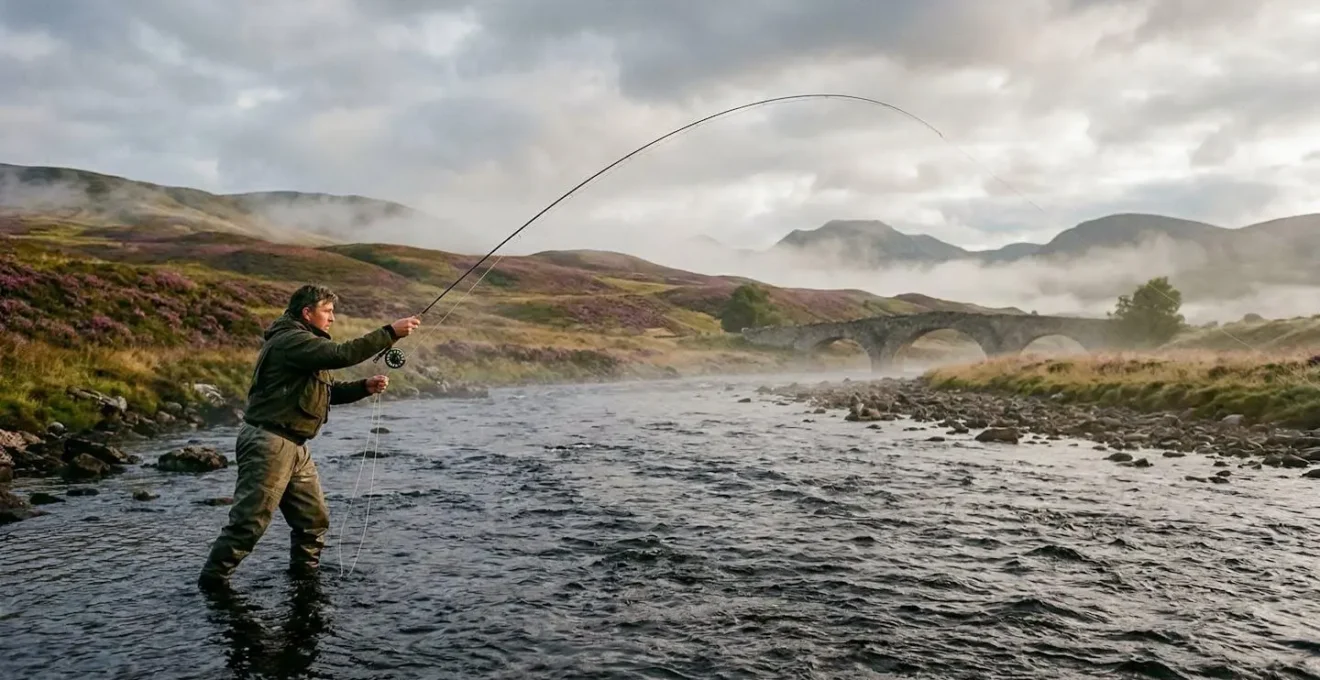
The secret to affordable Scottish salmon fishing isn’t finding ‘cheap’ spots; it’s understanding the system of access, timing, and etiquette that the pros use.
- River access in Scotland is tiered. Knowing the difference between private estates, angling associations, and council waters is the key to unlocking value.
- Seasonal timing is everything. Fishing outside the absolute peak season can cut permit costs by over 50% without drastically reducing your chances.
Recommendation: Your first step is to research Angling Association day tickets on a major river system like the Tay for late spring or early autumn. This is the sweet spot for value and opportunity.
The image is iconic: a silver Atlantic salmon, fresh from the sea, held aloft against a backdrop of misty Scottish hills. It’s a dream for any serious angler. But for many, the dream quickly evaporates when faced with the reality of booking a trip. Talk of exclusive beats on the River Spey, four-figure daily permits, and the mysterious role of the ‘ghillie’ can make the entire enterprise feel intimidating and financially out of reach. It feels like a closed club for the wealthy.
The common advice is to fish in the ‘shoulder seasons’ or go without a guide, but this only scratches the surface. These tips are useless without understanding the ‘why’ behind them. The truth is, a fantastic and affordable salmon fishing trip in Scotland is entirely possible, but it requires a different kind of currency: knowledge. It’s about achieving ‘system literacy’—understanding the unwritten rules, the tiers of river access, and the subtle art of timing that seasoned locals use.
But what if the real key wasn’t about saving a few pounds, but about investing your time to understand a system that unlocks incredible value? This guide is your mentor. It will not just tell you *what* to do; it will explain *how* the Scottish fishing system works from the inside. We will demystify the permit maze, explain river etiquette that acts as a key to access, and show you how to plan a trip that feels like a million dollars, without costing it. We’ll break down the legalities, the gear choices, and the on-river conduct that separates a frustrated tourist from a successful angler.
This article provides a complete roadmap to planning your affordable Scottish salmon fishing adventure. The following sections break down everything from legal requirements and river etiquette to gear choices and the conservation ethos that underpins it all.
Summary: Your Complete Guide to Planning a Budget-Friendly Scottish Salmon Trip
- Trout vs Salmon Seasons: When Are You Legally Allowed to Fish?
- The ‘Rotation’ Rule: How to Move Down a Pool Correctly?
- How to Handle a Fish to Ensure It Survives Release?
- Fly vs Spin Fishing: Which Is Allowed on Scottish Estates?
- Do You Need a Ghillie for a Successful Day on the River?
- Why You Can’t Just Fish in Any River You See?
- What Does ‘RSPCA Assured’ Mean for Salmon Welfare?
- Farmed vs Wild Scottish Salmon: Is the Price Difference Justified?
Trout vs Salmon Seasons: When Are You Legally Allowed to Fish?
The first step in planning your trip is understanding that you can’t just fish for salmon whenever you want. The Scottish salmon season generally runs from mid-January to late October, but this is governed by strict conservation laws that change throughout the year. The most important rule for any angler to know is the mandatory catch-and-release period for spring salmon. To protect vulnerable early-running fish, it is illegal to keep any salmon caught before April 1st. As the Scottish Government states, this was introduced in 2015 “to protect vulnerable spring sub-stocks.” This means that during the early part of the season, 100% of salmon must be released by law.
This legal framework directly influences the cost of fishing, creating opportunities for the savvy angler. This practice of “seasonal arbitrage” is your best tool. While April and May are prime time for spring salmon with incredible fighting fish, they also come with premium permit prices. In contrast, the summer months of June to August can see lower water levels and fewer fish, but permits are significantly cheaper. The real sweet spot for value is often September and October, when autumn runs bring fresh fish into the rivers and permit prices are more reasonable than the spring peak. Critically, there is a blanket ban on salmon fishing on Sundays across all of Scotland—a cultural tradition that is legally enforced.
Understanding this calendar is fundamental. Don’t just look for the cheapest day; look for the highest value period that aligns with your budget and expectations. An early autumn trip often provides the perfect balance of a good chance of fish and a permit that doesn’t require a second mortgage.
Why You Can’t Just Fish in Any River You See?
This is the single most important concept for a visiting angler to understand: in Scotland, there is no national fishing licence. As the Scottish Government’s policy clearly states, “Those who wish to fish in an area will need to ensure they have the relevant permission to do so.” This “permission” is the key. You are not buying a right to fish anywhere, but rather renting access to a specific piece of water—known as a ‘beat’—for a specific period. This is because the fishing rights are privately owned, separate from the land itself. Walking up to a promising-looking river and casting a line is considered poaching and is treated very seriously.
This system of private ownership creates a three-tiered structure of access, which is the foundation of finding your “value beat”:
- Private Estates: These are the famous, top-tier beats on rivers like the Spey or Dee. They often come with a full-time ghillie (guide), a fishing hut, and a price tag that can exceed £300 per day, with premium weeks running into the thousands.
- Angling Associations/Clubs: This is the sweet spot for the budget-conscious angler. Local clubs lease fishing rights from multiple owners and sell day or week tickets to visitors. The water is often just as good as private estates, but without the bells and whistles. This is where you’ll find the best value.
- Council-Owned Waters: Some local councils offer fishing on waters they control. These are often the cheapest options, sometimes as low as £10-£15 a day, but may be in less productive areas or for species other than salmon.
Your goal is to focus your research on the angling associations. Websites like FishPal are indispensable for viewing beat maps, checking availability, and booking permits online. They demystify the process by showing you exactly what water you’re paying for. By targeting these club waters, you gain access to prime salmon river for a fraction of the estate cost.
The ‘Rotation’ Rule: How to Move Down a Pool Correctly?
Once you’ve secured your permit for a club water, the next part of your “system literacy” is understanding river etiquette. This isn’t just about being polite; it’s a functional system that ensures every angler gets a fair chance to fish the water effectively. The most important unwritten law is the ‘rotation’ rule when fishing a pool. You don’t just stand in one spot; you must methodically work your way down the pool. The standard protocol is: cast, swing, step. You cast your fly across and slightly downstream, let it swing across the current, and once the line is straight below you, you take one or two steps downstream before making your next cast. This ensures you cover new water with every cast and you are constantly moving, allowing anglers who start the pool after you to follow at a respectful distance.
On busy association waters, this is not optional. Anglers will be watching, and failing to move down the pool is a major breach of etiquette. It signals you as an inexperienced outsider. The system works because everyone participates. When you reach the end of the pool, you get out of the river, walk back to the top (well away from the water’s edge to avoid spooking fish), and start again behind anyone who is already fishing. This dance is the heartbeat of a Scottish river.
This visual demonstrates the principle perfectly. Each angler maintains a consistent spacing, moving in concert down the length of the beat. For example, on a well-known beat like Fishponds on the River Tay, this rotation is essential for a productive and harmonious day, especially during the more affordable spring and summer periods. Mastering this simple rhythm is your ticket to being accepted and respected on any association water in Scotland.
Fly vs Spin Fishing: Which Is Allowed on Scottish Estates?
The next piece of the puzzle is your equipment. The classic image of Scottish salmon fishing is with a double-handed fly rod, and on many rivers, this is the only method permitted. However, some rivers and beats do allow spinning, which can be an easier entry point for beginners. The choice is not just a matter of preference; it’s dictated by the rules of the specific beat you are fishing. Making the wrong choice means you could be asked to leave the river. Generally, the more “prestigious” and expensive the river, the more likely it is to be fly-only. The River Spey, for example, is almost exclusively a fly-fishing river. In contrast, the River Tay, a larger and more powerful river, has many beats that allow spinning, particularly in the high water of the early season.
For the budget angler, this presents a strategic choice. Spinning gear is typically cheaper than a full fly-fishing setup. However, investing in a basic fly-fishing kit opens up far more water across Scotland. A perfectly serviceable setup can be assembled without breaking the bank; for example, a complete kit with a Shakespeare Oracle rod, a Vision Deep reel, and an Airflo Rage line can be had for around £260. While this is an initial outlay, it’s a long-term investment in your access to the sport.
This table gives a general overview, but you must always check the specific beat rules before you book. This information is usually available on the booking website or by calling the estate or club directly.
| River | Fly Fishing | Spinning Allowed | Best Budget Option |
|---|---|---|---|
| River Tay | Yes (All beats) | Yes (Selected beats) | Spinning in early season |
| River Tweed | Yes (All beats) | Yes (Some beats) | Association waters |
| River Spey | Yes (Required) | Rarely | Fly only – no choice |
| River Dee | Yes (Preferred) | Limited | Fly fishing |
Do You Need a Ghillie for a Successful Day on the River?
The Scottish ‘ghillie’ is a river guide, an expert on the water, a casting instructor, and a storyteller all in one. On expensive private estates, a ghillie’s services are often included in the price of the permit. For the budget angler fishing association water, hiring a ghillie is an extra cost, often £150-£250 per day. So, the big question is: do you need one? The honest answer is: it depends on your goals. If your primary goal is to learn—to master a Spey cast, to understand how to read a river, and to dramatically increase your chances of catching a fish—then hiring a ghillie for your first day is the best investment you can make. The knowledge gained in one day with a pro can pay dividends for years.
However, if your budget is tight and you’ve done your homework, going it alone is absolutely possible. This is where your ‘system literacy’ pays off. If you understand the rotation rule, know how to read a beat map, have checked the river levels online, and have a few reliable fly patterns, you can have a successful and rewarding day. There are many stories of DIY anglers having incredible success, like one angler who, on his first unguided day, caught and released a 6lb grilse and a 13lb salmon. It doesn’t always work out that way, but it proves that with preparation, it can be done.
The choice boils down to a trade-off: money vs. time. A ghillie accelerates your learning curve immensely. Going DIY requires more pre-trip research and a willingness to learn from your own mistakes. For a multi-day trip, a smart strategy is to hire a ghillie for day one and then apply what you’ve learned on your own for the following days.
How to Handle a Fish to Ensure It Survives Release?
Catching a salmon is only half the battle. Given the conservation status of Atlantic salmon, and the mandatory catch-and-release periods, knowing how to handle a fish properly is not just good practice—it’s an ethical obligation. The moment a fish is hooked, the clock is ticking. Playing a fish too long exhausts it, filling its muscles with lactic acid from which it may not recover. The goal should always be to land the fish as quickly as is reasonably possible. This is where your gear choice matters; a rod that is too light for the river will prolong the fight and endanger the fish.
Once the fish is near, the most critical phase begins. The guiding principle is to keep the fish in the water as much as possible. A salmon out of water is suffocating. If you must take a photo, be prepared. Have your camera ready, lift the fish horizontally with both hands supporting its belly, take the shot quickly, and return it to the water immediately. Holding a fish vertically by its tail can cause serious damage to its internal organs.
Using a wide-meshed, knotless net is essential, as is using barbless hooks, which make unhooking faster and less damaging. Before you ever touch the fish, always wet your hands to preserve the protective slime coating on its scales. This slime is its primary defence against infection. After unhooking, hold the fish gently in the current, facing upstream, until it is strong enough to swim away on its own. Releasing a tired fish into slack water is a death sentence. This final act of respect ensures the fish has the best possible chance to continue its journey and spawn, securing the future of the sport we love.
Your Checklist for Safe Salmon Handling
- Play and land the fish as quickly as possible; avoid exhausting it.
- Always keep the salmon in the water during unhooking whenever feasible.
- Use a soft, knotless-mesh landing net to minimize scale and fin damage.
- Wet your hands thoroughly before touching the fish to protect its sensitive slime layer.
- If you must lift for a photo, support the fish horizontally with both hands and be quick—never hold it vertically.
Key Takeaways
- Affordable salmon fishing in Scotland is accessed through knowledge of the permit system (Estates vs. Associations) and not by simply finding ‘cheap’ water.
- Mastering river etiquette, especially the ‘step, cast, swing’ rotation, is a non-negotiable skill for success on shared club waters.
- Proper fish handling and a ‘keep ’em wet’ philosophy are essential conservation duties for every angler, ensuring the sustainability of the sport.
What Does ‘RSPCA Assured’ Mean for Salmon Welfare?
While your focus as a visiting angler is on wild salmon, you will undoubtedly encounter the topic of farmed salmon. The ‘RSPCA Assured’ label is a certification you’ll see on salmon in supermarkets, and it relates exclusively to the welfare of farmed fish. It sets standards for things like stocking density, humane slaughter, and environmental conditions within fish farms. While it signifies a higher standard of welfare within the aquaculture industry, it has no direct connection to the wild salmon swimming in the rivers. However, the broader issue of salmon welfare is deeply connected to the wild angler.
The health of wild salmon populations is a serious concern. The Scottish Government Marine Directorate has noted that “Numbers of Atlantic salmon are declining across their North Atlantic range.” This decline is why conservation measures like mandatory catch and release are so vital. As an angler, your role in salmon welfare is not about farm certifications, but about being a steward of the wild resource. This means meticulously following catch and release guidelines, practicing safe fish handling, and reporting any signs of disease or pollution to the local authorities or river board.
The government actively monitors the health of salmon stocks across 173 separate inland water assessment areas. Your permit fee is not just rent; it’s a direct contribution to the management and conservation of these precious wild fish. By participating responsibly, you become part of the solution, helping to ensure that wild salmon continue to return to Scottish rivers for generations to come.
Farmed vs Wild Scottish Salmon: Is the Price Difference Justified?
As an angler, you are pursuing an experience, not a product. This is the fundamental difference when comparing the value of wild salmon fishing to buying farmed salmon. From a purely economic standpoint, the comparison seems absurd. A day permit on a decent association beat might cost £50, while a kilogram of farmed salmon at the store is about £10. But you are not paying for a fish; you are paying for the tradition, the challenge, the scenery, and the chance to connect with a truly wild creature in its natural environment. The value is in the adventure, not the fillet.
Wild salmon are the ultimate athletes of the fish world. They have travelled thousands of miles in the ocean, navigating by instinct back to the river of their birth. Their flesh is firm, their power is immense, and their beauty is a product of a life lived on the edge. A farmed salmon, while a valuable food source, is a product of a controlled, industrial process. The debate over the environmental impact of fish farms versus the economic benefits they bring to local communities is complex and ongoing.
For the angler, the justification for the “price” of pursuing a wild fish is self-evident. It’s the value of a day spent in nature, the intellectual puzzle of reading the water, the thrill of the take, and the deep satisfaction of releasing a magnificent creature to continue its journey. This table puts the two experiences in perspective.
| Aspect | Wild Salmon Fishing | Farmed Salmon |
|---|---|---|
| Cost | £30-£200+ per day permit | £10-15 per kg |
| Experience Value | Full day adventure, tradition, skills | Meal only |
| Conservation Impact | Supports river management | Environmental concerns |
| Local Economy | Supports ghillies, hotels, shops | Industrial scale operations |
| Quality | Athletic wild fish, seasonal | Available year-round |
Now that you are armed with this insider knowledge, the path to an affordable and unforgettable Scottish salmon fishing trip is clear. The next logical step is to start your research on association waters, compare beat maps, and book your permit with confidence.