Staying in a Scottish tenement is more than a novelty; it’s a direct encounter with 19th-century social engineering.
- High ceilings and ornate entrance tiles weren’t just for aesthetics—they were complex signals of social status and respectability.
- The drafts, distinct plumbing sounds, and endless stairs you experience are the direct legacy of a housing boom that prioritized density over modern comfort.
Recommendation: Use this guide to “read” your building’s history, transforming your stay from a simple rental into a rich historical experience.
Booking a stay in a Glasgow or Edinburgh tenement offers a promise of authenticity—high ceilings, grand bay windows, a genuine slice of Scottish city life. As a tourist, you might anticipate the charm. But what you are truly stepping into is a living museum, a vertical landscape shaped by the immense pressures of the Industrial Revolution. Many guides will mention the architecture is “old” or the entrances “pretty.” This is a profound understatement.
The reality of a tenement is a story of social aspiration, engineering compromises, and a century of adaptation. The drafts you might feel from a magnificent sash window aren’t a flaw; they are a feature of 19th-century ventilation philosophy. The elaborate tiles in the “close”—the communal entrance stairwell—are not mere decoration; they are a fossilised display of Victorian social hierarchy. Understanding these buildings means looking past the surface and reading the history embedded in their very stone and mortar.
This guide abandons the superficial tour. Instead, we will adopt the perspective of a housing historian to decode the architectural DNA of the tenement. We will explore why these buildings look and feel the way they do, and how those century-old decisions directly impact your comfort and experience today. From the social signalling at the front door to the physics of heat loss on the top floor, you will learn to see your temporary home not as a flat, but as a chapter in a continuing urban story.
To fully appreciate the unique character of these historic buildings, we will explore the key features and historical context that define the tenement experience. This structured overview will guide you through the architectural and social nuances of your stay.
Summary: A Visitor’s Historical Guide to the Scottish Tenement
- The Wally Dugs and Tiles: Why are Tenement Entrances So Ornate?
- The Drying Green: Can You Use the Back Garden for BBQ?
- Why Are Top Floor Tenements So Cold in Winter?
- Gorbals then and now: How Slums Became Sought After?
- Saniflo and Lead Pipes: What to Ask About Tenement Plumbing?
- Why Google Maps Travel Times Are Wrong for Edinburgh’s Vertical Streets?
- Where to See Rennie Mackintosh Designs in Glasgow?
- How to Explore Edinburgh’s Old Town on Foot Without Exhaustion?
The Wally Dugs and Tiles: Why are Tenement Entrances So Ornate?
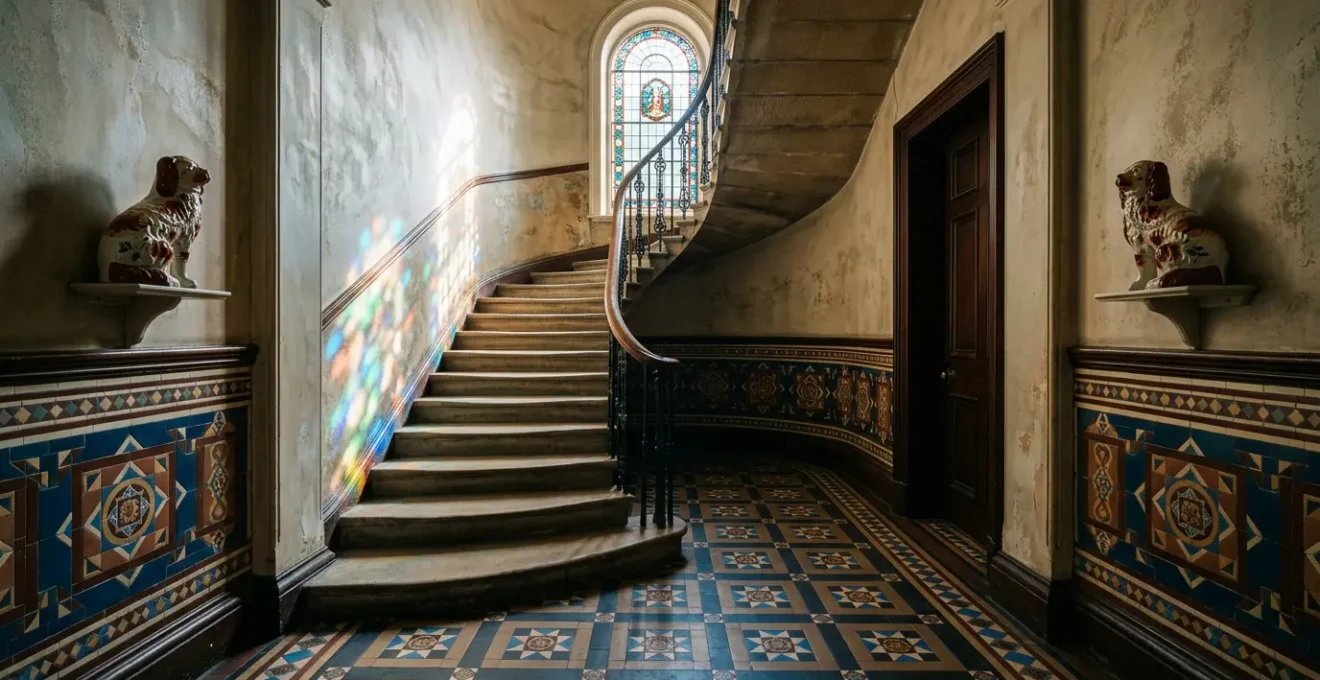
The first thing you will notice about your tenement is the entrance, or “close.” In many, you are greeted by a dazzling display of geometric tiles, stained glass, and intricately carved woodwork. This wasn’t simple decoration; it was a powerful form of social signalling in the Victorian era. As Glasgow’s population exploded from 250,000 to over a million between the early 19th and 20th centuries, tenements were built at a ferocious pace. In this anonymous new city, your entrance hall was your public face.
A clean, well-maintained, and ornate close communicated the “respectability” of the residents within. Lavish tiling and features like “Wally Dugs”—ceramic dogs often placed in windows or closes—were displays of modest affluence and house-pride. The National Trust for Scotland’s preserved flat at The Tenement House demonstrates this perfectly. The building from 1892 retains its ornate entrance, a testament to how residents viewed the communal stairwell’s cleanliness and appearance as a direct reflection of their own moral standing. The unwritten rules were strict, with residents’ associations often enforcing rigorous cleaning rotas.
So, as you walk through your close, take a moment. You are not just in a hallway; you are in a carefully constructed social statement, a 130-year-old declaration of worthiness designed to impress neighbours and visitors alike. Every worn tile and polished brass handle is a part of that story.
The Drying Green: Can You Use the Back Garden for BBQ?
Beyond the tenement block lies another key feature: the “back green” or “drying green.” This communal garden space was, and often still is, a shared utility. Its primary, historically mandated purpose was for drying laundry on wheeled pulleys or “whirly-gigs.” This seemingly simple space is governed by a complex, often unwritten, code of conduct rooted in the unique ownership structure of tenements. With 579,000 tenement properties making up 24% of all Scottish housing, understanding this shared ownership is key.
Unlike a modern apartment block with a clear management company, traditional tenements operate on a system of common ownership and mutual responsibility. The deeds of each flat (or “feu”) typically outline rights and responsibilities for the drying green, roof, and stairs. So, can you have a BBQ? The answer is “it depends.” It hinges on the specific rules of the building’s deeds and, more importantly, the established culture among the current residents. Setting up a barbecue without consulting neighbours would be seen as a significant social faux pas, a violation of the space’s primary function and shared nature.
This dynamic is unique to Scottish cities. As CityDays Glasgow Heritage notes, the social fabric of these buildings was distinct from the start.
Unlike other cities where wealthier residents fled to the suburbs, Glasgow’s tenements housed individuals from all social backgrounds
– CityDays Glasgow Heritage, Glasgow Heritage Guide
This social mix necessitated a robust system of communal negotiation. Your best course of action is to observe and ask. The drying green is a microcosm of tenement life: a shared space that functions smoothly through courtesy, tradition, and mutual respect.
Why Are Top Floor Tenements So Cold in Winter?
One of the most common experiences for a visitor staying on the top floor of a tenement is the surprising chill, even when the heating is on. This is a direct consequence of 19th-century construction. The defining features—high ceilings, large single-glazed sash windows, and solid stone walls—create a poor thermal envelope by modern standards. High ceilings, designed for ventilation and status, allow warm air to rise far away from the occupants, while vast, uninsulated roof spaces (the “coom”) act as a heat sink.
The iconic sash windows are the main culprits. They are beautiful, but they are notoriously drafty and offer minimal insulation. You might even find intricate frost patterns on the inside of the pane in the morning, a picturesque but clear sign of significant heat loss. This isn’t just a quirk; it’s a systemic issue with an aging housing stock. A recent structural survey revealed that over 50% of pre-1919 buildings face disrepair to critical elements, including roofs and windows, which exacerbates these thermal issues.
When you feel that draft, you are feeling history. You’re experiencing a building designed in an era of cheap coal, when a roaring fire in every room was the norm and airtightness was not a concept. Residents historically would have used heavy thermal curtains, rugs, and draught excluders to combat the cold. For a temporary guest, the best advice is to pack an extra jumper and appreciate the authentic, if chilly, experience of vertical living before the age of central heating and double glazing.
Gorbals then and now: How Slums Became Sought After?
The story of areas like the Gorbals in Glasgow is the story of the tenement’s journey in the public imagination. Once infamous for overcrowding and poverty, the Gorbals has undergone a radical transformation. This trajectory from “slum” to “sought-after heritage” is central to understanding modern Scottish cities. In the mid-20th century, the Gorbals was one of the most densely populated places in Europe; today, the area’s population has fallen from around 90,000 to approximately 10,000, a stark illustration of the “slum clearance” policies of the post-war era.
For decades, the official policy was demolition. Tenements were seen as unsanitary, outdated, and a symbol of poverty. Tower blocks were erected as the solution, a plan now widely regarded as a social and architectural failure. The turning point came in the 1970s with a seismic shift in public and official perception. Instead of seeing problems, people started to see potential and history.
This change was formalized through legislation. The designation of large swathes of the city as Conservation Areas was a crucial step in this process. As highlighted in a case study on Glasgow’s architectural history, this was a conscious move to protect, not demolish. In 1972, Glasgow’s West End became the city’s first Conservation Area, officially recognising tenements as having ‘special architectural or historic interest.’ This marked the moment the city began to view its tenement stock not as a liability to be cleared, but as a unique architectural palimpsest—a valuable asset to be preserved. This shift from slum to heritage is why you can now stay in a beautifully restored Victorian flat in areas that were once earmarked for the bulldozer.
Saniflo and Lead Pipes: What to Ask About Tenement Plumbing?
Tenement plumbing is an adventure in retrofitting. The vast majority of these buildings were constructed before indoor plumbing was standard. As the National Trust for Scotland highlights, early flats were basic; in some working-class areas, a single toilet could be shared by up to 30 people. The bathrooms you find today have been ingeniously—and sometimes precariously—carved out of former spaces: a corner of a large kitchen, a converted closet, or a former “bed recess.”
This history of adaptation is why tenement plumbing can be quirky. You might encounter lower water pressure on top floors, especially during morning “rush hour.” More significantly, you may find a “Saniflo” or other macerator pump system. These devices use a grinder to allow a toilet to be installed far from the main soil pipe. They make a distinctive grinding noise after flushing and are a triumph of modern retrofitting, but they are also sensitive—they are designed for human waste and toilet paper only. Flushing anything else can lead to a blocked pump, a situation best avoided.
As a prospective guest, it’s wise to be aware of this hidden history. While most plumbing is perfectly functional, knowing what to look for can prevent surprises. Before booking or on arrival, it’s reasonable to clarify a few key points about the building’s mechanical heart.
Your Pre-Booking Plumbing Checklist
- System Age: When was the plumbing last updated and are there any lead pipes remaining in the system?
- Macerator Systems: Is there a Saniflo or macerator system installed, and what are the rules for its use?
- Bathroom Origins: Where is the bathroom located—was it originally an indoor facility or retrofitted from another room?
- Water Pressure: What is the water pressure like on upper floors during peak usage times?
- Shared Drains: Are there any shared drainage responsibilities or known issues with other flats in the building?
Why Google Maps Travel Times Are Wrong for Edinburgh’s Vertical Streets?
In Edinburgh’s Old Town, Google Maps can be a deceptive guide. A journey that appears to be a 5-minute walk on a flat map can take 15 minutes and leave you breathless. This is because the map fails to account for the city’s extreme “verticality,” a direct result of its history of tenement construction. Confined by the city walls and defensive marshes, medieval Edinburgh could only grow upwards. By the 17th century, Edinburgh’s tenements were among the world’s tallest buildings, reaching up to 15 storeys high.
This legacy of vertical living created a city of dizzying layers. Streets exist on top of each other, connected by dozens of steep, narrow alleyways known as “closes” or “wynds.” A location that is 200 feet away horizontally might be 50 feet above or below you vertically. Google Maps calculates the horizontal distance but struggles to factor in the time and effort required to navigate the endless flights of stone stairs that connect these different levels.
When you are exploring the Old Town, you are not just walking; you are, in effect, mountaineering. Your cosy top-floor Airbnb on the Royal Mile might require climbing four flights of stairs inside the building, only to find that to get to the street below, you must descend another six flights via a public close. A good rule of thumb is to double any walking time estimate given by a mapping app within the Old Town and to be prepared for stairs—lots of them.
Where to See Rennie Mackintosh Designs in Glasgow?
While Glasgow is famous as the home of Charles Rennie Mackintosh, the godfather of the “Glasgow Style,” his influence extends far beyond the iconic buildings like the School of Art or the Willow Tea Rooms. For the observant visitor, his design DNA is woven into the fabric of ordinary tenements built in the early 20th century. You don’t always need a ticket to see his legacy; you just need to know how to look.
Mackintosh and his contemporaries championed a Scottish take on Art Nouveau, moving away from heavy Victorian ornamentation towards stylized, nature-inspired forms and elegant, elongated lines. This aesthetic filtered down from high-profile commissions into speculative housing developments. As you explore Glasgow’s residential areas, particularly in the West End or Southside, you can train your eye to spot these subtle but distinct features.
To go on your own architectural treasure hunt, look for these tell-tale signs of the Glasgow Style in tenement buildings:
- Window Shapes: Look for elongated windows, sometimes with curved or bowed tops, that break from the standard rectangular sash format.
- Doorway Details: Check the stained glass panels in front doors and the communal “close” door. Abstract floral motifs, particularly the stylized “Glasgow Rose,” are a classic sign.
- Ironwork: Examine railings and door handles for geometric patterns or whiplash curves characteristic of Art Nouveau.
- Fireplace Tiles: If you can see into ground floor rooms, look for fireplace tiles with distinctive colour palettes, often featuring greens, purples, and pinks.
By spotting these details, you are seeing the democratization of high design, a key part of the Glasgow Style’s philosophy. You are witnessing how a revolutionary artistic movement became part of the city’s everyday domestic landscape.
Key takeaways
- Tenement features like ornate tiles and high ceilings were primarily forms of Victorian social signalling, not just decoration.
- The physical discomforts of tenement life, such as drafts and plumbing quirks, are a direct legacy of 19th-century construction priorities and retrofitting.
- Understanding the history of a tenement—from slum clearance to conservation—transforms a simple stay into a deep, appreciative experience of living history.
How to Explore Edinburgh’s Old Town on Foot Without Exhaustion?
The key to exploring Edinburgh’s vertical landscape without burning out is to change your mindset: stop thinking like a tourist in a hurry and start thinking like a historian. Embrace a slower, more observant pace. The very architecture that makes the city challenging to walk is also what makes it fascinating. Instead of rushing from A to B, use the buildings themselves as a guide and a reason to pause.
A practical method, suggested by heritage walking guides, is to use the tenements to regulate your pace. As you tackle a steep close, take a break. Look up. Count the floors of the buildings towering above you—most rise three to six stories without a lift. Observe the details: the different colours of front doors, the date stamps carved into the stone, the remnants of old ironwork. This method, of using slow observation, naturally builds rest periods into your exploration while dramatically enriching the experience.
This is not just a theoretical exercise; it is a lived reality for the city’s residents. It brings to mind the words of one long-term local, reflecting on the daily reality of vertical living.
Carrying home shopping up the many stairs of my three floors is more than enough for me!
– Hazel Saunderson, Engine Shed Blog – Historic Environment Scotland
Her sentiment captures the essence of the experience. The verticality is a constant physical presence. By adopting a strategy of mindful walking and deliberate pauses, you are not only saving your energy but also engaging with the city on a deeper level. You are reading the architectural palimpsest, seeing the layers of history, and beginning to understand the city as its residents do: one step, and one storey, at a time.
By understanding the ‘why’ behind the high ceilings, the drafts, and the steep stairs, your stay in a Scottish tenement is transformed. It ceases to be a simple holiday rental and becomes an immersive lesson in social and urban history, allowing you to connect with the city in a way no ordinary hotel stay ever could.