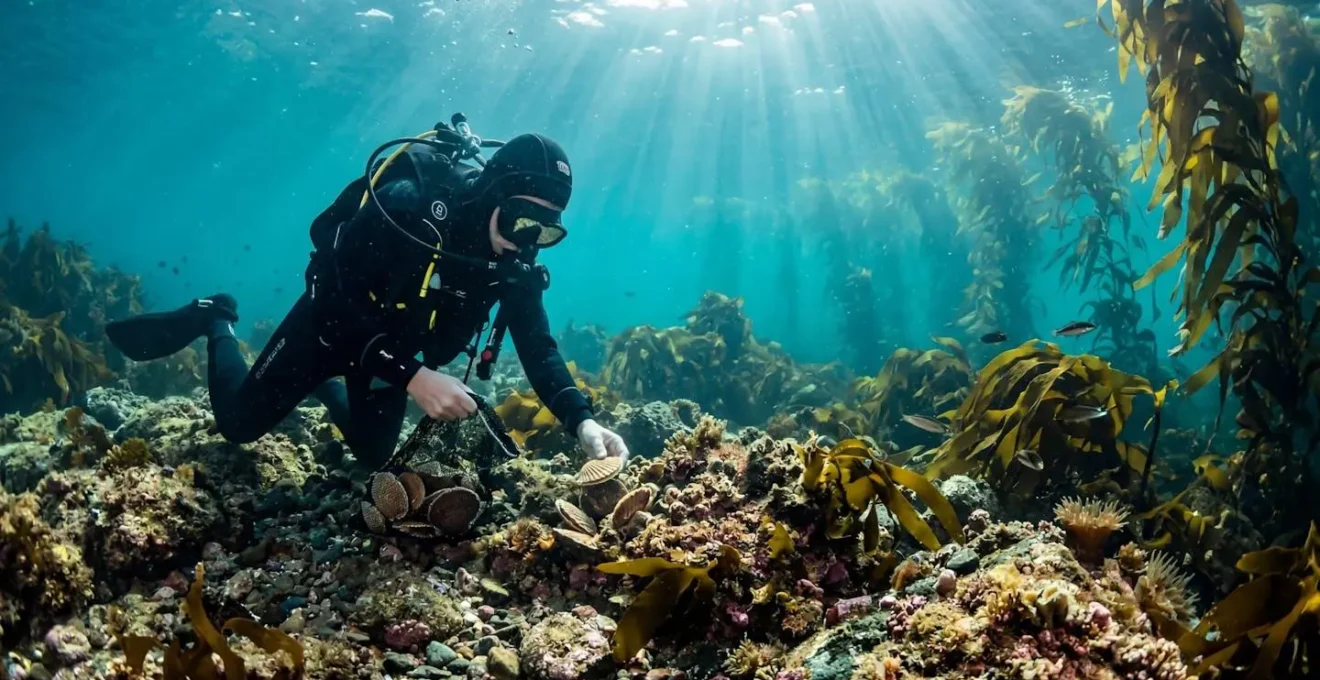
The high price of ethical seafood like hand-dived scallops reflects its true ecological cost, protecting marine habitats and local economies.
- Creel-caught shellfish avoids destroying the seabed, unlike dredging, justifying a higher price for lower environmental impact.
- Certifications like ‘RSPCA Assured’ and accreditations such as the ‘WiSe Scheme’ provide trustworthy indicators of higher welfare and responsible practices.
Recommendation: Look beyond the price tag and ask about the method of capture; it’s the most powerful question for ensuring a sustainable choice.
You’re seated in a cosy Scottish restaurant, the sea mist clinging to the windows. The specials board catches your eye: “Hand-Dived Scallops.” The price, however, gives you pause—it’s nearly triple that of the dredged scallops on the main menu. Is it just marketing, or is there a deeper story behind that cost? Many diners face this dilemma, wanting to make a good choice but lacking the information to justify the expense. Common advice often boils down to simplistic rules like “buy local” or “look for a label,” but these don’t capture the full picture of what it means to eat from the ocean with a clear conscience.
As a marine ecologist, I can tell you the price difference isn’t just about the diver’s labour; it’s the visible cost of an invisible benefit to the entire marine ecosystem. True ethical consumption of Scottish seafood isn’t about following a simple checklist. It’s about understanding the ecological story behind every item on your plate—a story that encompasses the health of the seabed, the welfare of farmed fish, and the safety of the whales and dolphins that share these waters. The price tag is a signal, pointing towards a more sustainable relationship with our oceans.
This guide will equip you with the knowledge to read those signals. We will explore the critical differences in fishing methods, decipher the meaning of welfare standards, and learn how to enjoy Scotland’s marine life both on your plate and in the wild, without causing unintentional harm. By the end, you won’t just see a price; you’ll see a choice and understand its profound impact.
To navigate these complex choices, we will delve into the key questions every conscious consumer should ask. The following sections break down everything from oyster safety and fishing techniques to wildlife tour ethics, providing a complete framework for responsible seafood enjoyment in Scotland.
Summary: A Conscious Diner’s Guide to Scottish Seafood
- When is the Best Month to Eat Scottish Oysters Safely?
- Why Creel Caught Langoustines Are Better for the Seabed?
- Which Fish Should You Avoid on Scottish Menus Due to Overfishing?
- How to Humanely Kill and Cook a Live Crab?
- Oban or Ullapool: Which Port Has the Freshest Seafood Kiosks?
- What Does ‘RSPCA Assured’ Mean for Salmon Welfare?
- What Are the Signs of Stress in Marine Wildlife You Must Ignore?
- How to Choose an Ethical Wildlife Tour Operator in Scotland?
When is the Best Month to Eat Scottish Oysters Safely?
The old adage “only eat oysters in months with an ‘R'” was once a reliable guide to avoid spoilage in warmer months before modern refrigeration. Today, in Scotland, safety is less about the calendar and more about water quality. The key to safely enjoying Scottish oysters year-round lies in understanding bio-classification. Scottish waters are rigorously monitored and classified based on their microbiological purity. According to Scotland’s Marine Assessment, a reassuring 59% of Scottish shellfish production areas are designated as Class A, meaning the shellfish are so pure they can be sold directly for consumption.
So, what do these classifications mean for you?
- Class A: The gold standard. Oysters from these waters are ready to eat straight from the sea.
- Class B: Still high quality, but shellfish must undergo a purification process called depuration (being held in clean seawater tanks) before they can be sold.
- Class C: These shellfish require a lengthy period of relaying in cleaner waters before they are safe.
A reputable restaurant or fishmonger will always source from Class A or properly purified Class B waters. While biotoxin alerts can occasionally close harvesting areas temporarily, these are rare and strictly enforced. Therefore, the “best” month is any month you can confirm your oysters come from a high-grade, monitored water source. Instead of asking about the month, ask about the water’s classification.
Why Creel Caught Langoustines Are Better for the Seabed?
When you see “creel caught” on a menu next to langoustines (also known as Dublin Bay Prawns or Norway Lobster), it signifies more than just a traditional fishing method; it signals a profound respect for seabed integrity. Creeling involves lowering baited traps, or ‘creels’, to the seafloor, which are later hauled up. This method is highly selective, targeting specific species and allowing undersized or non-target animals to be returned to the sea, often unharmed. The creels themselves rest gently on the bottom, leaving the delicate marine ecosystem—including corals, sponges, and other organisms—undisturbed.
This is in stark contrast to bottom trawling, the more industrial alternative. Trawling involves dragging a heavy, weighted net across the seafloor, indiscriminately scooping up everything in its path. This practice can devastate the seabed, flattening habitats that take decades or even centuries to recover. It’s the marine equivalent of clear-cutting a forest to catch a few specific animals. The collateral damage, known as bycatch, is often immense. The choice between a creel-caught and a trawled langoustine is a choice between surgical precision and brute force.
Case Study: The Economic Ecology of Creeling in Argyll
The environmental benefit of creeling also translates into significant local economic value. A compelling analysis of fishing in Argyll highlighted this concept of economic ecology. It revealed that although creel fishermen land less than half the volume of seafood compared to their trawling counterparts, their low-impact method generates far more value for the local economy—£4.66 million annually versus the trawlers’ £3.15 million. Furthermore, creel boat owners and crews reinvest over £600,000 more back into their local communities each year than the trawling sector. This demonstrates that supporting creel-caught seafood is an investment in both the health of the ocean and the resilience of Scotland’s coastal communities.
Which Fish Should You Avoid on Scottish Menus Due to Overfishing?
Scotland’s waters are bountiful, but not limitless. Years of fishing pressure have put several key species in a precarious position. As the Marine Conservation Society starkly points out, the global situation is critical.
Over 90% of the world’s fish stocks are now fished at, or above, sustainable levels.
– Marine Conservation Society, Scottish Seabird Centre Blog on Sustainable Fishing 2024
This global pressure is reflected in local waters. Making an informed choice at a restaurant means knowing which species are struggling and which are thriving. While populations can fluctuate, certain fish consistently appear on “avoid” lists due to severe overfishing or critical endangerment. North Sea cod, for example, has been a staple for generations but has suffered from long-term overexploitation. Wild Atlantic salmon stocks are also dangerously low in many rivers, and the European eel is critically endangered. Choosing these species contributes to the decline of already fragile populations.
Fortunately, for every fish to avoid, there is often a delicious and sustainable alternative. Swapping endangered eel for farmed rainbow trout, or choosing sustainably managed mackerel or herring, makes a significant difference. The following guide provides a quick reference for making smarter choices.
| Fish Species | Sustainability Status | Smart Swap Alternative |
|---|---|---|
| North Sea Cod | Avoid (Red) | Icelandic/Barents Sea Cod or Line-Caught Pollock |
| European Eel | Critically Endangered | Farmed Rainbow Trout |
| Wild Atlantic Salmon | Avoid Unless River-Specific | RSPCA Assured Farmed or Wild Pacific |
| Mackerel | Best Choice (Green) | N/A – Excellent Choice |
| Herring | Good Choice | N/A – Sustainable Option |
How to Humanely Kill and Cook a Live Crab?
For many, the pinnacle of fresh seafood is a crab or lobster purchased live from the harbour. However, this comes with the responsibility of ensuring the animal’s life ends as quickly and painlessly as possible. Boiling a live crustacean is a traditional method, but scientific consensus is growing that these animals are sentient and can experience stress and pain. A more humane approach, which ensures an instantaneous death, is crucial. This is an application of a key welfare indicator: the reduction of suffering at the end of life.
The most effective and humane method for crabs is spiking, which rapidly destroys the two main nerve centres. While it may seem daunting, it is far quicker and kinder than boiling alive. If you are not comfortable performing this yourself, a good fishmonger should be willing to do it for you at the point of purchase. This ensures the animal is dispatched correctly without causing prolonged distress. The goal is to treat the animal with respect from the moment it leaves the water to the moment it is prepared for the table.
Here are the steps for the humane spike method:
- Place the crab on its back on a stable surface.
- Locate the two main nerve centers: one is a small depression behind the eyes, the other is under the tail flap.
- Using a sharp, pointed instrument (like an awl or a sharpened screwdriver), pierce quickly and firmly through the first nerve center behind the eyes.
- Immediately pierce the second nerve center under the tail flap.
- This process should render the crab instantly unconscious and killed within seconds, after which it can be cooked.
Oban or Ullapool: Which Port Has the Freshest Seafood Kiosks?
The quest for the freshest seafood often leads travelers to Scotland’s bustling fishing ports. Two of the most famous are Oban, the “Gateway to the Isles,” and Ullapool, a gem on the North Coast 500 route. Both offer incredible seafood, but they provide distinctly different experiences. The definition of “freshest” depends on what you value most: variety and volume, or an intimate boat-to-plate story. Neither is better than the other; they simply cater to different desires.
Oban is a major transport hub, and its famous green-roofed seafood kiosks benefit from a constant influx of landings from a wide area. Here, “fresh” means landed that morning and delivered by a well-oiled logistics chain. You’ll find a huge variety, from plump scallops and oysters to mountains of langoustines. It’s a place of abundance, perfect for those who want to sample a wide array of what the West Coast has to offer while watching the CalMac ferries come and go.
Ullapool offers a more intimate and remote experience. Here, “fresh” often means it was landed from a boat moored just yards away, sometimes within the hour. The famous Seafood Shack exemplifies this ethos, with a menu that changes daily based on what the local fleet has brought in. The focus might be narrower—perhaps legendary cullen skink or a simple haddock wrap—but the connection to the source is tangible and immediate. It’s an authentic taste of a small, working fishing community.
| Aspect | Oban | Ullapool |
|---|---|---|
| Character | Gateway to the Isles – High volume, variety | NC500 Gem – Intimate boat-to-plate feel |
| Freshness Definition | Landed that morning via transport links | Off the boat within the hour |
| Signature Dishes | Plump scallops and langoustines | Legendary cullen skink, haddock wrap |
| Best For | Variety seekers, ferry watchers | Authentic remote experience |
| Volume | Multiple kiosks and restaurants | Focused Seafood Shack experience |
What Does ‘RSPCA Assured’ Mean for Salmon Welfare?
Farmed salmon is a significant part of Scotland’s seafood industry, and with it come important questions about animal welfare. The ‘RSPCA Assured’ label is one of the most reliable welfare indicators a consumer can find. This certification is not a simple pass/fail stamp; it represents a commitment to a comprehensive set of higher welfare standards throughout the salmon’s entire life cycle, from hatchery to harvest. It is a sign that an independent body has audited the farm against strict criteria that go far beyond standard legal requirements.
These standards are designed to ensure the fish are raised in conditions that cater to their natural behaviours. This includes providing more space to swim, ensuring responsible handling to minimise stress, and mandating humane slaughter methods. The scheme also prohibits the routine use of antibiotics. When you choose RSPCA Assured salmon, you are supporting farms that have invested in these better practices. It’s a powerful way to vote with your wallet for a more ethical approach to aquaculture.
The impact of this scheme in Scotland is substantial. It is not a niche standard but a mainstream commitment by a large portion of the industry. Recent data shows that the vast majority of Scottish farmed salmon is now raised under this scheme. According to industry reports, 82.42% of Scottish farmed salmon are raised to RSPCA Assured standards. This widespread adoption means consumers have a readily available, higher-welfare choice when purchasing one of Scotland’s most iconic products.
What Are the Signs of Stress in Marine Wildlife You Must Ignore?
Enjoying Scotland’s marine wildlife is a highlight for many, but our presence can be a source of stress for these animals. It’s crucial to distinguish between genuine signs of distress and normal behaviours that can be easily misinterpreted. Misreading these signals can lead to unnecessary intervention or, conversely, ignoring a real problem. One of the most common misinterpretations involves seals. If you see a seal floating vertically in the water with just its head showing, you might assume it’s struggling. This behaviour is known as “bottling” and is a completely normal resting position. The seal is essentially having a nap while staying afloat.
Another frequently misunderstood behaviour is “bow-riding” by dolphins and porpoises. When these animals swim in the wave created at the front of a moving boat, it is not a sign they are playing with you or in distress. It is an intelligent, energy-saving technique they use to travel, much like a cyclist drafting behind another rider. It’s a natural behaviour that they would exhibit with large whales as well as boats. Intervening or trying to “help” in these situations is not necessary and can cause more harm than good.
The key is to observe from a distance and not assign human emotions or motivations to animal behaviours. True signs of distress are often more obvious: visible entanglement in ropes or netting, an animal listing heavily to one side, or an obvious injury. If an animal’s behaviour changes drastically because of your presence—for example, it stops feeding or moves away from its young—you are too close. The best action a tourist can take is to give all wildlife ample space and respect their natural behaviours.
Key Takeaways
- Water classification (Class A) is a better indicator of oyster safety than the month of the year.
- The fishing method is critical: “creel caught” protects the seabed, while bottom trawling can destroy it.
- Independent certifications like ‘RSPCA Assured’ for salmon and ‘WiSe Scheme’ for tours are the most reliable signals of ethical practices.
How to Choose an Ethical Wildlife Tour Operator in Scotland?
Choosing a wildlife tour in Scotland is an opportunity to connect with magnificent creatures like minke whales, dolphins, and seals in their natural habitat. However, this choice also carries a responsibility. The presence of tour boats, if not managed correctly, can disturb animals and have long-term negative consequences. The most significant direct threat from human activity in these waters is entanglement in fishing gear. Research shows this is not a minor issue; it’s a widespread problem that causes injury and death. A recent scientific study revealed that a shocking 22% of live minke whales observed on Scotland’s west coast show scars and other evidence of previous entanglements.
This stark reality highlights the importance of choosing a tour operator who is not just a passenger service, but an active steward of the marine environment. An ethical operator prioritizes the welfare of the animals above the “perfect photo opportunity.” They are knowledgeable about animal behaviour, adhere to strict approach distances, and often contribute to conservation efforts. They understand that they are guests in the animals’ home. The best operators are often accredited under the WiSe (Wildlife Safe) Scheme, a national training program that certifies operators who follow best practices for minimising disturbance to marine wildlife.
Making an informed choice before you book is the most powerful tool you have. By asking the right questions, you can quickly determine an operator’s commitment to sustainability and animal welfare. A good operator will welcome these questions as a sign of a responsible customer. Use the following checklist to vet potential tour companies and ensure your experience supports, rather than harms, the incredible wildlife you’ve come to see.
Your Action Plan: Vetting an Ethical Wildlife Tour
- Ask directly: ‘Are you WiSe Scheme accredited?’ This is the primary indicator of responsible practice.
- Inquire about their specific minimum approach distances for different species like seals, dolphins, and whales.
- Confirm if a trained marine biologist or a certified wildlife guide is on board to provide educational commentary.
- Check their commitment: Ask how they contribute to local conservation efforts or citizen science programs (e.g., photo-ID databases).
- Verify their operational practices: Do they use quieter engines or make an effort to reduce their vessel’s noise and wake?
Your next meal is an opportunity. By asking the right questions—’How was this caught?’, ‘Is this from a certified source?’—you become an active participant in the conservation of Scotland’s magnificent marine ecosystems. Choose wisely.
Frequently Asked Questions on Scottish Seafood and Wildlife
Is a seal floating vertically in the water a sign of distress?
No, this is called ‘bottling’ and is a normal sleeping position for seals. They are simply resting in the water column and do not require assistance.
Should I be concerned if dolphins are riding the bow wave of my boat?
No, bow-riding is a natural, energy-saving travel technique that dolphins and porpoises use. It is not a sign of playfulness directed at humans or an indication of distress.
What are genuine signs of wildlife distress I should report?
You should immediately report any animal with visible netting or rope on its body, an animal that is listing to one side and unable to correct itself, or any marine animal exhibiting unusually confined movements. If you see this, do not approach the animal; instead, call the British Divers Marine Life Rescue (BDMLR) with your location.