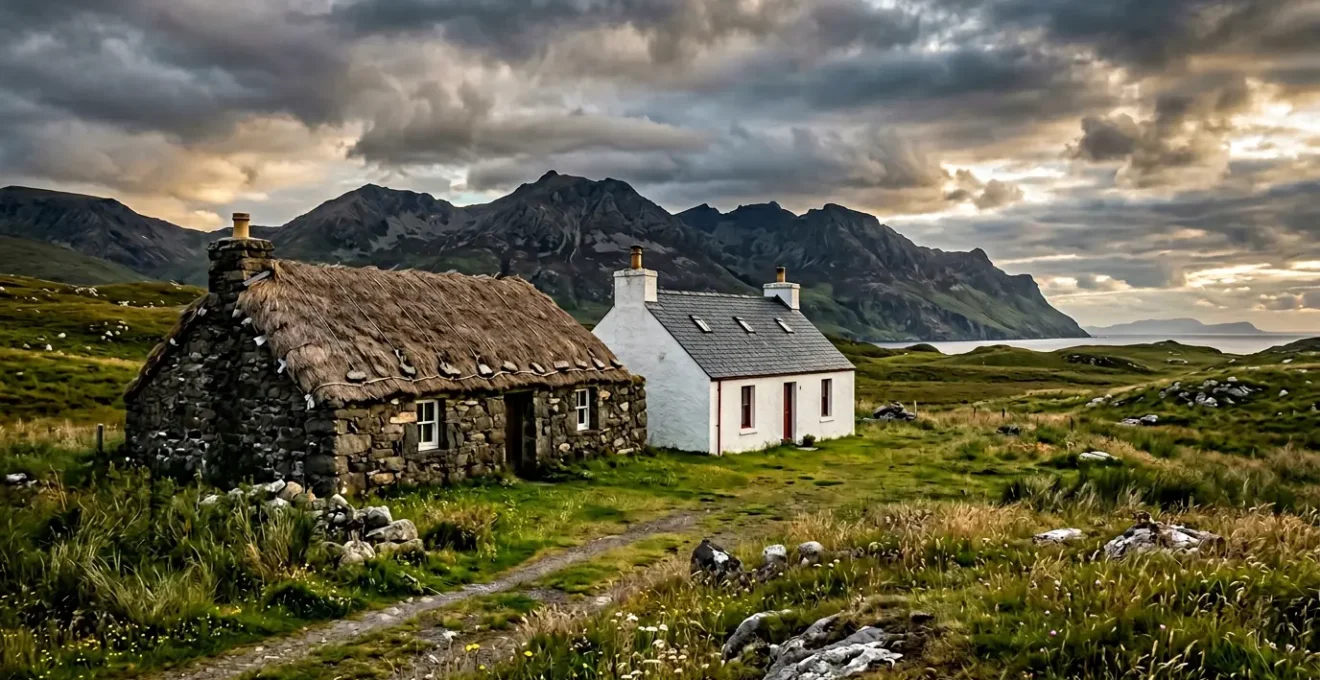
The evolution of Scottish housing is a direct, functional response to profound social and economic pressures, not a simple progression of architectural styles.
- Design choices that seem decorative or primitive, like ornate tenement tiles or chimneyless blackhouses, were driven by practical needs such as sanitation, agriculture, and social aspiration.
- The built landscape is a physical document of history, with major events like the Protestant Reformation and modern preservation laws directly responsible for the state of buildings today.
Recommendation: To truly understand Scottish architecture, look beyond aesthetics and learn to read the story of the people, politics, and technology of the time written in stone and mortar.
For any history lover travelling through Scotland, the landscape presents a beautiful puzzle. You see the skeletal remains of a stone cottage in the Highlands, then a few miles later, a perfectly preserved, whitewashed croft house standing proud against the wind. In the cities, you might marvel at the soaring elegance of a Georgian townhouse or the intricate tilework in the entrance to a Victorian tenement. It’s easy to see these as separate, isolated examples of Scottish building styles, chapters from different books entirely.
The common approach is to catalogue them by date, noting the shift from rustic to refined. But this misses the most fascinating part of the story. What if the smoky blackhouse, the ruined abbey, the grand tenement, and the modern museum are not just disconnected structures but part of a single, continuous narrative? The real key to understanding Scotland’s architectural evolution lies not in what was built, but in why it was built that way. Every design choice was a direct answer to the pressing questions of the day: How do we stay warm? How do we show we are clean and modern? How do we assert our status? How do we make a living from this land?
This article uncovers the functionalism behind the form. We will explore how the socio-economic and legislative pressures of the time shaped everything from the curve of a roof to the pattern on a floor tile. By connecting these seemingly disparate buildings, we reveal a living history written in stone, telling a story of survival, faith, ambition, and constant adaptation.
This guide unpacks the story behind Scotland’s iconic buildings, exploring the forces that shaped them. From the strict rules governing historic properties to the practicalities of life in a tenement, we’ll reveal the fascinating ‘why’ behind the nation’s built heritage.
Summary: A Journey Through Scotland’s Architectural Soul
- Grade A Listed: Why Can’t Owners Change the Windows?
- Marram Grass or Reed: What Makes a Hebridean Roof?
- Where to See Rennie Mackintosh Designs in Glasgow?
- Dundee Waterfront: How Modern Design Fits with Heritage?
- The Abbeys of the Borders: Why Are They All Ruins?
- The Lift Issue: Why Many Castle Hotels Are Not ADA Compliant?
- The Wally Dugs and Tiles: Why are Tenement Entrances So Ornate?
- High Ceilings and Drafts: What to Expect Staying in a Tenement?
Grade A Listed: Why Can’t Owners Change the Windows?
The frustration is understandable: you own a piece of history, but you can’t install modern, energy-efficient windows. This isn’t arbitrary bureaucracy; it’s a core principle of heritage preservation in Scotland. The country’s most significant structures are protected under a grading system, and the regulations are tightest at the top. A building’s ‘listing’ is a legislative imprint that freezes its architectural narrative at a key moment in time. Changing original features like timber sash-and-case windows is seen as erasing a crucial part of that story.
These buildings are considered of national or international importance, architecturally or historically. According to Scotland’s heritage classification system, only 7% of Scotland’s 47,400 listed buildings are Category A, making their preservation the highest priority. The ‘fabric’ of the building, including its original windows, is seen as integral to its character. The goal is to manage change, not prevent it, but any intervention must be justifiable and reversible.
However, authorities recognize the need for modern comfort. A practical compromise is often found, avoiding the replacement of the historic fabric itself. As the City of Edinburgh Council’s guidance clarifies, the solution lies in working with, not against, the original structure.
Secondary glazing is encouraged. It usually involves an independent internal window in addition to the existing. It maintains the original facade while improving insulation, and does not usually require listed building consent.
– Edinburgh Council, Listed Buildings and Conservation Areas Guidance
This approach embodies the central conflict of preservation: balancing the building’s historical integrity with the owner’s need for a functional, comfortable space. It’s a dialogue between past and present, mediated by planning law and innovative solutions like frameless internal glazing.
Marram Grass or Reed: What Makes a Hebridean Roof?
The traditional Hebridean blackhouse, low-slung and solid, seems to grow directly from the landscape. Its most defining feature is the roof, a thick thatch that appears almost organic. This design is a masterclass in material dialogue, a direct architectural response to the limited resources and harsh climate of the Western Isles. The choice of material was not aesthetic but entirely functional, dictated by what the wild, windswept land could provide: marram grass (Ammophila arenaria).
Unlike the cereal straws or water reed used in other parts of Scotland, marram grass was harvested from the coastal dunes. It was tough, waxy, and resilient to the salt-laden gales. This material choice had a profound impact on the roof’s construction. It was laid in thick layers directly onto the roof timbers, often without any waterproof membrane, and held down not by pins but by a distinctive net of ropes weighted with heavy stones. This construction allowed the wind to pass over the rounded profile of the roof, pushing it down rather than lifting it off.
This use of local material remains a significant, though now rare, feature of Scotland’s building heritage. A survey by Historic Scotland found that almost 25% of Scotland’s surviving thatched buildings use marram grass, with its use concentrated in the Western Isles. The design of the blackhouse itself was integrated with the roof; with no chimney, the peat smoke would filter up through the thatch, the creosote-laden soot curing the grass and making it more waterproof. This soot, or ‘greeble,’ would be scraped off annually and used as a valuable fertilizer on the poor machair soil—a perfect, self-sustaining system born from necessity.
Where to See Rennie Mackintosh Designs in Glasgow?
While vernacular architecture often speaks of collective, anonymous creation, Scotland’s story also includes moments where a single vision transformed a city’s identity. Charles Rennie Mackintosh’s work is a prime example of aspirational architecture, where his unique blend of Scottish tradition, Art Nouveau, and Japanese design principles created a style that was entirely new yet unmistakably Glaswegian. His influence is so profound that exploring the city becomes a treasure hunt for his distinctive designs.
Mackintosh’s public commissions were particularly impactful, embedding his artistic vision into the fabric of daily life. From a newspaper office to a church, he demonstrated that functional buildings could also be works of total art. While some major works like the Glasgow School of Art have faced tragedy, many of his creations and hidden gems remain accessible. To trace the evolution of his style and its integration into the city, you can follow a route that reveals his genius at different scales.
This path offers a glimpse into the mind of a master, showing how he approached everything from a grand facade to the intricate details of a doorway, forever shaping Glasgow’s architectural character.
Your Action Plan: A Mackintosh Walking Tour of Glasgow
- Start at The Daily Record Building: Begin on Renfield Lane to observe Mackintosh’s 1901 facade. Note how the coloured glazed bricks were a functional choice to maximize light in the narrow lane.
- Visit Glasgow Art Club: Head to 185 Bath Street to see his first significant public commission. The ‘Mackintosh Frieze’ is a centerpiece of the Billiard Room, an early sign of his integrated approach to design.
- Find the Doorway at 5 Blythswood Square: This often-overlooked detail was designed for the Glasgow Lady Artists’ Society. It showcases his ability to create a powerful statement even with a small commission.
- Explore The Lighthouse: Make your way to Scotland’s Centre for Design and Architecture. Originally housing The Glasgow Herald, this was his first major public commission, and the tower offers stunning city views.
- End at Mackintosh Queen’s Cross Church: Conclude your tour at the only church he designed that was actually built. Here, you can witness his mastery of light, space, and spiritual symbolism on a grand scale.
Dundee Waterfront: How Modern Design Fits with Heritage?
The story of Scottish architecture is not over; it is continuously being written. The Dundee Waterfront redevelopment is one of the most ambitious chapters in recent history, posing a critical question: how can bold, modern design coexist with and even enhance a city’s rich industrial and maritime heritage? The project’s centerpiece, the V&A Dundee designed by Kengo Kuma, is a powerful statement. Its dramatic, sweeping form, inspired by the sea cliffs of Scotland, is unapologetically contemporary.
Yet, its success lies not in ignoring the past but in entering into a dialogue with it. The museum’s prow-like structure juts out over the River Tay, physically reconnecting the city to the water that was once its lifeblood. It sits beside the RRS Discovery, the historic ship built in Dundee that carried Scott and Shackleton to Antarctica. The new architecture does not overshadow the old; instead, it frames it, creating a powerful visual juxtaposition of Dundee’s industrial past and its post-industrial, culturally-led future. This is the modern “socio-economic response” in architectural form—a city using design to signal its reinvention.
The integration goes beyond mere proximity. Inside the ultra-modern V&A is a perfect example of heritage preservation. The museum now houses the meticulously restored Oak Room, a complete 13.5-metre-long interior designed by Charles Rennie Mackintosh in 1907 for a Glasgow tea room. Saved by Glasgow Museums in the 1970s when the building was demolished, it was stored for 50 years before being brought back to life within the new museum. This act demonstrates how modern architecture can serve as a vessel for heritage, offering a protective and accessible context for historical treasures that might otherwise be lost.
The Abbeys of the Borders: Why Are They All Ruins?
The magnificent, ruined abbeys of the Scottish Borders—Melrose, Jedburgh, Dryburgh, and Kelso—are some of the most romantic and evocative sites in the country. Their skeletal arches and crumbling walls invite contemplation, but their state is not the result of gentle decay over time. They are, in fact, historical crime scenes. Their ruin was the direct result of a series of brutal political, military, and religious events that systematically dismantled what were once the wealthiest and most powerful institutions in Scotland.
The story of their decline is a stark lesson in how architecture becomes a casualty of history. Located in a volatile border region, the abbeys were repeatedly targeted during the Wars of Independence with England. However, the most catastrophic damage was inflicted during two specific periods. First, during Henry VIII’s “Rough Wooing” in the 1540s, English armies engaged in a campaign of deliberate, systematic destruction, burning and pulling down the structures to break Scottish morale and power.
Just a few years later, the Scottish Reformation of 1560 delivered the final, fatal blow. By outlawing the Catholic Mass and dissolving the monasteries, the Reformation cut off the abbeys’ religious purpose and their source of income. Deprived of patronage and purpose, they were left to decay, their lands distributed to loyal Protestant nobles. For centuries afterward, their finely dressed stones were seen not as sacred heritage but as a convenient, free quarry for local building projects, a process that continued until the Romantic movement of the 19th century began to value them as picturesque ruins worthy of preservation.
This timeline, based on information from Historic Environment Scotland, shows a clear sequence of destruction rather than a slow decline.
| Period | Event | Impact on Abbeys |
|---|---|---|
| 1296-1328 | Wars of Independence | Repeated sacking and damage |
| 1544-1551 | Henry VIII’s Rough Wooing | Systematic destruction |
| 1560 | Scottish Reformation | Outlawed Catholic mass, loss of patronage |
| 1600s-1800s | Stone quarrying period | Buildings used as free stone source |
| 1800s | Romantic movement | Preservation as picturesque ruins |
The Lift Issue: Why Many Castle Hotels Are Not ADA Compliant?
Staying in a historic Scottish castle hotel is a dream for many, but for travellers with mobility issues, it can quickly become a logistical nightmare. The absence of lifts (elevators) and accessible rooms is a common issue, and it stems from the same fundamental conflict seen in preserving listed buildings: the clash between historical integrity and modern-day expectations of accessibility. Castles, by their very nature, were designed for defence, not convenience. Their thick stone walls, spiral staircases (turnpikes), and uneven floors are integral to their historic character but are the very antithesis of modern accessibility standards.
Many of these castle hotels are themselves Category A or B listed buildings, meaning that any significant internal alteration, such as installing a lift shaft, is considered a major and often unacceptable intervention. Cutting through several feet of medieval stonework and historic room layouts is often structurally impossible without causing irreparable damage to the building’s fabric and character. Planners and heritage bodies must weigh the undeniable public good of improved accessibility against their legal duty to protect the nation’s most important historic structures.
This doesn’t mean the issue is ignored. Rather, it has led to creative, hybrid solutions that seek to provide accessibility without compromising the core historic structure. As described in Historic Environment Scotland guidelines, the solution often involves separating the functions. The main historic parts of the castle are preserved as-is, while modern, fully accessible accommodation is created in annexes or converted outbuildings like stable blocks. These new structures can offer all the luxury and accessibility required, while guests can still enjoy the ambiance and public spaces of the main castle. This approach allows for a high-quality visitor experience that respects both the needs of the guest and the integrity of the historic building.
Key Takeaways
- Buildings Are Social Documents: Every architectural choice, from a thatched roof to a tiled floor, is a response to the social, economic, and technological realities of its time.
- Preservation Is A Balance: Protecting heritage is not about freezing buildings in time, but managing change in a way that respects historical integrity while accommodating modern needs.
- Heritage and Modernity Can Coexist: Innovative modern design can create a dialogue with the past, framing and preserving historic structures to tell a new chapter in a city’s story.
The Wally Dugs and Tiles: Why are Tenement Entrances So Ornate?
Step inside a traditional Glasgow or Edinburgh tenement, and you may be greeted by a surprising burst of colour and artistry. The entrance hall, or ‘close’, is often lined with intricate, glazed ceramic tiles, with a pair of ceramic dogs (‘wally dugs’) sometimes standing guard. This decorative flourish seems at odds with the building’s purpose as mass housing. But this is not mere decoration; it’s a direct architectural expression of one of the greatest socio-economic pressures of the Victorian era: the obsession with sanitation and public health.
The rise of the tenement coincided with devastating cholera outbreaks and a growing scientific understanding of germs. In response, a “gospel of hygiene” swept through society. The choice of materials for tenement closes was a direct reaction to this. As the Glasgow City Heritage Trust explains, the beautiful was also deeply practical.
Glazed, wipe-clean tiles (‘wally closes’) were directly connected to the Victorian obsession with sanitation and hygiene, a reaction to cholera outbreaks. The tiles were not just decorative but a public statement of cleanliness and modernity.
– Glasgow City Heritage Trust, Victorian Glasgow Architecture Study
These hard, non-porous surfaces were easy to wash down, presenting a clean, sanitary face to the world in stark contrast to the dirt and disease of the slums. But it was also aspirational architecture. The complexity of the tile pattern became a clear visual indicator of the status of the building’s residents. Simple, mass-produced geometric patterns were for the closes of skilled workers, while elaborate, hand-painted Art Nouveau floral scenes signified the homes of the affluent middle class. The ‘wally close’ was both a functional sanitary solution and a public projection of status and respectability.
High Ceilings and Drafts: What to Expect Staying in a Tenement?
Living in or staying in a Victorian tenement offers a chance to experience a piece of Scotland’s urban history firsthand. However, the very features that give these apartments their character—soaring ceilings, large single-glazed windows, and solid stone walls—also create a unique living environment that can be a surprise to the uninitiated. Understanding the original functionalism of the design is key to appreciating the experience and managing its quirks, namely the infamous high ceilings and drafts.
The high ceilings were not just for grandeur; they were a core part of the Victorian ventilation strategy. In an age before air conditioning, and with a lingering fear of stagnant, “miasmatic” air thought to carry disease, high ceilings allowed unhealthy air to rise, while large windows provided cross-ventilation. This natural air circulation was considered essential for a healthy home. Today, we perceive this constant air movement as a ‘draft’. Similarly, the large sash-and-case windows were designed to let in maximum light but were not built to modern standards of insulation.
Embracing a stay in a tenement means adapting to its character rather than fighting it. It’s about understanding that what we call a ‘draft’ was once considered ‘healthy air’, and that the creak of a floorboard or the sound of a neighbour’s door is part of the communal living heritage these buildings represent. Modern comfort can be achieved by working with the building’s original features.
Action Plan: A Modern Comfort Guide for Historic Tenement Stays
- Check the Shutters: If traditional wooden shutters are present, verify that they are functional. They are not just for security; closing them at night provides an excellent layer of insulation against heat loss.
- Assess the Curtains: Look for heavy, floor-length curtains. These act as effective thermal barriers, trapping cold air from the large windows before it enters the room.
- Review Furniture Placement: Identify the heating sources (radiators, fireplace). Check if furniture is arranged to create cozy ‘pools of warmth’ rather than being spread out in the large, open space.
- Reframe the Airflow: Instead of seeing all air movement as a ‘draft’, observe the natural ventilation. A well-ventilated space is less prone to dampness, a key benefit of the original design.
- Audit the Acoustics: Listen for the sounds of the building. Accepting the acoustic character—the echo in the close, the sound of footsteps—is part of the authentic experience of living in a shared, historic structure.
By applying these simple checks, you can turn a potentially cold and drafty stay into a warm, comfortable, and historically rich experience, appreciating the building for what it is.
By learning to read the stories in these buildings, from the grandest castle to the humblest cottage, we connect with the lives, struggles, and ambitions of those who came before us. The next time you see a ruined wall or an ornate doorway, you’ll know to ask not just “what is this?” but “why is it like this?”—and you will be one step closer to understanding the true soul of Scotland.
Frequently Asked Questions about Tenement Architecture
What do simple geometric patterns indicate about a tenement’s original residents?
Simple geometric tile patterns in a tenement close typically indicated housing for the respectable working class or the lower middle class. The tiles still served the purpose of hygiene and projecting modernity, but used more affordable, mass-produced designs compared to wealthier buildings.
What characterized affluent middle-class tenement entrances?
The entrances of tenements for the affluent middle class were characterized by highly elaborate, often custom-made, decorative schemes. These would frequently feature complex, hand-painted floral Art Nouveau scenes, detailed mosaics, and stained glass, showcasing the owner’s wealth and sophisticated taste.
Why were these entrances called ‘wally closes’?
‘Wally’ is a Scots dialect word for porcelain, china, or ceramic. A ‘close’ is the common entrance and stairwell of a tenement building. Therefore, a ‘wally close’ is simply a literal description: an entrance hall lined with glazed ceramic tiles.