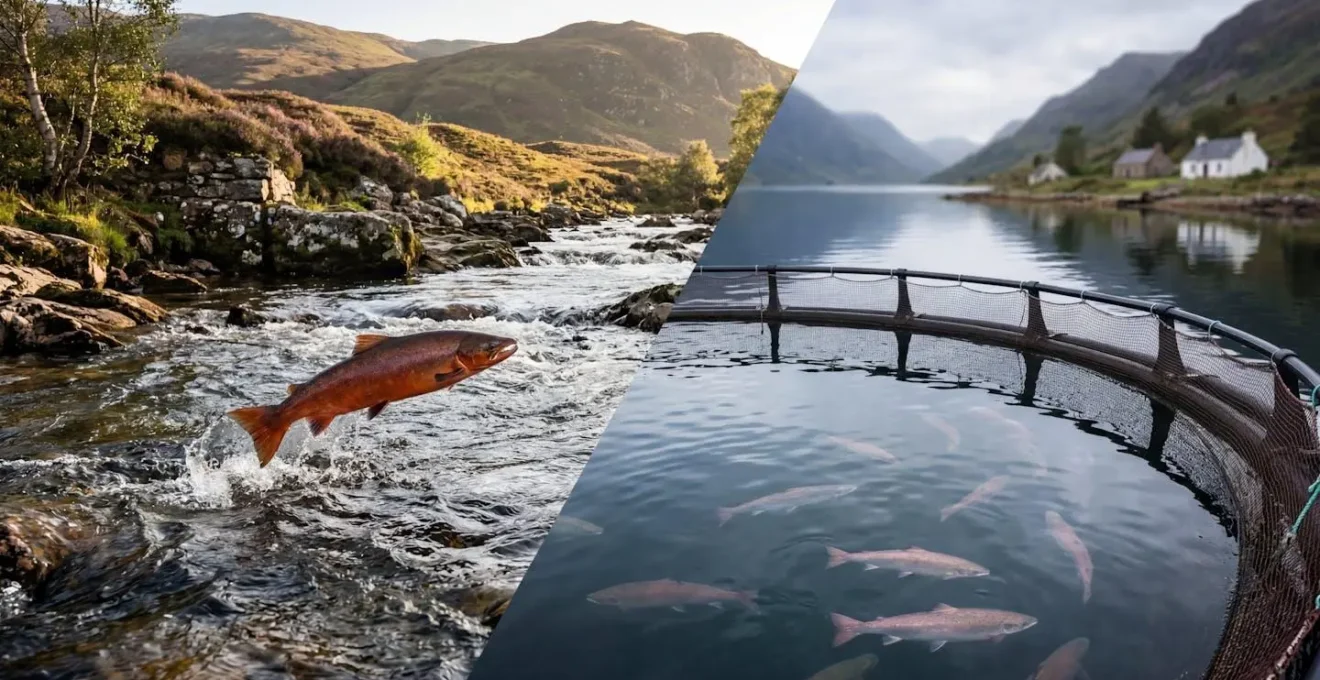
The price difference between farmed and wild salmon is an auditable ledger of environmental impact, animal welfare, and true culinary value, not just a simple matter of fat content or availability.
- Farming certifications like ‘RSPCA Assured’ can mask alarmingly high mortality rates, making independent auditing of the source critical.
- Wild salmon’s higher price reflects its genuine scarcity due to population decline and the low-impact methods required for sustainable harvesting.
Recommendation: Use sensory clues and question the harvesting method (for all seafood, not just salmon) to perform your own ‘pantry audit’ and ensure your purchase aligns with your ethical and quality standards.
Standing at the fishmonger’s counter, the choice seems simple: a pale pink, thick fillet of farmed Scottish salmon, or its deeper red, leaner, and significantly more expensive wild counterpart. The common wisdom tells us farmed is fattier and cheaper, while wild is leaner and pricier. This observation, while true, is merely the final entry in a long and complex ecological ledger. As a marine sustainability auditor, my role is to look beyond the price tag and examine the entire system—from egg to plate—to understand what that cost truly represents.
This guide is not just about telling you which salmon to buy. It’s about giving you the tools to conduct your own audit. We’ll delve into the murky waters of welfare certifications, decode the language of flavour pairings, and expand our investigation to other Scottish seafood like langoustines and scallops. You’ll learn to use ‘sensory forensics’—using your own senses of sight, smell, and taste—to identify quality and uncover the story behind your seafood. The price gap isn’t just a number; it’s a reflection of system integrity, animal welfare, and the hidden environmental costs or benefits of our choices.
By the end of this audit, you won’t just be a consumer; you’ll be an informed custodian of the sea, capable of reading the story behind the fish and making a choice that satisfies both your palate and your principles. The question isn’t simply “is the price difference justified?” but rather, “what am I actually paying for?”
This article will guide you through the key audit points, from the texture and welfare of salmon to the wider environmental impact of different fishing methods. The following summary outlines the critical checks we will perform together.
Summary: Farmed vs Wild: A Complete Seafood Audit
- Hot Smoked or Cold Smoked: Which Texture Suits Your Palate?
- What Does ‘RSPCA Assured’ Mean for Salmon Welfare?
- Lemon or Capers: What Doesn’t Overpower the Smoke Flavor?
- The Smell Test: How to Know If Vacuum Packed Fish Is Bad?
- How to Fly Home with Smoked Salmon Without It Spoiling?
- When and Where to Watch Salmon Leaping in Autumn?
- Why Creel Caught Langoustines Are Better for the Seabed?
- Hand-Dived Scallops: Why Are They Three Times the Price of Dredged?
Hot Smoked or Cold Smoked: Which Texture Suits Your Palate?
The first step in our audit is understanding the physical evidence: the flesh itself. The key difference between farmed and wild salmon lies in their fat content, a direct result of their lifestyle. A wild salmon, constantly swimming against strong currents, develops a lean, muscular body. In contrast, a farmed salmon in a pen leads a more sedentary life, resulting in a higher fat content. An analysis from seafood retailers confirms that farmed salmon contains 13-15% fat vs wild salmon’s 5-8%. This single metric profoundly influences the ideal preparation method, particularly for smoking.
This difference in fat is not just a number; it’s the determining factor for texture and flavour delivery. The higher fat in farmed salmon makes it more forgiving to heat, resulting in a moist, flaky texture when hot-smoked. The fat renders and bastes the flesh from within. Wild salmon’s leanness, however, makes it susceptible to drying out under high heat. It shines when cold-smoked, a process that preserves its firm, silky texture and allows its more complex, nuanced flavour to come through without being cooked.
Understanding this relationship is a form of sensory forensics. The choice between hot and cold smoke is not arbitrary; it’s a technical decision dictated by the salmon’s life story, as summarized in the comparative table below.
| Smoking Method | Best For | Temperature | Result |
|---|---|---|---|
| Hot Smoking | Farmed Salmon (13-15% fat) | 120-180°F | Flaky, moist texture |
| Cold Smoking | Wild Salmon (5-8% fat) | 70-90°F | Silky, delicate texture |
Choosing the right smoke style for the type of salmon is the first sign of a producer who respects the ingredient. Mismatched pairings often indicate a one-size-fits-all industrial process, a red flag in any quality audit.
What Does ‘RSPCA Assured’ Mean for Salmon Welfare?
Certifications on packaging are intended to provide consumers with trust and peace of mind. However, a core tenet of auditing is to “trust, but verify.” The ‘RSPCA Assured’ label is one of the most common on farmed salmon in the UK, suggesting a higher standard of animal welfare. But what does the ecological ledger show when we look closer? The standards, while aiming to be an improvement, operate within the inherent limitations of intensive aquaculture.
The primary concerns in salmon farming are overcrowding, disease transmission, and the spread of parasites like sea lice. These issues can lead to significant stress and high mortality rates. In a shocking finding, a WildFish investigation revealed that a 74% mortality rate is allowed on RSPCA Assured certified farms over a full production cycle. This means a farm can lose nearly three-quarters of its stock and still potentially retain its certification. Such a high tolerance for loss raises serious questions about the “welfare premium” consumers believe they are paying for.
This visual discrepancy highlights the stark reality. On one side, the potential conditions of a certified environment; on the other, the natural habitat that defines a wild animal. The issue is not necessarily malicious intent, but a systemic challenge of maintaining health in dense aquatic populations. As Rachel Mulrenan, Scotland Director at WildFish, points out, the system itself is flawed:
RSPCA Assured and ASC can endorse and certify farms where more than half of fish die prematurely from disease or parasite infestation over a production cycle
– Rachel Mulrenan, Scotland Director at WildFish
Ultimately, a label is a promise, not a guarantee. A thorough audit requires looking past the packaging to the practices themselves, questioning what level of compromise is acceptable in the name of affordable protein.
Lemon or Capers: What Doesn’t Overpower the Smoke Flavor?
After auditing the production system, we return to the plate. The accompaniments served with smoked salmon are not just a matter of tradition; they are a direct response to the fish’s intrinsic properties. This is sensory forensics at its most delicious, revealing clues about the salmon’s fat content and smoke intensity through the choice of pairing.
Think of it as an equation of balance. A rich, fatty, and robustly smoked farmed salmon can stand up to, and even benefits from, strong, sharp flavours. The acidity of capers, the punch of red onion, and the richness of a dill cream sauce cut through the fat and complement the heavy smoke. These are not just flavour additions; they are balancing agents. In contrast, a delicate, low-fat, peat-smoked wild salmon would be completely overwhelmed by such aggressive partners. Its nuanced flavour, which is the very thing you paid a premium for, would be lost.
Traditional Scottish smokehouses understand this implicitly. A case study of their practices reveals that wild salmon is often served with nothing more than a simple oatcake and perhaps a dollop of crowdie cheese. The goal is to elevate the fish, not mask it. A simple squeeze of lemon is often the most that is offered, providing a light acidic lift without overpowering the star ingredient.
| Salmon Type | Smoke Type | Best Pairing | Avoid |
|---|---|---|---|
| Wild (5-8% fat) | Peat smoke | Lemon only | Heavy sauces |
| Farmed (13-15% fat) | Oak smoke | Capers, dill | – |
| Wild | Applewood | Black pepper | Cream sauces |
Next time you are served smoked salmon, perform a quick audit of the plate. The choice of lemon or capers is a subtle but clear indicator of the type and quality of the salmon being presented.
The Smell Test: How to Know If Vacuum Packed Fish Is Bad?
The final checkpoint before consumption is the freshness audit, especially crucial for vacuum-packed products which can hide sensory clues. Vacuum packing is a great preservation method, but it creates an anaerobic (oxygen-free) environment that can concentrate natural compounds, leading to a strong “fishy” smell upon opening. An inexperienced consumer might discard perfectly good fish, while an unwary one might consume spoiled product. Your nose is a primary auditing tool, but it must be calibrated.
The key is the 60-second rule. A fresh piece of salmon may have a concentrated odour when the seal is broken. However, if the fish is sound, this smell should dissipate almost completely within a minute of exposure to air. If a pungent, ammonia-like, or sour smell persists, the fish is past its prime, and the system integrity of its preservation has failed. This is a non-negotiable red flag.
Beyond smell, your eyes and fingers provide further data. The flesh should be firm and bounce back when pressed gently; if it’s mushy or leaves an indent, spoilage has begun. Look for “gapping”—where the muscle flakes separate—or any milky, slimy liquid in the pack. The colour should be vibrant, not dull or brownish at the edges. Mastering these sensory checks empowers you to trust your own judgment over a printed date.
Your Action Plan: Sensory Checklist for Salmon Freshness
- Open vacuum pack and wait 60 seconds – initial ‘fishy’ smell should dissipate.
- Check visual cues – look for gapping flesh, milky liquid, or dullness.
- Test texture – flesh should be firm, not mushy when pressed gently.
- Examine color – wild salmon should be deep orange-red, farmed salmon pink.
- Check packaging date – ‘Use By’ is safety critical, ‘Best Before’ is a quality indicator.
Treating the ‘Use By’ date as a strict safety deadline and the ‘Best Before’ date as a guideline for peak quality is the final piece of this puzzle. With these tools, you can confidently assess the quality of your purchase, ensuring both safety and enjoyment.
How to Fly Home with Smoked Salmon Without It Spoiling?
Transporting a perishable delicacy like smoked salmon is an exercise in logistical risk management. The goal is to maintain a consistent, cold temperature and protect the product’s physical integrity. An auditor would view this as maintaining the “cold chain”—a series of refrigerated production, storage, and distribution activities. When you fly, you become the final, crucial link in that chain.
The first decision is selecting the right product for travel. Hot-smoked salmon, having been fully cooked, is generally more stable and robust than its delicate, raw, cold-smoked cousin. Some producers even offer “retort-pouched” salmon, which is shelf-stable. If you opt for traditional vacuum-packed salmon, ask the producer for a “travel-grade” seal, which is often a thicker plastic and more robust vacuum, reducing the risk of a breach in transit.
Insulation and temperature control are paramount. Use TSA-approved frozen gel packs, as loose ice or melted water is not permitted in luggage. Wrap the sealed salmon and gel packs in several layers of newspaper—an excellent and lightweight insulator. This bundle should be placed in the center of your suitcase, cushioned on all sides by clothes. This uses the bulk of your luggage as a thermal buffer, protecting the salmon from the rapid temperature fluctuations in the aircraft’s cargo hold. Finally, a crucial step often overlooked is a quick check of the customs regulations of your destination country; some nations have strict rules about importing food products, even for personal consumption.
By treating the process with this level of care, you are not just transporting a souvenir; you are preserving the quality and safety of a high-value food item, ensuring your investment arrives in perfect condition.
When and Where to Watch Salmon Leaping in Autumn?
To truly understand the “wild” in wild salmon, one must witness the raw, powerful spectacle of their upstream migration. Every autumn, Scotland’s rivers, like the Shin and the Tummel, become arenas for an incredible athletic feat. This is not just a tourist attraction; it is the culmination of a life cycle and a stark visual reminder of what makes these creatures so special—and so vulnerable. Seeing the leaping salmon provides the emotional context for the high price and conservation status of their species.
The “leaping” is the salmon’s return journey to its natal river to spawn, fighting against the current to create the next generation. It is a powerful display of instinct and endurance. Prime viewing spots like the Falls of Shin or the Pitlochry Dam fish ladder offer platforms to witness this phenomenon, typically from September to November. This experience connects you directly to the system integrity of a healthy river ecosystem, the very foundation of the wild salmon population.
However, this breathtaking sight is becoming rarer. The ecological ledger shows a worrying trend. Wild populations are under severe pressure from habitat loss, pollution, and the impacts of aquaculture, such as disease transfer. In a stark statistic, WildFish conservation data shows a 70% decline in wild salmon numbers in Scottish rivers over the past two decades. This dramatic decline is the primary driver of wild salmon’s scarcity and, consequently, its high price. It’s not an artificial luxury; it’s a reflection of a dwindling natural resource.
The premium paid for wild salmon is not just for a tastier fish; it’s a contribution to a system under threat, and an acknowledgment of the profound natural wonder that a simple fillet represents.
Why Creel Caught Langoustines Are Better for the Seabed?
Our audit now expands beyond salmon to another icon of Scottish seafood: the langoustine. Here, the critical distinction is not farmed versus wild, but the method of capture. Langoustines can be caught by bottom trawling or with creels (baited pots). This choice has a monumental impact on the marine environment, a classic case of assessing the “collateral damage” of a food production system.
Bottom trawling involves dragging a heavy net across the seafloor. It is an indiscriminate and highly destructive method. While effective at catching langoustines, the trawl net also scrapes, ploughs, and destroys everything else in its path, including delicate habitats like coral gardens and maerl beds that are vital for the entire marine ecosystem. It’s the equivalent of bulldozing a forest to catch a few birds. Bycatch—the capture of non-target species—is also extremely high, often reaching 40-60% of the total haul.
Creel fishing, in contrast, is a static, passive method. Baited pots are lowered to the seafloor and selectively attract the target species. The impact on the seabed is minimal, limited to the small footprint of the pot itself. Marine Conservation Society research indicates trawling damages 100% of the seabed area covered vs 5% for creel pots. Bycatch is also significantly lower, as undersized langoustines or other species can be returned to the sea alive. The difference in environmental impact is staggering.
| Method | Seabed Impact | Bycatch Rate | Carbon Footprint |
|---|---|---|---|
| Creel Pots | Minimal – targeted placement | <5% | Low – static gear |
| Bottom Trawling | Severe – complete disruption | 40-60% | High – fuel intensive |
When you see “creel-caught” on a menu, you are seeing a certification of a low-impact process. The often higher price reflects a more laborious, less “efficient” method that prioritizes the long-term health of the ocean over short-term yield. It is a perfect example of a justifiable welfare premium, applied to the entire ecosystem.
Key Takeaways
- The price of seafood is an ecological ledger; a higher price can signify lower environmental impact and better welfare, not just scarcity.
- Certifications like ‘RSPCA Assured’ are not a guarantee of high welfare; critically examine their standards, as high mortality rates can be permissible.
- The harvesting method (e.g., creel vs. trawl, hand-dived vs. dredged) is the most significant factor in the sustainability of wild-caught seafood and its “collateral damage.”
Hand-Dived Scallops: Why Are They Three Times the Price of Dredged?
Our final case study, the scallop, perfectly encapsulates the core principle of our entire audit: the price is a direct reflection of the process. Like langoustines, scallops can be harvested in two vastly different ways: by dredging or by hand-diving. The price difference—often a factor of three or more—is a clear and justifiable entry in the ecological ledger, representing the delta between industrial extraction and mindful harvesting.
Dredging for scallops is one of the most destructive forms of fishing. It involves dragging a heavy metal cage with raking teeth along the seabed. This method not only captures scallops but obliterates the delicate marine habitat in its path, crushing everything from starfish to juvenile fish and leaving a barren underwater landscape. The collateral damage is immense and long-lasting, destroying the very nursery grounds that future marine life depends on.
Hand-diving is the antithesis of this approach. A professional diver descends and carefully selects only mature scallops one by one, leaving smaller, juvenile scallops to grow and reproduce. The seabed and its other inhabitants are left completely undisturbed. This method has virtually zero bycatch and zero habitat damage. It is, however, far more labour-intensive, time-consuming, and weather-dependent than dredging. The premium price of hand-dived scallops is not for the scallop itself, but for the guarantee of a pristine harvesting process. You are paying for the damage that was *not* done. This sentiment is echoed by experts who scrutinize these industries.
Eating Atlantic salmon from open net salmon farms is the wrong choice for our health and the health of our environment. Responsible consumers should avoid these inhumanely, unsustainably raised fish.
– Douglas Frantz and Catherine Collins, Authors of Salmon Wars
The choice is clear. As an informed consumer-auditor, you now have the framework to look at a price tag and see not an expense, but an investment. By choosing creel-caught, hand-dived, or genuinely sustainable wild options, you are investing in the health of our oceans and ensuring there are fish left to catch, and marvel at, for generations to come. Your purchasing power is your final audit report; file it with conviction.
Frequently asked questions on Farmed vs Wild Scottish Salmon: Is the Price Difference Justified?
Why does vacuum-packed salmon smell strong when first opened?
The anaerobic environment in vacuum packaging concentrates natural fish compounds. If the smell dissipates within 60 seconds, the fish is fine.
What’s the difference between ‘Use By’ and ‘Best Before’ on salmon?
‘Use By’ is a safety marker – don’t consume after this date. ‘Best Before’ indicates peak quality but salmon may still be safe if properly stored.
How long can vacuum-packed salmon last in a camping cooler?
With proper ice management keeping temperature below 40°F, vacuum-packed salmon can last 3-5 days in a quality cooler.