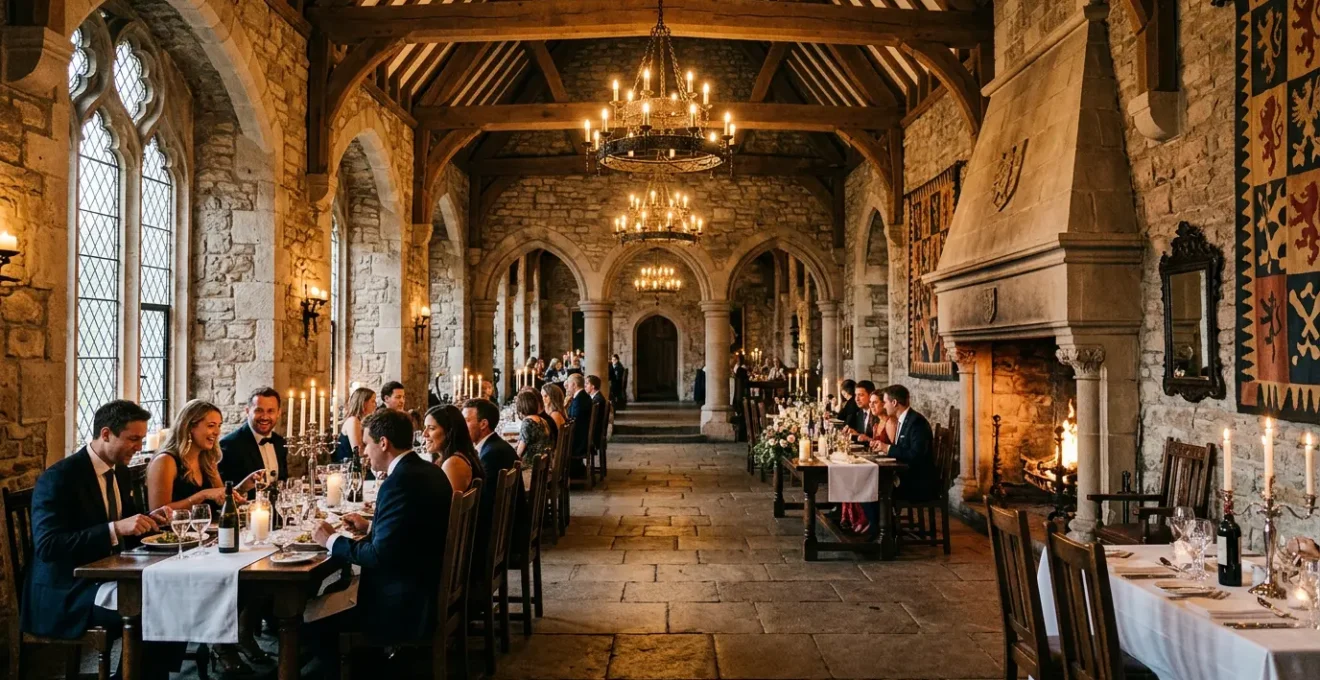
The ‘flaws’ of a castle hotel—drafts, noises, and lack of lifts—are not bugs; they are often features mandated by historical preservation laws.
- The guest experience is dictated by the building’s original function (military fortress vs. noble estate) and its legal protection status (e.g., Grade A Listed).
- Modern comforts like double-glazing and silent plumbing are frequently prohibited to maintain the structure’s authentic historical fabric.
Recommendation: Shift your mindset from a hotel guest expecting modern perfection to a temporary custodian of history to truly appreciate your stay.
The fantasy is potent: a weekend spent within ancient stone walls, dining in baronial halls, and sleeping in a four-poster bed where history was made. You book a castle hotel expecting a fairy tale, a seamless blend of historic grandeur and five-star luxury. Yet, the reality can be jarring for a guest accustomed to the flawless uniformity of modern hotels. The room is colder than expected, the floorboards creak with an unnerving personality, and the promised “en-suite” is a cleverly converted Tudor closet. You find yourself asking: is this luxury, or just old and inconvenient?
Most travel guides will offer generic advice about packing layers or simply “embracing the quirks.” They touch on the surface of the experience, treating these characteristics as charming eccentricities. But this perspective misses the fundamental point. These are not random flaws; they are tangible symptoms of a constant, delicate battle between preservation and modernization. As a heritage building surveyor, I see these buildings not as hotels, but as protected historical documents that happen to accommodate guests. Their “inconveniences” are the very evidence of their authenticity.
This guide reframes the castle hotel experience. Instead of viewing it through the lens of a consumer disappointed by a lack of modern amenities, we will explore it through the eyes of a surveyor. We will uncover the structural, legal, and operational reasons *why* your room is drafty, *why* the radiators clang in the night, and *why* you have to climb four flights of a spiral staircase. By understanding the “why” behind the “what,” you can transform potential frustration into a profound appreciation for the living history around you, moving beyond the Disney-fied expectation to connect with the authentic soul of the building.
This exploration will provide the context needed to truly appreciate your historic stay. We will delve into the practicalities of dress codes, the legal reasons behind accessibility challenges, and the truth behind those ghostly reputations, giving you the tools to manage expectations and choose the right castle for your historical immersion.
Summary: A Surveyor’s Field Guide to the Realities of Castle Hotels
- Do You Need a Jacket and Tie for Dinner in a Castle Hotel?
- The Lift Issue: Why Many Castle Hotels Are Not ADA Compliant?
- Are Haunted Room Requests Guaranteed or Just Marketing?
- How to Avoid Booking a Castle During an Exclusive Use Wedding?
- Why Radiators in Castles Make Noise at Night?
- Eilean Donan: Is It a Fake or a Faithful Restoration?
- Grade A Listed: Why Can’t Owners Change the Windows?
- Stirling vs Edinburgh: Which Castle Has Better Military History?
Do You Need a Jacket and Tie for Dinner in a Castle Hotel?
The question of dinner attire is often the first sign that a guest’s expectations are colliding with the hotel’s historic context. In a standard hotel, “smart casual” is a universally understood, relaxed code. In a castle, it can be a minefield of tradition. The requirement for a jacket and tie is not arbitrary snobbery; it’s a legacy of the building’s original purpose. Many of these dining rooms were designed for formal aristocratic entertaining, and the dress code is a deliberate attempt to preserve that atmosphere. It’s an integral part of the “performance” of staying in a castle, inviting guests to step into a more formal, historical role for the evening.
As a guest reviewer for Ashford Castle’s George V Dining Room noted, “Men are requested to wear a jacket, no jeans or trainers. Women on our visit were in smart dresses or tailored trousers.” This reflects a common standard in top-tier castle hotels, where the dining experience is a destination in itself. However, the level of formality is directly linked to the castle’s current incarnation—a five-star luxury property will have vastly different expectations from a family-run B&B in a smaller château.
Understanding this variance is key to avoiding a packing faux-pas. The castle’s classification—from a grand luxury hotel to a more rustic B&B—is the best indicator of its dining culture. A property designed for large-scale, high-end tourism will uphold stricter standards to maintain its luxury brand, while a smaller, family-operated establishment is likely to prioritize a welcoming, relaxed atmosphere over sartorial rules.
The following table provides a general framework for what to expect, but the golden rule is to always inquire directly before you travel. Terms like “smart elegant” can be ambiguous, and direct clarification is the only way to be certain.
| Castle Type | Typical Dinner Dress Code | What This Actually Means |
|---|---|---|
| Five-star luxury castle (e.g., Ashford, Dromoland) | Smart elegant/Jacket required | Men: Jacket and dress trousers essential, tie preferred Women: Cocktail dress or elegant separates |
| Boutique castle hotel | Smart casual | Men: Collared shirt and chinos acceptable Women: Nice blouse with dress pants or casual dress |
| Family-run château | Relaxed smart casual | Men: Neat polo shirt and dark jeans often fine Women: Casual dress or nice jeans with dressy top |
| Castle B&B | Come as you are | Comfortable travel clothes generally acceptable |
The Lift Issue: Why Many Castle Hotels Are Not ADA Compliant?
For many guests with mobility challenges, the absence of an elevator is the most significant and frustrating barrier in a castle hotel. It’s easy to perceive this as a failure of service, but from a surveyor’s perspective, it’s a direct consequence of a fundamental conflict: modern accessibility versus historical preservation. The very features that make a castle a fortress—thick stone walls, narrow spiral staircases, and complex, multi-level layouts—are an engineer’s nightmare when it comes to retrofitting a lift. Installing a modern lift shaft can require demolishing 5-foot thick, structurally-integral medieval walls, an act that would fundamentally damage the building’s historical integrity.
This is not just a matter of difficulty; it’s a matter of law. In the US, for example, accessibility guidelines contain specific provisions for historic properties. Properties listed on the National Register of Historic Places can use alternative accessibility methods when full compliance would “threaten or destroy” the building’s historic significance. Similar protections exist worldwide, such as the Listed Building Consent process in the UK. Owners are legally bound to prioritize the preservation of the historic fabric over achieving perfect modern accessibility. This means they cannot simply “put in a lift” if it compromises the building’s protected status.
This presents an immense challenge. The image below of a narrow stone spiral staircase perfectly illustrates the physical impossibility of installing an elevator without catastrophic damage to the original structure. The very architecture is a defense mechanism, designed to be difficult to traverse, and modern accessibility standards are often fundamentally incompatible with that design.
As a result, many castle hotels can only offer “partially accessible” rooms, often located in newer wings or on the ground floor. It is crucial for guests with mobility concerns to have a detailed conversation with the hotel before booking, specifying their exact needs. Do not rely on generic website descriptions. Ask for photos of the route to the room, inquire about the number of steps, and confirm the location of accessible facilities. Understanding these limitations is not about excusing the lack of access, but about recognizing the legal and structural constraints the property operates under.
Are Haunted Room Requests Guaranteed or Just Marketing?
The allure of a ghostly encounter is a powerful marketing tool for many castle hotels. Brochures and websites often hint at spectral residents, from a “Grey Lady” wandering the corridors to the phantom footsteps of a long-dead knight. For some guests, this is a highlight, and requesting the “most haunted room” is a key part of the experience. However, it’s important to approach these claims with a healthy dose of skepticism and understand the line between folklore and a building’s physical properties. From a surveyor’s standpoint, most “hauntings” can be attributed to the building’s authentic acoustic profile and material behavior.
An ancient building is a living, breathing entity. It settles, shifts, and responds to changes in temperature and humidity in ways a modern, sterile building does not. What a guest might interpret as a ghostly whisper could be the sound of wind whistling through a poorly sealed, single-pane window—a feature mandated by preservation laws. The “phantom footsteps” on the floor above could be the natural creak of centuries-old oak floorboards expanding and contracting as they cool overnight. These are not signs of the supernatural; they are audible proof of the building’s authentic, historic construction.
Hotels that lean into their haunted reputation often do so as a way to package and sell this natural ambiance. A genuinely “haunted” experience is, by its very nature, not something a hotel can schedule or guarantee. A hotel that promises a ghost is selling a story, not a verifiable event. To gauge the authenticity of the claim, a discerning guest should ask specific questions:
- What specific historical events or figures are associated with the ghostly claims? Vague stories are a red flag.
- Can you provide any documented history or accounts related to these stories?
- Are there specific rooms associated with these tales, and what have other guests reported?
A property that is serious about its history will have detailed answers. A property that is simply using it as a marketing gimmick will offer little more than spooky platitudes. Ultimately, the most “haunted” castles are simply the most well-preserved ones, where the sounds of the past have not been silenced by modern insulation and construction.
How to Avoid Booking a Castle During an Exclusive Use Wedding?
You’ve booked your romantic castle getaway, envisioning quiet evenings by a roaring fire and peaceful strolls through manicured grounds. You arrive to find the car park overflowing, the main hall draped in white bunting, and the bar commandeered by a boisterous wedding party. This is a common pitfall for castle hotel guests, as these properties are premier wedding venues. An “exclusive use” booking means the wedding party has rented the entire property, and while you may have a room, you are essentially a bystander at someone else’s celebration. Access to key facilities like the main restaurant, gardens, or swimming pool may be restricted.
Timing is a critical factor. The wedding industry has clear seasonal peaks, and castle venues are no exception. Data on venue booking patterns shows that most castle weddings occur on Saturdays between May and September. Booking a mid-week stay, especially outside of these months, significantly reduces your chances of clashing with a large event. This is also when you’re likely to find better rates and a more tranquil atmosphere, allowing the castle’s historic character to shine without the distraction of a party.
However, relying on seasonality alone is not enough. Proactive communication is the only guaranteed way to avoid disappointment. When booking, it is essential to move beyond the online booking portal and speak directly with the hotel’s reservation team. A simple “Is my stay likely to be affected by any private events?” is a good start, but more specific questions will yield clearer answers. Use the following as a guide:
- “Will the main restaurant, bar, and grounds be fully accessible to all hotel guests during our stay?”
- “Are there any celebrations scheduled that might include loud evening entertainment, music, or fireworks?”
- “Does the hotel have a separate, dedicated wedding website?” (These often reveal booked-out dates not visible on the main booking engine).
If you notice that a castle’s online availability is completely blocked for weekends but wide open from Sunday to Thursday, it’s a strong indicator that weekends are reserved for exclusive-use events. A little sleuthing can ensure your historic retreat remains the peaceful and exclusive experience you envisioned.
Why Radiators in Castles Make Noise at Night?
Of all the “quirks” of a castle stay, few are as consistently reported as the nocturnal noises emanating from the heating system. The clanking, hissing, and gurgling of old radiators can be alarming for a light sleeper accustomed to silent, modern HVAC systems. It’s easy to let one’s imagination run wild, attributing the sounds to the castle’s resident ghost. However, the reality is far more mundane and is rooted in the physics of early 20th-century engineering. These noises are not a sign of a fault or a haunting, but of a hydronic heating system operating exactly as designed.
Most castles were retrofitted with central heating long after their initial construction, often using hot-water or steam systems that were state-of-the-art in their day. These systems work by circulating heated water or steam through a network of iron or copper pipes to cast-iron radiators. The distinctive sounds are a natural byproduct of this process. The primary cause is thermal expansion. As hot water floods the cold metal pipes, the pipes expand, causing them to shift slightly and make ticking or clanking sounds as they rub against floor joists or wall brackets. As they cool, they contract, producing a different set of groans and pings.
Another common culprit is trapped air. Over time, air bubbles can accumulate in the high points of the pipework. When water flows past, it creates a gurgling or whooshing sound. Steam systems are even more prone to dramatic noises, with a characteristic “hammering” sound caused by steam rapidly condensing back into water inside the pipes. While a modern plumber can “bleed” a radiator to release some trapped air, the fundamental design of these sprawling, aging systems makes a certain level of noise inevitable. It is, in essence, the sound of the castle’s circulatory system at work. Instead of a flaw, it should be viewed as part of the building’s authentic, mechanical soundtrack.
Eilean Donan: Is It a Fake or a Faithful Restoration?
Eilean Donan Castle is one of Scotland’s most iconic and photographed landmarks. Its dramatic setting on a tidal island, connected by a stone bridge, perfectly matches the romantic ideal of a Highland fortress. However, for the guest seeking an authentic medieval experience, it’s crucial to understand what Eilean Donan truly is. The structure you see today is not a preserved medieval castle; it is an early 20th-century reconstruction. As a surveyor, I would classify it not as a restoration, but as a “romantic reincarnation.”
The original castle had a long and storied history but was largely destroyed in a Jacobite uprising in 1719. It then lay in ruins for almost two centuries. According to historical records, the rebuild was a massive undertaking, as the castle was destroyed in 1719 and rebuilt between 1912-1932—a gap of nearly 200 years. This is a critical distinction. A “restoration” aims to faithfully return a building to a specific, documented historical state. A “reconstruction” or “revival” often creates an idealized version of the past, blending historical elements with contemporary ideas of what a castle *should* look like.
Lt. Colonel John MacRae-Gilstrap, who bought the island and financed the project, based the design on surviving ground plans of the original castle. However, the final result was heavily influenced by the romantic castle revival movement popular at the time. This is why Wikipedia’s architectural assessment describes the modern building as “‘a romantic reincarnation in the tradition of early 20th-century castle revivals.'” It was designed to look and feel like an ancient castle, but with the sensibilities and construction techniques of the Edwardian era. For example, a concrete dome was included in the construction to support a flat-roofed section—a decidedly non-medieval feature hidden from view.
This does not diminish Eilean Donan’s beauty or historical importance, but it fundamentally changes the visitor’s experience. You are not walking through a building that has stood untouched since the Middle Ages. You are walking through a magnificent, early 20th-century interpretation of one. For the traveler managing expectations, this is a vital piece of information. Eilean Donan offers a stunning fairytale image, but for a truly authentic, preserved medieval structure, one might need to look elsewhere.
Key Takeaways
- Historical preservation laws, not hotel management, are the primary dictators of the guest experience in a listed castle.
- The most authentic castles are often the most “flawed” by modern standards; drafts, noise, and patchy Wi-Fi are signs of preserved historical fabric.
- Researching a castle’s original function (e.g., military fortress vs. noble estate) is the single best way to set accurate expectations for comfort and layout.
Grade A Listed: Why Can’t Owners Change the Windows?
Perhaps the most common complaint from guests during a winter stay in a UK castle is the drafty single-pane windows. It seems like a simple fix: replace them with modern, energy-efficient double-glazing. However, for a building with a “Grade A” or “Grade I” listed status, this “simple fix” is illegal. This designation is the highest level of protection, reserved for buildings of exceptional national or international importance. It means the owner is not a freeholder in the modern sense; they are a custodian, legally obligated to preserve the building’s historical and architectural character for the nation. This includes the original windows.
From a preservationist’s viewpoint, the windows are one of the most important “character-defining features” of a historic building. Their size, shape, the way the glass was made (often with slight imperfections), and the wooden or lead frames (the “fenestration”) are all a part of the building’s story. Replacing them with modern uPVC or even timber-framed double-glazing would irrevocably alter its appearance and authenticity. Consequently, any proposed alteration requires a formal “Listed Building Consent” application, which would almost certainly be denied for window replacement on a Grade A property. Owners must repair the original windows using period-appropriate materials and techniques, a vastly more expensive and less efficient solution than replacement.
The Economics of Preservation in Castle Hotels
Amberley Castle in the UK provides a stark example of the financial reality of operating a listed building. Any repair must utilize historically accurate materials and be performed by specialized craftsmen. A single stone mullioned window, for instance, cannot be replaced with a standard unit. The original stone may need to be repaired by a stonemason, and the leaded glass panes restored by a specialist. The cost for a single, complex window repair can easily run from £5,000 to £10,000. In contrast, a modern high-performance window might cost £500. It is estimated that these stringent preservation requirements can add 30-40% to the operational expenses of a listed castle hotel compared to a non-listed luxury hotel of a similar size. This cost is inevitably passed on to the guest in the room rate.
This legal straightjacket has a direct and tangible impact on the guest experience, extending far beyond just drafty windows. The restrictions on altering the building’s fabric mean that modern amenities are often compromises. This is why a guest in a highly protected castle must adjust their expectations.
Action Plan: What Listed Status Means for Your Stay
- Anticipate drafts: Windows will be single-paned and potentially drafty. Pack warm sleepwear, especially in winter, and don’t be shy about asking for extra blankets.
- Manage connectivity expectations: Wi-Fi may be patchy. Drilling through thick stone walls for modern cabling is often restricted, leading to weak signals in certain rooms.
- Plan for power: Power outlets may be limited and inconveniently placed to avoid chasing new channels into historic plaster. Bring a multi-socket power strip.
- Accept bathroom quirks: Bathrooms are often retrofitted into spaces not originally designed for plumbing, such as former dressing rooms or closets, which can result in unusual layouts.
- Embrace temperature variance: Original heating systems must be preserved where possible. This can lead to rooms that are difficult to heat evenly, with noticeable hot and cold spots.
Stirling vs Edinburgh: Which Castle Has Better Military History?
When choosing between two of Scotland’s most famous castles, Stirling and Edinburgh, the question of which has the “better” military history is complex. Both are formidable fortresses with centuries of conflict etched into their stones. However, they represent different facets of Scottish military and royal history, and this difference in their original function has a profound impact on their layout, atmosphere, and the story they tell today. Understanding this distinction is a perfect analogy for choosing a castle hotel: the building’s original purpose is the best predictor of the modern guest experience.
Edinburgh Castle evolved into a powerful symbol of royal authority and a national administrative center. While it was undeniably a military stronghold, it was also a royal residence, a treasury, and home to the national records. Its layout reflects this duality, with the opulent Royal Palace and the Great Hall standing alongside military barracks and the famous Mons Meg cannon. It feels like a fortified city, a center of power designed for governance as much as for defense.
Stirling Castle, by contrast, is often considered more of a pure military fortress, the strategic “Key to Scotland.” Its location, controlling the lowest bridging point of the River Forth, made it the most important strategic prize in the country. Its history is dominated by sieges and battles, from William Wallace to Bonnie Prince Charlie. While it also boasts a magnificent Royal Palace (one of the finest Renaissance buildings in the UK), its overall feel is more rugged and tactical. The layout is dictated by defense-in-depth, with layers of walls and gun batteries that speak directly to its role as a military machine.
This same principle of “function dictates form” applies directly to castle hotels. A castle built primarily as a military fortress will have a very different character from one designed as a nobleman’s country estate. The former will likely feature smaller rooms (originally for soldiers), narrow corridors, and small windows, while the latter will have grand halls, spacious suites, and large windows designed for light and views.
| Historical Function | Modern Layout Impact | Typical Room Features | Best For Travelers Who… |
|---|---|---|---|
| Military Fortress | Narrow corridors, small windows, thick walls | Compact rooms, limited natural light, authentic atmosphere | Value history over luxury comfort |
| Noble’s Country Estate | Grand halls, spacious rooms, ornate details | Large suites, high ceilings, period furniture | Seek luxury and elegance |
| Royal Court | State rooms, formal gardens, ceremonial spaces | Museum-like common areas, formal atmosphere | Enjoy pageantry and grandeur |
| Romantic Victorian Revival | Fantasy elements, comfort-focused design | Modern amenities in Gothic packaging | Want Instagram-worthy stays |
Frequently Asked Questions About Staying in a Castle
Why do castle radiators make clanking sounds at night?
Old hot-water and steam heating systems make noise due to thermal expansion of metal pipes and trapped air bubbles. As the system heats and cools, metal expands and contracts, creating distinctive clanking sounds.
Are the strange sounds I hear supernatural or structural?
Most ‘haunted’ phenomena are part of the castle’s natural acoustic profile: wind through ancient eaves creates moaning sounds, old floorboards creak with temperature changes, and stone walls conduct sound in unexpected ways.
Can I request a quieter room if I’m a light sleeper?
Yes, ask for rooms away from the main heating system or in modern annexes. Ground floor rooms typically have less pipe noise than upper floors where main heating pipes run through walls.