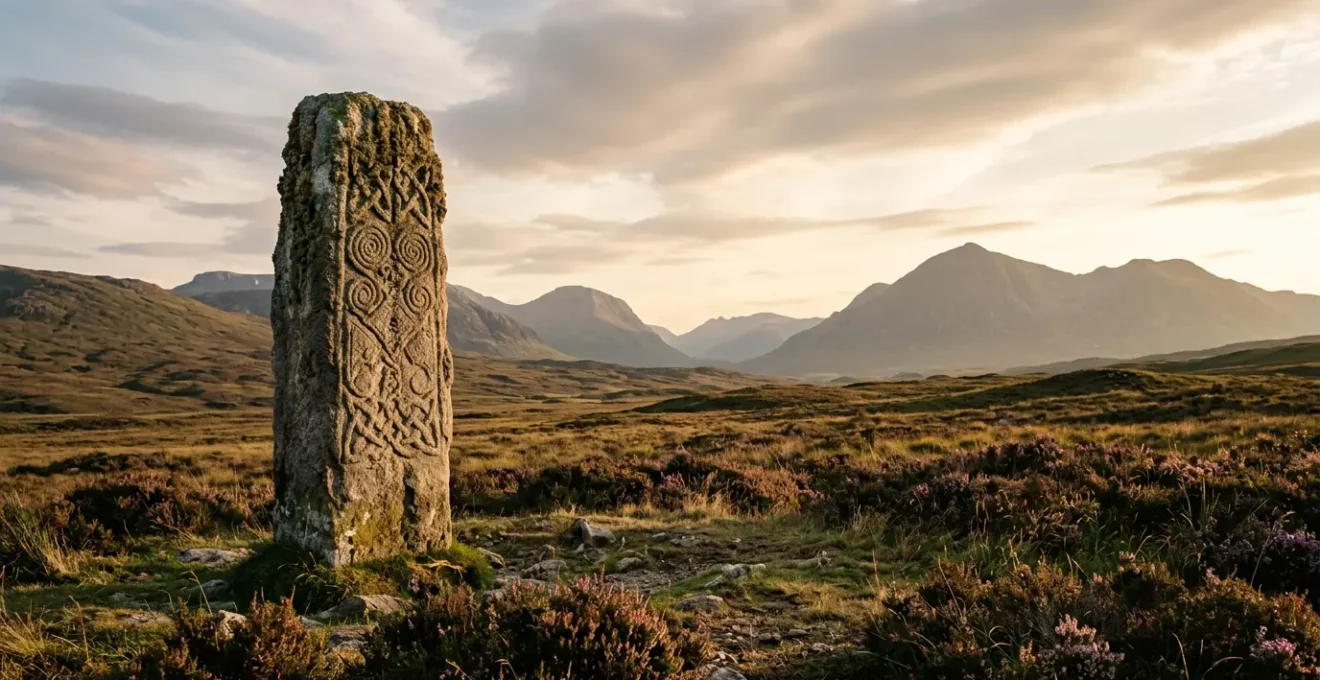
Celtic knots are far more than pretty patterns; they are a visual language expressing the profound interconnectedness that defines Scottish culture.
- Their endless lines symbolize continuity, linking the ancient past to living traditions.
- Each interwoven strand reflects the fabric of community, from music to craftsmanship.
Recommendation: Choose a design not just for its beauty, but for the piece of the Scottish soul it represents.
When you hold a piece of jewelry adorned with a Celtic knot, a fundamental question arises: is this merely an attractive, intricate design, or does it hold a deeper significance? Many will offer simple answers, attributing specific meanings to each pattern—love, faith, or eternity. While not entirely incorrect, these definitions barely scratch the surface. They present the knots as a static dictionary of symbols, when in truth, they are part of a vibrant, living tradition. The real meaning of these ancient designs is not found in a simple chart, but is woven into the very fabric of Scottish life itself.
To truly understand them, one must look beyond the object and see the principles they embody. The continuous, looping lines speak to a philosophy of interconnectedness and continuity that is not a relic of the past but a dynamic force in contemporary Scotland. The mistake is to seek a single, fixed meaning for a knot. The deeper truth is that the knot is a metaphor for the culture itself—a complex, beautiful, and unbroken thread connecting past and present, art and life, people and landscape. This guide will not just define the symbols; it will show you where their spirit lives on, revealing how the principles of Celtic knotwork are expressed in everything from ancient stone circles to modern art.
To unravel this intricate tapestry, this article explores the various threads of Scottish culture where the philosophy of the Celtic knot is made tangible. The following sections will guide you through this journey of discovery.
Summary: Celtic Knots and the Interwoven Fabric of Scottish Culture
- Beyond Stonehenge: Where are the Druidic Circles in Scotland?
- Celtic Connections: How to Get Tickets for the Best Gigs?
- The Seanachaidh: Where to Hear Traditional Oral Storytelling?
- Harris Tweed: Why Must It Be Woven at Home to be Authentic?
- Where to Find the Real Locations Behind Scottish Faerie Folklore?
- Scots vs Gaelic: What is the Difference in Dialect?
- Where to See Rennie Mackintosh Designs in Glasgow?
- Blackhouse vs Whitehouse: How Highland Housing Evolved?
Beyond Stonehenge: Where are the Druidic Circles in Scotland?
The allure of Scotland’s ancient past is powerful; indeed, recent tourism data shows Scotland welcomed 4.4 million international visitors in 2024, many drawn to its enigmatic stone circles. While Stonehenge often dominates the conversation, Scotland is home to some of the most profound Neolithic sites on Earth. Places like the Callanish Standing Stones on the Isle of Lewis are not merely rocks; they are monuments to a worldview deeply connected to natural cycles. Archaeologists believe they were used for astronomical observation and religious ceremonies, mapping the movements of the sun and moon. This act of charting celestial paths mirrors the very essence of a Celtic knot.
The endless loops of a knot can be seen as a representation of these same cycles: the rising and setting of the sun, the turning of the seasons, and the larger cycles of life, death, and rebirth. The stone circles are, in a sense, colossal, earthbound knots. They physically anchor humanity within the cosmos, making tangible the interconnectedness between people and the universe. As you stand within one of these circles, you’re not just viewing an ancient relic; you are stepping inside a worldview where everything is part of a continuous, interwoven pattern. The purpose may be shrouded in myth, but the principle of continuity is clear.
Celtic Connections: How to Get Tickets for the Best Gigs?
The interwoven principle of Celtic knots finds one of its most vibrant, audible expressions in traditional Scottish music. A folk session is not a series of solo performances but a living, breathing collaboration where melodies twist, turn, and loop around each other. The fiddle, pipes, and guitar are not just playing in unison; their parts are intertwined, creating a complex sonic tapestry that is much greater than the sum of its parts. This is the Celtic knot made manifest in music, a perfect example of its philosophy as a living tradition.
Nowhere is this more evident than at Celtic Connections, Glasgow’s world-renowned winter music festival. Here, hundreds of events showcase this collaborative spirit. Securing tickets for the most popular shows requires some planning. For example, the Transatlantic Sessions are always one of the fastest to sell out, so booking early is essential. The festival spans around 25 venues, so exploring the full programme is wise. Tickets generally range from £16 to £29, and a new pass for under-26s offers rolling discounts, making this cultural immersion accessible. Attending this festival is to experience the ‘interwoven fabric’ of Celtic culture in real time.
The Seanachaidh: Where to Hear Traditional Oral Storytelling?
Before history was widely written, it was spoken. The *seanachaidh*, or traditional storyteller, was the keeper of a clan’s genealogy, myths, and legends. They were the living library of a community, and their art was a masterful act of weaving threads of narrative into a cohesive whole. This practice is intrinsically linked to the symbolism of Celtic knots. As the experts at Real Irish note in their analysis of the tradition:
The intricate designs of Celtic knots are often said to represent the endless cycle of life, death, and rebirth, as well as the interconnectedness of all things in the natural world.
– Real Irish, Unseen Ties That Bind Us: The History Of Celtic Knots
This concept of an endless, interconnected cycle was the very structure of oral storytelling. Stories did not have simple, linear endings but folded back on themselves, linking heroes of the past to the present-day listeners. Celtic knots may have even served as mnemonic devices for the seanachaidh. The unending path of a knot, with its twists and turns, could represent the complex plot of a hero’s journey or the intertwined lineages of a great family. The symbol and the story were one and the same, a visual language for an oral culture. Though dedicated storytellers are rarer today, their spirit lives on at folk festivals and cultural centres across Scotland.
Harris Tweed: Why Must It Be Woven at Home to be Authentic?
The Celtic knot is a masterclass in structure, where every thread is vital to the integrity of the whole. This principle finds a literal, tangible expression in one of Scotland’s most iconic crafts: Harris Tweed. By law, to be authentic, Harris Tweed must be hand-woven by islanders in their homes in the Outer Hebrides of Scotland. This is not arbitrary; it is a legal protection of a cultural knot, binding the fabric to the people and the place. The weaving process itself is a direct parallel to knotwork, with the warp and weft threads interlacing to create a strong, beautiful, and unified textile.
This commitment to authenticity does more than preserve a tradition; it sustains the community. In a country where tourism now supports more than 220,000 Scottish jobs, with a significant portion in rural areas, authentic cultural products like Harris Tweed are vital. The income generated from such heritage crafts helps keep these communities alive, funding local services and preserving a way of life. When you buy Harris Tweed, you are not just purchasing cloth. You are investing in the interwoven fabric of a community, supporting a system where craft, identity, and economy are inextricably linked, just like the threads in a Celtic knot.
Where to Find the Real Locations Behind Scottish Faerie Folklore?
Scottish folklore is rich with tales of the *Sìth* (or Sidhe), the faerie folk, who inhabit a world that exists parallel to our own, hidden behind a veil. These stories are not just children’s fables; they are expressions of a deep connection to the landscape and a belief in a reality beyond the visible. Celtic knots, with their endless, overlapping lines, provide the perfect symbol for this liminal world. The continuous path of the knot, which has no beginning and no end, evokes the timeless, cyclical nature of the faerie realm. Some knot patterns are ancient, with one scholar noting a particular design is one of the oldest Celtic knots, and has been dated back to stone age carvings, linking them to the same deep past from which folklore emerges.
This connection between the land and the legend is not merely abstract; it is rooted in specific, powerful places across Scotland. These locations often feature the same kind of ancient megalithic structures we’ve already discussed, creating a dense web of meaning. Exploring them is to trace the patterns of the nation’s mystical imagination.
Action Plan: Tracing Faerie Folklore in the Landscape
- Visit Callanish Standing Stones: Local legends tell that these stones were once giants who were petrified for refusing to convert to Christianity, forever binding them to the land.
- Explore Kilmartin Glen: This area has one of Britain’s most significant concentrations of Neolithic and Bronze Age monuments, with over 800 ancient sites where the veil between worlds feels thin.
- Experience the Clava Cairns: These 4,000-year-old passage graves near Inverness are shrouded in sacred significance and are believed by some to be portals or places of power.
- Visit at Optimal Times: To feel the full atmosphere of these sites, visit at sunrise or sunset, when long shadows create an ethereal, otherworldly light.
By visiting these sites, you are walking through the physical inspiration for the stories and symbols that define Scotland’s soul.
Scots vs Gaelic: What is the Difference in Dialect?
Language is the ultimate interwoven fabric of a culture, a living tapestry of words and meanings passed down through generations. In Scotland, this tapestry is particularly rich, composed of several distinct yet related threads, primarily English, Scots, and Scottish Gaelic. While often confused, Scots and Gaelic are entirely different languages. Gaelic is a Celtic language, part of the Goidelic branch alongside Irish and Manx. Scots is a Germanic language that evolved from a northern dialect of Old English. They are as different as Spanish is from German. Yet, both are essential threads in the national identity.
This relationship between distinct but related Celtic languages is reflected in the terminology for Celtic knots themselves, showing both shared heritage and unique identity. The ancient illuminated manuscripts, like the famous Book of Kells, are where this connection between language and art is most profound. The pages are filled with intricate knotwork, a visual language that complements the written text.
| Language | Term for Celtic Knot | Cultural Context |
|---|---|---|
| Irish | snaidhm Cheilteach | Traditional Gaelic term |
| Scottish Gaelic | snaidhm Ceilteach | Highland usage |
| Welsh | cwlwm Celtaidd | Welsh Celtic tradition |
| Cornish | kolm Keltek | Cornwall heritage |
Just as these languages share roots but have their own distinct patterns and sounds, different Celtic knots share a common design philosophy but manifest in countless unique forms. The diversity within a shared tradition is a core Celtic principle.
Key Takeaways
- Celtic knots are more than symbols; they are a metaphor for the interconnectedness and continuity of Scottish culture.
- This “interwoven” philosophy is visible in tangible traditions like music, storytelling, and craftsmanship.
- The meaning of a knot is not static but is a living principle that continues to evolve and find expression in modern Scotland.
Where to See Rennie Mackintosh Designs in Glasgow?
At first glance, the sleek, modernist lines of Charles Rennie Mackintosh might seem a world away from ancient Celtic knots. Yet, as a scholar of art, I argue that Mackintosh was a modern-day *seanachaidh*, translating the core principles of Celtic art into a new visual language for the 20th century. His work is a prime example of the principle of continuity, where ancient ideas are not discarded but re-formed. Look closely at his designs: the elongated, elegant curves, the use of stylized natural forms like the “Glasgow Rose,” and the way his lines flow and intertwine in furniture and architecture. This is Celtic knotwork, abstracted and refined.
Mackintosh’s genius was rooted in Glasgow, a city that continues to be a crucible of culture. It is a designated UNESCO City of Music, and its world-famous Celtic Connections festival attracts around 110,000 visitors and an estimated 1,200 musicians and artists. In this environment, where tradition is constantly being performed and reinvented, Mackintosh’s work feels perfectly at home. To see his designs at the Willow Tea Rooms or Scotland Street School is to witness the enduring thread of Celtic design philosophy being woven into the modern urban landscape. He demonstrates that the spirit of the knot is not confined to the past but is an adaptable, living force.
Blackhouse vs Whitehouse: How Highland Housing Evolved?
The evolution of housing in the Scottish Highlands from the traditional “blackhouse” to the more modern “whitehouse” is a story about more than just architecture; it is a story about the changing shape of the community. The traditional blackhouse was, in many ways, a social knot made physical. Built low to the ground with thick stone walls and a central hearth, it was a single, long structure where both people and animals lived under one roof. Life was communal, intertwined, and centered around the warmth of the fire. The home was a hub of interconnectedness, mirroring the unified structure of a Celtic knot.
The arrival of the “whitehouse” in the 19th century marked a significant change. With separate rooms, chimneys, and larger windows, it reflected a shift towards a more individualized way of life, influenced by external ideas of sanitation and privacy. However, to see this as a complete break from the past is to misunderstand the resilience of the culture. While the physical structure changed, the deep-rooted ties of community, kinship, and connection to the land persisted. The pattern of the knot was altered, but the thread remained unbroken. This evolution shows that Scottish culture, like the lines of a Celtic knot, is capable of adapting and changing its form without losing its essential continuity.
So when you choose a piece of Celtic jewelry, you are not just acquiring an object of beauty. You are holding a piece of this living history, a tangible symbol of an enduring philosophy. The next step is to explore these symbols not as a dictionary of meanings, but as an invitation to connect with the deep, interwoven soul of Scotland.
Frequently Asked Questions about Celtic Knots: What Do the Symbols Actually Mean?
How did Celtic knots serve as memory aids for storytellers?
With no beginning and no end, the continuous lines of Celtic knots represent unity and the eternal cycle of life, death, and rebirth. For a storyteller, this structure could mirror the complex, looping narratives of myths and genealogies, with the knot’s path acting as a map for the tale.
Which knot patterns were most commonly used in storytelling traditions?
The Triquetra, or Trinity Knot, is one of the most well-known patterns. Its three-cornered shape has been interpreted in many ways, from the Christian Holy Trinity to the Pagan concept of the three stages of life (maiden, mother, crone) and the three realms of the earth: land, sea, and sky. Its simple yet profound structure made it a powerful symbolic anchor for a wide range of stories.
Where can travelers experience authentic Scottish storytelling today?
While dedicated seanachaidhs are rare, the tradition of storytelling is alive and well within the folk music scene. Festivals like Celtic Connections, which showcases traditional arts in up to 30 venues across Glasgow, are excellent places to hear stories told through song and spoken word, continuing the ancient oral tradition in a modern context.