Braveheart gets one thing right: William Wallace’s story is epic. The film, however, is almost entirely fiction, and the real history is far more fascinating.
- The truth isn’t in simple fact-checking lists, but in the tangible evidence found across Scotland’s medieval landscape.
- Authentic understanding comes from strategic travel: using the right pass, asking guides probing questions, and examining the real weapons and architecture of the era.
Recommendation: Use this guide to transform a simple holiday into a journey of historical immersion, trading Hollywood fantasy for the profound and atmospheric reality of 13th-century Scotland.
The thunder of hooves, the stirring speeches, the impossible romance—Mel Gibson’s Braveheart is a cinematic tour de force that seared a specific image of William Wallace into the global consciousness. It is a passionate, powerful film. It is also, from a historical perspective, a work of profound fiction. For the history buff, the first impulse upon discovering this is often to create a checklist of inaccuracies: the kilts, the blue face paint, the non-existent tradition of primae noctis, the phantom affair with an English princess he never met. While satisfying, this fact-checking exercise barely scratches the surface.
To simply debunk the film is to miss the point entirely. The true challenge, and the far greater reward, lies not in listing what is false, but in actively seeking what is true. And that truth is not found in books alone. It is etched into the cold stones of Scottish castles, it whispers in the wind across lonely battlefields, and it rests in the weight of a real 14th-century sword. The real history of William Wallace is an experience, a journey of historical immersion that can, and should, replace the Hollywood myth with something far more compelling.
This is not a guide to what Braveheart got wrong. This is a historian’s guide to getting it right. We will explore the practical tools for your quest, like the best heritage passes, learn how to read a battlefield beyond the movie’s tactics, discover how to turn a museum visit into a forensic investigation, and understand why the when and where of your visit can be the difference between tourism and time travel.
This article provides a complete itinerary for the discerning historical traveler. Below, you will find a summary of the key steps to uncovering the authentic story of Scotland’s most famous hero, from practical planning to deep historical engagement.
Summary: Braveheart vs Reality: A Guide to the True History of William Wallace
- Explorer Pass or Heritage Pass: Which Covers More Educational Sites?
- Horrible Histories: Where to Find Gore and Battles to Interest Kids?
- Audio Guide vs Human Guide: Which is Better for Deep Learning?
- Best Museums in Glasgow for When It Pours?
- Culloden Battlefield: Why You Should Not Take Selfies on the Graves?
- Viking vs Jacobite History: Which Itinerary Suits Your Family Best?
- The Bottle Dungeon: What Was It Really Used For?
- Why Visit Scotland’s Lesser-Known Heritage Sites During Off-Peak Seasons?
Explorer Pass or Heritage Pass: Which Covers More Educational Sites?
Your first step in planning a journey of historical immersion is securing the key to the kingdom’s past. For years, travelers debated the merits of the Explorer Pass versus the Scottish Heritage Pass. As a historian, allow me to simplify your decision: the choice has been made for you. The comprehensive Scottish Heritage Pass, which once covered a vast array of properties, has been discontinued. Your primary tool for this expedition is now the Historic Scotland Explorer Pass.
This is no downgrade. An analysis of its coverage shows the Explorer Pass provides access to 78 historic sites across Scotland, including the most crucial locations tied to the Wars of Scottish Independence. It is less about the quantity of sites and more about the quality of the itinerary you build. The pass is not a mere ticket; it is a curated map to the medieval world. To get the most educational value, you must use it not as a tourist, but as a detective following Wallace’s trail.
The table below clarifies the situation, highlighting why focusing your efforts on a strategic Explorer Pass itinerary is the most effective approach for any visitor today.
| Feature | Explorer Pass | Heritage Pass (Discontinued) |
|---|---|---|
| Number of Sites | 78 Historic Scotland sites | 120+ sites (HES, NTS, Historic Houses) |
| Duration | 14 consecutive days | Various options |
| Key Medieval Sites | Edinburgh, Stirling, Doune Castle | All HES plus private estates |
| Price Range | £40-60 | No longer available |
Using this pass effectively means planning a narrative. Start at Stirling Castle to understand the strategic importance of the region where Wallace won his greatest victory. Visit Doune and Dirleton Castles to see authentic 14th-century fortress architecture, unspoiled by later additions. Conclude at Edinburgh Castle to see how the legend has been packaged and presented, allowing you to critically compare it with the atmospheric authenticity you’ve experienced elsewhere.
Horrible Histories: Where to Find Gore and Battles to Interest Kids?
Braveheart thrives on its visceral, and largely inaccurate, depiction of medieval battle. The film presents chaotic, head-on cavalry charges against infantry, a tactic that would have been suicidal and was rarely employed as shown. To engage a younger audience, or indeed any of us captivated by the film’s action, the goal is not to find “gore,” but to uncover the brutal, intelligent, and often terrifying reality of medieval warfare. This is where material culture and interactive exhibits become your best teaching tools.
Instead of imagining wild charges, visit a museum and stand before an authentic suit of armor or a real claymore. Notice the weight, the craftsmanship, and the evidence of repair. These are not props; they are documents of survival and violence. They tell a truer story of combat than any film sequence. The real weapons were often smaller and more practical than their Hollywood counterparts, designed for specific functions in formations, not for individual heroics.
Case Study: The Battle of Bannockburn Centre
To truly understand the difference between film fantasy and battlefield reality, a visit to the Battle of Bannockburn Centre is essential. While this battle belongs to Robert the Bruce, its principles are a direct refutation of Braveheart‘s tactics. The centre’s 3D battle simulator allows visitors to command armies and test the strategies of the era. Here, you quickly learn why the Scottish schiltron—a tight formation of soldiers with long pikes—was so devastatingly effective against the English cavalry. You don’t just learn that the movie is wrong; you experience *why* it is wrong, gaining a deep and lasting appreciation for medieval military genius.
This approach transforms a fascination with “gore” into a genuine interest in history, strategy, and the harsh realities faced by soldiers of the time. It is an education in physics and fear, far more memorable than any movie scene.
Audio Guide vs Human Guide: Which is Better for Deep Learning?
At a historic site, the temptation is to plug in an audio guide. It offers a neat, pre-packaged narrative. However, in the context of deprogramming from a film as pervasive as Braveheart, the audio guide is insufficient. It tells you what you are looking at, but rarely has the flexibility to tell you what you are *not* looking at—the myths, the misconceptions, the cinematic ghosts that populate the site in the minds of most visitors. For deep learning, a human guide is an indispensable resource. They are not just narrators; they are scholars, storytellers, and, most importantly, myth busters on the front line.
The sheer scale of the film’s inaccuracies is why a dialog is necessary. As medieval historian Sharon Krossa famously summarized when reviewing the film, the fiction is not trivial, it is total:
The events aren’t accurate, the dates aren’t accurate, the characters aren’t accurate, the names aren’t accurate, the clothes aren’t accurate—in short, just about nothing is accurate.
– Sharon Krossa, Medieval historian’s critique of Braveheart
A good guide is aware of this context. They have answered the same movie-inspired questions a thousand times and can preemptively address the fictions while highlighting the subtle, more interesting truths. Your role as a historical detective is to empower them to do so. Instead of passively listening, you should come prepared with strategic questions. This turns a one-way lecture into a two-way tutorial.
Your Checklist: Strategic Questions to Ask Human Guides About Wallace
- Ask: ‘What’s the biggest misconception about Wallace that visitors have from Braveheart?’
- Question: ‘How has the film changed the way you explain this site to visitors?’
- Inquire: ‘What evidence exists here that contradicts the Hollywood version?’
- Challenge: ‘If Wallace stood here today, what would surprise him about his own legend?’
- Request: ‘Can you point out architectural features that date specifically to the 1290s?’
By asking these questions, you signal that you are ready for a deeper level of engagement. You are not just a tourist; you are a student, and most guides will rise to the occasion with enthusiasm, sharing anecdotes and details reserved for those who truly want to learn.
Best Museums in Glasgow for When It Pours?
While Glasgow may not be the epicenter of William Wallace’s life, it serves as a vital repository of the material culture of his era. And on a typically rainy Scottish day, the city’s museums offer the perfect sanctuary for the history buff. The goal here is a forensic examination of the physical evidence of the period. While other cities have the castles, Glasgow has the artifacts that populate them, offering a reality check to Hollywood’s vision.
The premier destination is the Kelvingrove Art Gallery and Museum. Its collection of arms and armor is world-class and provides a direct, tangible connection to the realities of 13th and 14th-century combat. This is where you can stand inches away from the genuine articles and see the truth for yourself. This deep historical context is unsurprising, given that the city’s intellectual heart, the University of Glasgow, established just 146 years after Wallace’s death in 1451, has been a center for this kind of scholarship for centuries.
Case Study: Kelvingrove’s Arms & Armour Collection Reality Check
At Kelvingrove, you can directly compare the Hollywood prop with historical fact. The massive two-handed sword wielded by Mel Gibson is a fantasy. The collection reveals that the actual claymores of the period were smaller, lighter, and more agile. More profoundly, the collection does not shy away from the era’s accepted brutality. It houses a two-handed sword whose handle, according to legend, was covered with the dried and tanned skin of Hugh de Cressingham, the hated English treasurer slain by Wallace’s forces at the Battle of Stirling Bridge. Whether the legend is true or not, its existence tells us more about the psychological climate of the war than any fictional narrative could.
A rainy day in Glasgow, therefore, is not a setback to your historical quest; it is an opportunity. It is a chance to move from the macro-view of castles and battlefields to the micro-view of the very objects that shaped lives and decided fates. It is an essential part of a well-rounded historical investigation.
Culloden Battlefield: Why You Should Not Take Selfies on the Graves?
A visit to Culloden Battlefield is a sobering and essential detour for anyone interested in Scotland’s long fight for independence. Though this 1746 battle concludes the Jacobite story, more than 400 years after Wallace, it serves as a powerful lesson in historical empathy and the appropriate way to engage with sites of tragedy. The fundamental error many visitors make, often influenced by romanticized media like Outlander, is to treat the battlefield as a dramatic backdrop—a film set for a selfie.
This is a profound misunderstanding of the place. Culloden Moor is not a park. It is a mass grave. The small, weathered clan stones that dot the landscape are not decorations; they are grave markers indicating where hundreds of men fell and were buried in vast, desperate trenches. To pose smilingly on this ground is to dance on a tomb. The quiet, often misty atmosphere of the moor itself seems to demand a certain reverence, a solemnity that is the antithesis of a casual photo opportunity.
The lesson of Culloden is directly applicable to our quest for William Wallace. Sites like Stirling Bridge or the fields of Falkirk are also sacred ground where thousands fought and died. They demand the same respect. The impulse to treat history as entertainment, heavily amplified by films like Braveheart, can have damaging real-world consequences, trivializing tragedy and sometimes even fueling modern animosity.
The Braveheart phenomenon, a Hollywood-inspired rise in Scottish nationalism, has been linked to a rise in anti-English prejudice
– Ian Burrell, The Independent
As a historical traveler, our role is to be a witness, not a performer. We are there to listen to the silence of these places, to try and comprehend the scale of the human cost, and to carry that understanding with us. This is the deepest form of historical immersion—an emotional and ethical connection to the past.
Viking vs Jacobite History: Which Itinerary Suits Your Family Best?
To truly understand the significance of William Wallace, one must place his struggle within the broader narrative of Scotland’s identity. He was not the beginning nor the end of the story. For families or individuals planning an extended historical tour, a fascinating choice emerges: to follow the Jacobite trail, which represents the final, tragic crescendo of the independence saga Wallace began, or to trace the even older Viking influence that shaped Scotland’s rugged coastal character. Each offers a different lens through which to view the nation’s history.
The Jacobite Trail, winding through the Highlands to its finale at Culloden, is a story of grand, romantic failure, of clan warfare, and of a direct political struggle against the crown. The Viking Trail, concentrated in the northern isles of Orkney and Shetland, is a much older tale of seafaring, settlement, and the creation of a distinct Norse-Gaelic culture that long resisted assimilation by the Scottish mainland. The choice of itinerary depends entirely on the kind of historical narrative you find most compelling, as the following comparison shows.
| Aspect | Viking Trail (Orkney/Shetland) | Jacobite Trail (Highlands) |
|---|---|---|
| Historical Period | 8th-11th century foundations | 17th-18th century finale |
| Travel Style | Ferries and coastal routes | Land-based through glens |
| Key Sites | Jarlshof, Skara Brae | Culloden, Fort George |
| Wallace Connection | Shaped independent coastal culture | Culmination of independence struggle |
| Best For Families | Archaeological exploration | Dramatic historical narrative |
Crucially, the method of travel on these itineraries becomes a history lesson in itself. A family taking ferries between the Orkney islands viscerally understands the maritime nature of Viking life. Similarly, a family driving through the winding, rugged glens of the Highlands can appreciate the challenges of communication and the logic of guerrilla warfare that defined the Jacobite and earlier rebellions. The landscape becomes a character in the story, teaching lessons that a museum exhibit alone cannot.
Key Takeaways
- The most authentic history of William Wallace is experienced not through film, but through the tangible, atmospheric reality of Scotland’s castles, battlefields, and artifacts.
- A human guide is an invaluable tool for deep learning; use strategic questions to move beyond surface-level facts and debunk cinematic myths directly at the source.
- For the truest historical immersion, visit lesser-known heritage sites during the off-season to experience the cold, quiet, and profound authenticity of the medieval world without the crowds.
The Bottle Dungeon: What Was It Really Used For?
Hollywood’s portrayal of medieval cruelty is often straightforward and brutal. The reality, however, was frequently more sophisticated and psychologically terrifying. No place in Scotland embodies this more chillingly than the Bottle Dungeon at St Andrews Castle. It is a masterpiece of psychological torture, and understanding its function provides a stark contrast to the public, political nature of Wallace’s own gruesome end.
The Bottle Dungeon is not merely a pit in the ground. Hewn from solid rock, it is 24 feet deep with a narrow opening at the top and a base that widens out, creating its “bottle” shape. This design was not accidental; it was engineered for maximum suffering. The shape and rock walls created near-total sensory deprivation and amplified every sound, distorting them into a cacophony of madness. Prisoners could neither stand fully upright nor lie down comfortably on the curved, damp floor. It was a place designed not just to hold a person, but to systematically dismantle their mind.
Case Study: The Psychology of Medieval Punishment
The use of the Bottle Dungeon was reserved for high-status political and religious prisoners, individuals for whom a public execution might create martyrs. It was a form of private, psychological destruction. This stands in sharp contrast to the fate of William Wallace, who was subjected to a highly public and ritualistic execution by hanging, drawing, and quartering on 23 August 1305. Wallace’s death was pure political theatre, a brutal message sent by the English crown to the people of Scotland. The Bottle Dungeon was the opposite: a silent, hidden horror. Understanding this distinction is to understand the different tools of power in the medieval world: public spectacle versus private annihilation.
Visiting the Bottle Dungeon today, peering down into its dark, narrow maw, is one of the most powerful moments of historical immersion available in Scotland. It connects you to the period’s ingenuity and its profound capacity for calculated cruelty, a truth far more disturbing than any fictional battle scene.
Why Visit Scotland’s Lesser-Known Heritage Sites During Off-Peak Seasons?
We arrive at the final, and perhaps most crucial, piece of advice for the seeker of historical truth. The greatest barrier to authentic experience at famous sites like Edinburgh or Stirling Castle is often the very phenomenon Braveheart helped create: the crowd. The sheer volume of visitors can turn a solemn fortress into a bustling theme park, making true connection with the past all but impossible. The solution is twofold: seek out the lesser-known sites, and visit during the quiet, atmospheric off-peak seasons.
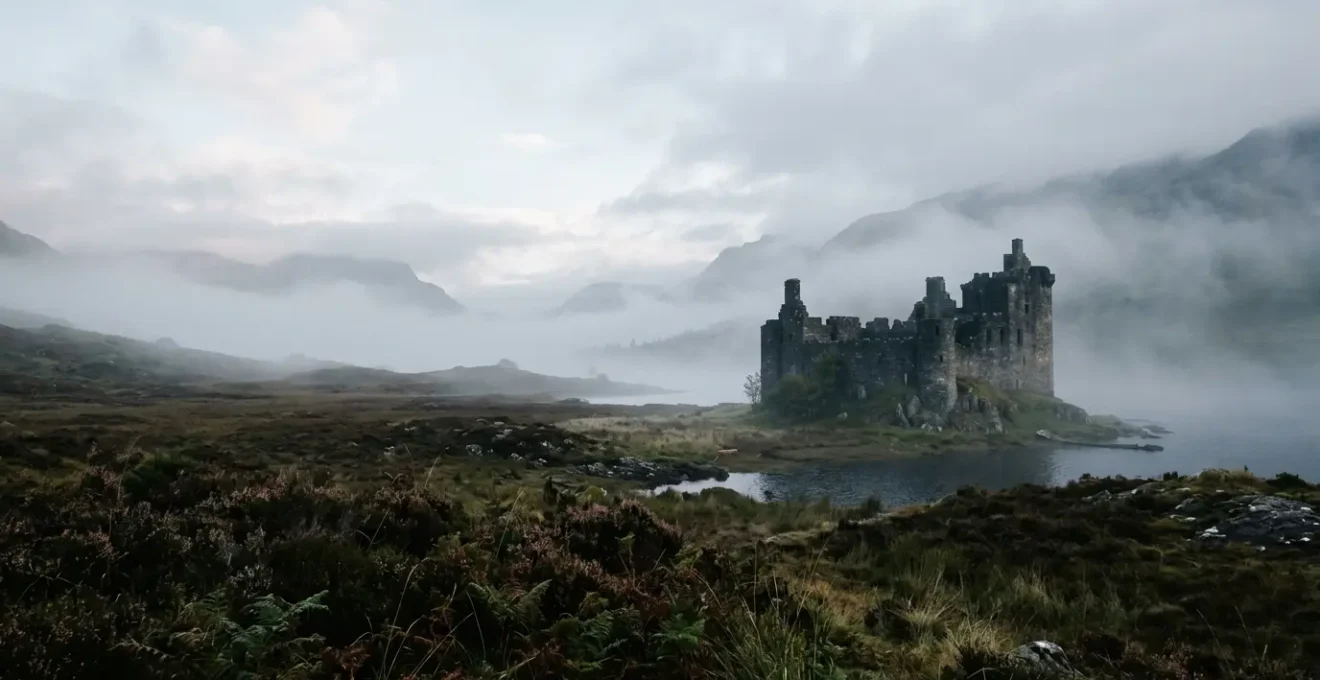
There is a profound historical lesson in feeling the biting November wind whip through the broken walls of Doune Castle, the same cold that medieval inhabitants would have endured for months on end. There is a magic in exploring the ruins of Dirleton Castle at dawn, alone with the stones and the birds, seeing it as its builders did, not through a filter of tour groups. This is atmospheric authenticity, and it is the ultimate prize for the dedicated historical traveler. Visiting in the winter or autumn months offers practical advantages as well: smaller tour groups for guides, more time to speak with museum curators, and the chance to find local storytellers in historic pubs on cold evenings.
This approach is a conscious rejection of the packaged, commercialized history that film and mass tourism promote. It is an active choice to seek a quieter, colder, but infinitely more rewarding truth. It is about understanding that the story of Scotland is not just in the grand castles, but in the small, resilient brochs; not just in the summer sun, but in the relentless winter drizzle that shaped the nation’s character. By embracing the off-season, you are not compromising; you are choosing a superior form of historical engagement.
The true Scotland of William Wallace awaits not in a film reel, but in the wind that whips across Stirling, in the cold stone of a dungeon, and in the stories held by those who keep its memory. The next step, the journey from your armchair to the authentic past, is yours to take.