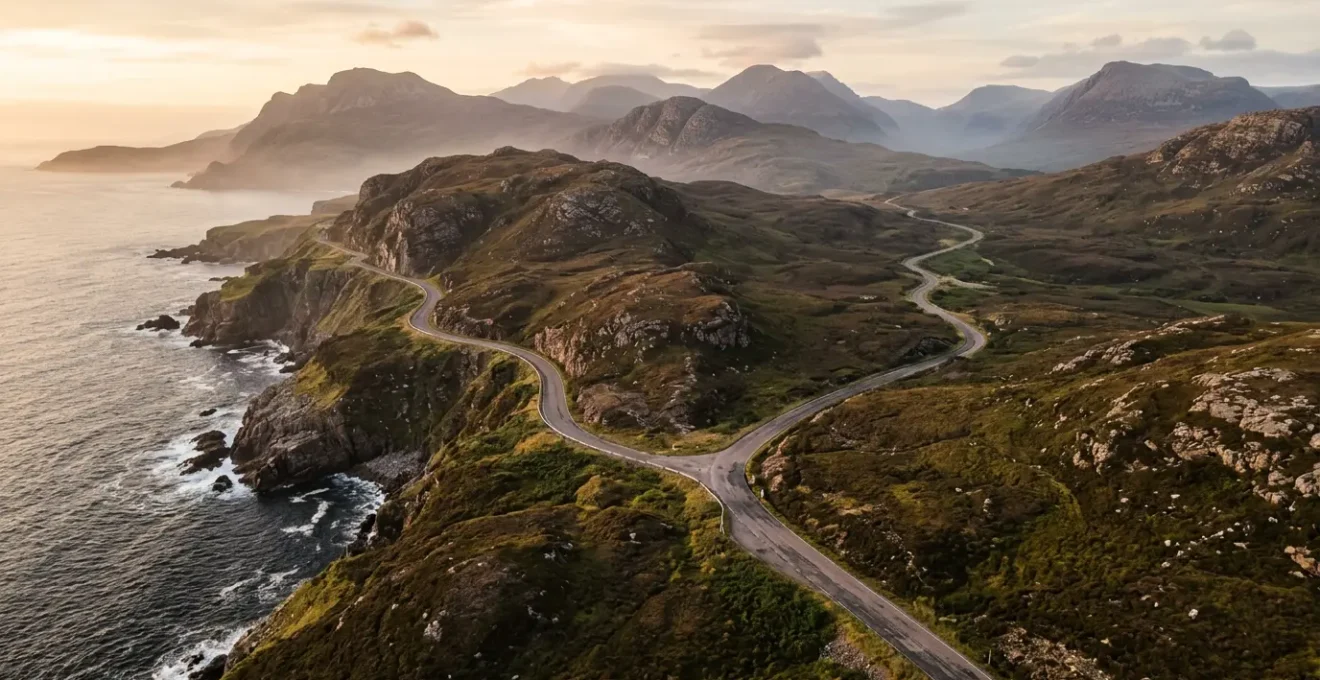
The vision of a North Coast 500 road trip is often one of pure freedom: a ribbon of asphalt unfurling through majestic glens, with the open road as your only guide. You imagine pulling over wherever your heart desires, discovering a hidden B&B, and sharing stories with the locals over a dram of whisky. But then, another voice creeps in—a more anxious one. It whispers of “No Vacancies” signs, of sleeping in a steamed-up car, of missing out because every good option was snapped up months ago. This internal debate isn’t just about logistics; it’s a fundamental conflict between our desire for spontaneity and our deep-seated need for security.
As a travel psychologist, I see this dilemma constantly. Most travel guides offer a simple, binary solution: “Book everything 12 months in advance to avoid disappointment.” While factually sound, this advice ignores the very essence of what draws us to a road trip in the first place—the thrill of discovery. It treats the problem as purely logistical, failing to address the psychological tension at its core. The fear of being stranded is real, but so is the fear of being trapped in a rigid, soulless itinerary with no room for magic.
This guide offers a different path. We will not choose a side between the meticulous planner and the free spirit. Instead, we will fuse the best of both worlds into a single, powerful strategy: structured flexibility. This approach is about making deliberate, high-impact bookings that act as solid “anchors” for your trip, thereby creating secure “zones of spontaneity” where you can genuinely and safely ‘wing it’. We will deconstruct the psychology of booking, from the fine print of cancellation policies to the hidden advantages of a direct phone call, giving you the tools to build an itinerary that is both resilient and liberating.
Throughout this article, we’ll explore the specific pressure points of the NC500, from the notorious ‘Isle of Skye Gap’ to the critical CalMac ferry crossings. You’ll learn how to navigate these challenges not with brute force booking, but with a smarter, psychologically-attuned strategy that calms anxiety and maximizes adventure.
Summary: Navigating the NC500 Planner’s Dilemma
- Free Cancellation: Why You Must Read the 24h vs 48h Fine Print?
- Booking.com or Direct: Which Gets You the Better Room?
- Do You Need Travel Insurance for UK Staycation Accommodation?
- The ‘Isle of Skye Gap’: Why You Find No Rooms in August?
- Hostels or Large Cottages: Which is Cheaper for Groups of 6?
- Why You Cannot Just ‘Turn Up’ and Find a Bed in Summer?
- When to Book Isle of Skye Campsites to Guarantee a Spot?
- How to Book CalMac Ferries for the Outer Hebrides Without Getting Stranded?
Free Cancellation: Why You Must Read the 24h vs 48h Fine Print?
From a psychological perspective, “Free Cancellation” is not just a feature; it’s a potent anxiety-reduction tool. It provides a safety net, allowing our brains to commit to a plan without feeling trapped. However, the effectiveness of this tool depends entirely on understanding its mechanics. The difference between a 24-hour and a 48-hour cancellation policy isn’t just a day; it’s a critical window that can mean the difference between flexibility and a forfeited deposit. Many online travel agents (OTAs) default to a 48-hour policy, which can easily catch out travelers who assume a more lenient 24-hour window.
The key is to weaponize this flexibility. A savvy NC500 planner doesn’t just book one room; they might book two or three different options in a general area, all with free cancellation, 6-9 months in advance. This locks in lower prices and guarantees a bed. Then, they set calendar reminders for 72 hours before each deadline—not 48. This “anxiety buffer” accounts for time zone confusion and gives ample time to make a final decision without pressure. You must be ruthless with your reminders and cancel the unwanted options just outside the 48-hour window. This is the essence of structured flexibility: using the system to create choices, not limitations.
Failing to manage this has real consequences. An experienced traveler on the NC500, despite booking six months ahead for a May trip, still had to alter their route due to a lack of options. They observed the grim reality for those who hadn’t planned: cars with steamed-up windows parked in lay-bys, a clear sign of occupants who had failed to find a room and were forced to sleep in their vehicle. This isn’t an exaggeration, particularly around hyper-popular areas like Skye in peak season.
The fine print isn’t a chore to be skipped; it’s the rulebook for a game you can win, ensuring you have a guaranteed bed while preserving your freedom to change your mind until the last possible, strategic moment.
Booking.com or Direct: Which Gets You the Better Room?
The choice between using an Online Travel Agency (OTA) like Booking.com and contacting the property directly is a classic battle between convenience and connection. OTAs offer an immediate hit of gratification: easy comparison, instant confirmation, and a centralised system for all your bookings. Psychologically, it feels efficient and secure. However, this convenience often comes at a cost, both financial and experiential. The rates on OTAs can be 15-20% higher to cover the platform’s commission, and you’re often getting access to a limited pool of rooms that the owner has allocated to the platform.
Booking direct, while requiring more initial effort, taps into a different psychological reward system: building a personal connection. A phone call or email to a small B&B owner can yield information an OTA never could. You might secure a better rate, request a specific room with a view, or get invaluable local advice. This personal touch is the lifeblood of Highland hospitality. Many small establishments, especially family-run B&Bs, prioritise direct bookings and may only list their less desirable rooms on major platforms. By booking direct, you’re not just a confirmation number; you’re a guest they’re looking forward to welcoming.
This table breaks down the fundamental trade-offs, helping you decide which method aligns with your psychological priorities at different stages of planning.
| Booking Method | Advantages | Disadvantages | Best For |
|---|---|---|---|
| Booking.com/OTAs | Easy comparison, instant confirmation, reviews visible | Higher rates (15-20% commission added), limited inventory | Initial research and scouting |
| Direct Booking | Better rates, room requests possible, personal service, full inventory access | More time-consuming, less convenient | Final booking once location chosen |
The visual of a warm, personal welcome is precisely what you gain from a direct booking relationship. It transforms a simple transaction into the beginning of a memorable travel experience.
The optimal strategy is often a hybrid approach. Use OTAs for initial scouting and to get a feel for a location, but make the final, crucial bookings directly with the provider. This gives you the best of both worlds: broad market knowledge and the specific, personal benefits of a direct relationship.
Ultimately, asking “which gets me a better room?” is the wrong question. The right question is “which method gives me more control, a better experience, and a greater sense of security?” The answer, more often than not, is a direct conversation.
Do You Need Travel Insurance for UK Staycation Accommodation?
The idea of travel insurance for a domestic UK trip, a “staycation,” can feel like an unnecessary expense. The NHS covers medical emergencies, and we speak the language. This psychological bias, known as “familiarity bias,” makes us underestimate the risks in our own backyard. We think, “What could possibly go wrong?” On the NC500, the answer is: a lot. Not in terms of personal danger, but in financial chain reactions. A single road closure, a mechanical failure, or a sold-out local event can trigger a costly domino effect.
Consider a real-world example from the NC500: a marathon event in Durness caused every single room within an hour’s drive to be fully booked. Travellers with car trouble who arrived late lost their non-refundable bookings and found themselves stranded. Similarly, a temporary closure of the Bealach na Bà can mean you miss your pre-paid accommodation on the other side, a non-refundable restaurant reservation, and even a critical CalMac ferry connection. These aren’t just inconveniences; they can add up to hundreds of pounds lost in a single day.
The right travel insurance acts as your ultimate “anxiety buffer.” It’s not about insuring against a tiger attack; it’s about protecting yourself from the cascading financial consequences of mundane problems. However, not all policies are created equal, especially for domestic trips. Many standard policies don’t cover UK travel, or have clauses that make them useless for an NC500 trip. Before purchasing, you must verify the specifics.
Your Checklist for NC500-Proof Travel Insurance
- Verify coverage explicitly includes UK domestic trips (many “staycation” policies are add-ons).
- Check the “trip curtailment” clause: does it cover accommodation costs if a road closure or breakdown forces you to leave early?
- Ensure your vehicle breakdown policy includes accommodation coverage, or that your travel insurance fills this gap.
- Confirm the policy excess is under £100. A policy with a £250 excess is useless for claiming a lost £150 hotel room.
- Look for “missed departure” coverage, specifically mentioning ferry connections, which is crucial for any islands segment of your trip.
Think of it this way: for the price of a decent bottle of single malt, you are buying the psychological freedom to know that if something goes wrong, it’s a story for the pub, not a financial disaster.
The ‘Isle of Skye Gap’: Why You Find No Rooms in August?
The Isle of Skye in summer is not a normal travel destination; it’s a phenomenon of concentrated demand. The psychological mistake many visitors make is viewing Skye as just another part of the NC500. It is not. It is a geographical and logistical bottleneck where the demand for accommodation massively outstrips supply. The “Skye Gap” refers to this chasm between tourist numbers and available beds. Believing you can find a room here on a whim in July or August is a fantasy that will quickly collide with a harsh reality.
The data is stark. It’s not uncommon for July accommodation slots on Skye to be completely full by January. This isn’t an exaggeration to create panic; it’s a statistical reality born from a finite number of rooms and a global marketing appeal. This intense pressure creates a high-stress environment for unprepared travelers, leading to the frantic, late-afternoon search for a bed that almost always ends in disappointment.
However, understanding this bottleneck allows for a psychologically brilliant strategy: the “Commuter Solution.” Instead of fighting for an overpriced room in Portree, you establish a base on the mainland in a location like Kyle of Lochalsh, Plockton, or Dornie. This is a prime example of “structured flexibility.” Your accommodation is a secure “anchor,” but your days are free to explore Skye at will. You trade a few minutes of driving for a massive reduction in cost and stress.
Case Study: The Commuter Solution in Practice
Travelers regularly report huge savings and reduced stress by adopting this strategy. One group saved a staggering £400 over three nights by staying in the charming village of Plockton instead of Portree, adding only a 25-minute drive each way across the bridge. This isn’t an isolated incident; mainland hotels near the Skye bridge report that up to 30% of their summer guests are, in effect, “Skye commuters” who have intelligently opted out of the island’s accommodation Hunger Games.
By accepting the reality of the “Skye Gap” and planning around it, you transform a potential point of extreme stress into a demonstration of savvy, flexible travel planning. You get to enjoy the magic of Skye without paying the psychological (or financial) price of staying there.
Hostels or Large Cottages: Which is Cheaper for Groups of 6?
When travelling as a group, the accommodation choice between a large self-catering cottage and multiple hostel rooms is not just a financial calculation; it’s a decision about the entire social dynamic of your trip. The “cheaper” option is often more complex than the nightly rate suggests. A cottage offers a private, communal hub—a space to cook together, relax, and bond. A hostel, even with private rooms, offers a more fragmented experience, but one with greater individual freedom and less shared responsibility.
From a purely financial standpoint, the break-even point is influenced heavily by food costs and hidden extras. A cottage’s high up-front cost can be offset by a low per-person grocery bill. Hostels might seem cheaper room-by-room, but the cost of eating out for every meal can quickly eclipse the initial savings. Then there are the “hidden costs” of cottage rental: time spent shopping, cooking, and cleaning, which can subtract from your precious holiday hours.
This analysis for a group of six over three days reveals a surprising truth: the financial difference can be minimal. The decision, therefore, should be a psychological one. Does your group thrive on shared activities and a central “home base,” or does it function better when individuals have the freedom to come and go as they please? The cottage enforces togetherness, while the hostel enables independence.
| Accommodation Type | Nightly Rate | Food Cost (3 days) | Hidden Costs | Total per Person |
|---|---|---|---|---|
| Highland Cottage | £450 | £360 (groceries) | £60 (cleaning supplies, basics) | £145 |
| Hostel Private Rooms | £420 (3 rooms) | £540 (eating out) | None | £160 |
| Mixed (Hostel Dorms) | £180 | £480 (mix) | None | £110 |
The best choice depends on your group’s “social budget” as much as its financial one. Before booking, have an honest conversation: are you looking for a shared home or simply a collection of beds? The answer will guide you to the right decision far better than a simple price comparison.
Why You Cannot Just ‘Turn Up’ and Find a Bed in Summer?
The fantasy of “just turning up” is a powerful one. It speaks to our desire for ultimate freedom and serendipity. The reality on the NC500 in summer is a brutal lesson in supply and demand, compounded by a factor many travelers completely forget: the infrastructure. The belief that you can simply hop on your phone at 5 PM and find a nearby room is dangerously misplaced. This isn’t just about rooms being booked; it’s about the very inability to even search for them.
Large stretches of the NC500, particularly the wild and beautiful sections between Applecross and Durness, and further along to Tongue, are notorious digital blackouts. You can drive for hours with absolutely no mobile signal. The romantic notion of a digital detox turns into raw anxiety when the sun is setting, you have no bed for the night, and your GPS is a blank screen. One couple reported spending three hours driving between “No Vacancies” signs after losing signal near Kinlochbervie, a deeply stressful and trip-ruining experience.
Even if you do have a signal, the odds are stacked against you. An analysis of NC500 accommodation pricing shows that last-minute bookings cost 60% more during peak season, if you can find them at all. Furthermore, many small B&B owners are not running 24/7 hotel receptions. They are individuals running a business from their home. It is common practice for them to stop answering the door to speculative callers after 8 PM and to switch off their phones by early evening to have a private life. The “winging it” strategy relies on a 24/7 service infrastructure that simply does not exist in many parts of the Highlands.
This isn’t to say spontaneity is dead. It’s to say that true, enjoyable spontaneity is the *result* of a secure plan. It’s the freedom you feel when you know your bed for the night is guaranteed, allowing you to take that unplanned detour to a hidden beach without a knot of anxiety in your stomach.
When to Book Isle of Skye Campsites to Guarantee a Spot?
For campers, the NC500 offers some of the most breathtaking pitches in Europe. It also presents one of the most competitive booking environments. If booking B&Bs is a challenge, securing a spot on a popular campsite, especially on the Isle of Skye, is an even greater one. The psychological trap is assuming that a tent gives you more flexibility. In reality, the most sought-after campsites function like boutique hotels, with their bookings for summer vanishing months in advance.
The data is clear and unforgiving. Comprehensive NC500 camping availability research reveals that peak season campsites book out 4-8 months in advance. This is especially true for pitches with electric hook-ups, which are often the first to go. Sites in prime locations like Glenbrittle, with its direct access to the Cuillin mountains and the Fairy Pools, are often fully booked for July and August within weeks, or even days, of their booking calendars opening in January.
To succeed, you must abandon a passive approach and adopt a proactive, strategic mindset. Waiting until spring to book a summer campsite spot is a recipe for disappointment. Success requires treating the booking opening day as a key event in your calendar. This is your primary “booking anchor” as a camper.
- January 1-2: This is the D-Day for many independent campsites like Glenbrittle and Kinloch. Be ready to book online the moment their systems go live for the summer.
- 6-Month Mark: For any site with an electric hook-up, consider this your absolute minimum booking window.
- 2-3 Months Ahead: You may still find availability for basic, non-electric tent pitches at this stage, but your choices will be severely limited.
- Cancellation Watch: If your desired site is full, don’t give up. Set daily alerts and check the booking system at 9 AM and 5 PM. These are common times for sites to process cancellations, and a spot can open up unexpectedly.
Securing your campsite is the foundation of your flexible itinerary. With your nightly resting place guaranteed, you are free to roam the hills and glens during the day with the peace of mind that a free-spirited adventurer truly needs.
Key Takeaways
- The NC500 planning dilemma is a psychological conflict between the need for security and the desire for spontaneity; the goal is to satisfy both.
- “Structured Flexibility” is the key: use non-negotiable “booking anchors” (ferries, key campsites) to create safe “spontaneity zones” in between.
- The biggest risks are not dramatic events, but cascading financial and logistical failures from small, overlooked details like ferry dimensions or digital blackouts.
How to Book CalMac Ferries for the Outer Hebrides Without Getting Stranded?
If your NC500 adventure includes the magnificent extension to the Outer Hebrides, the CalMac ferry is not part of your holiday; it is the absolute, non-negotiable cornerstone of your entire plan. From a psychological planning perspective, the ferry booking is your master anchor. All other accommodation and activity plans must be built around it. Treating it as a flexible, turn-up-and-go service, especially in summer, is the single most common and catastrophic mistake a traveller can make. These boats are lifelines for island communities, and tourist vehicles are just one part of their load.
The most infamous pitfall is the “Vehicle Dimensions Disaster.” You might think you know the length of your car or campervan, but CalMac’s booking system is ruthlessly precise. A bike rack, a roof box, or even an aftermarket aerial can push you into the next size category. A family with a campervan was denied boarding at Ullapool after measuring 6.1m with bikes on the back, having booked as ‘under 6m’. They lost their entire £180 ferry fare and had to wait three days for the next available slot for a larger vehicle. This isn’t a rare horror story; CalMac staff report it happening multiple times a week in summer.
To avoid this fate, you must adopt a protocol of extreme diligence. Booking a CalMac ferry is a mission-critical task that requires precision and a zero-error mindset. The following steps are not recommendations; they are your booking bible.
Your Action Plan for CalMac Booking Success
- Book Ferries First: Before booking a single hotel or campsite, secure your ferry crossings. These dates are the unmovable pillars of your itinerary.
- Measure Everything: Use a tape measure on your vehicle. Measure its total length, including any bike racks or tow bars, and its total height, including any roof boxes or aerials.
- Add a Buffer: When you have your exact measurement, add a 20cm (8-inch) buffer when selecting your vehicle category online. This is your safety margin against any measurement error.
- Screenshot Your Booking: After booking, take a screenshot of the confirmation page, ensuring it clearly shows the vehicle category you selected. This is your proof if any issues arise at the port.
- Arrive Early: The “recommended” arrival time is 30 minutes before sailing. Ignore it. Aim to arrive at least 45-60 minutes early to handle any potential issues without pressure.
- Book Mid-Week: If possible, book sailings between Monday and Thursday. They have significantly more availability and are less prone to disruption than the busy weekend sailings.
By treating your CalMac booking with the seriousness it deserves, you transform it from a potential point of catastrophic failure into the solid foundation upon which your entire, wonderful Hebridean adventure can be built with confidence.