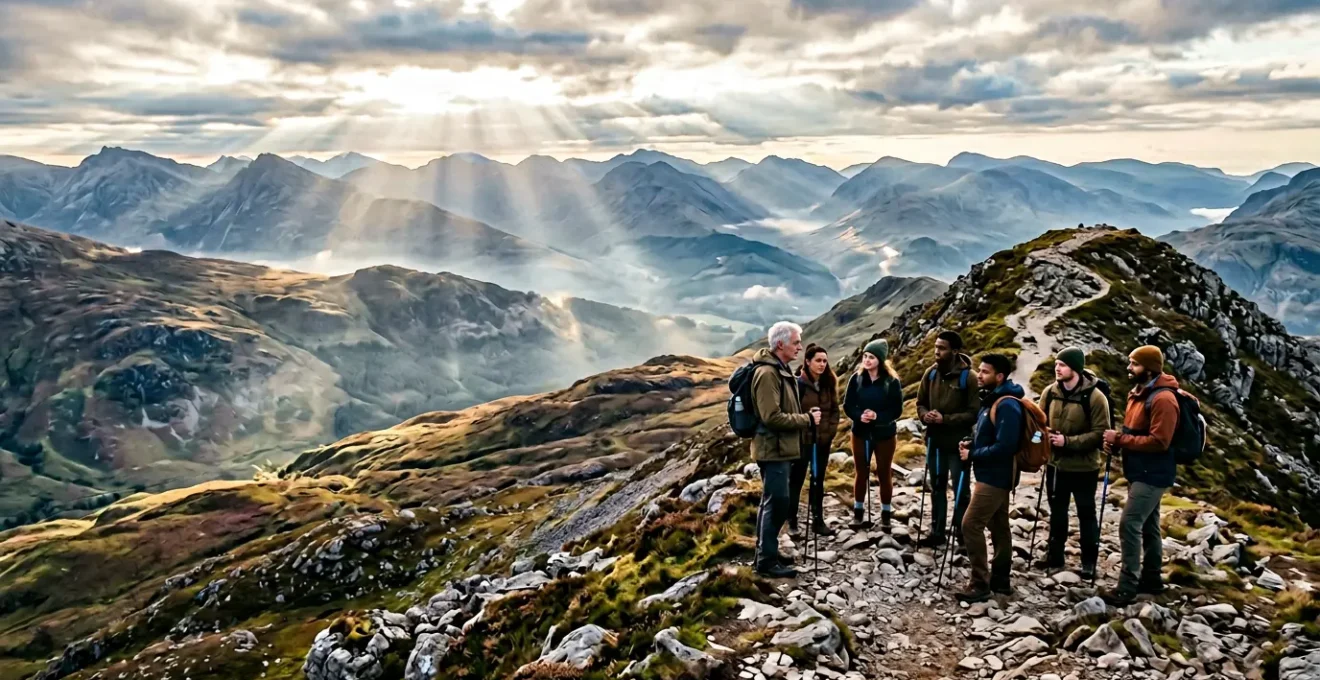
The greatest barrier to joining a hill walking club isn’t fitness; it’s misunderstanding the ‘social contract’ of mutual support that defines the community.
- Your value to a group is measured in awareness and preparedness, not speed or peak-bagging counts.
- Etiquette, safety protocols, and even car sharing are all expressions of this shared responsibility.
Recommendation: Shift your focus from “Am I fit enough?” to “How can I be a reliable and considerate member of the team?” This guide shows you how.
As a club membership secretary, I’ve read countless emails that all start the same way. They come from keen solo walkers, people who love the solitude of the hills but feel a pull towards company and more adventurous routes. They look at club photos of smiling groups on a misty Munro summit and a familiar anxiety creeps in: “I’d love to join, but I’m worried I’m not fit enough,” or “I’m afraid I’d just slow everyone down.” It’s the single biggest hurdle that keeps great potential members from taking that first step. The common advice—to just check walk grades on a website or “get a bit fitter”—misses the point entirely.
This advice focuses on physical metrics, but the real barrier is a social one. The fear isn’t just about legs giving out; it’s about the social embarrassment of being the weak link, of not having the right gear, or of not knowing the unwritten rules. But what if the key to joining a club wasn’t about meeting some imaginary fitness benchmark, but about understanding the club’s unspoken ‘social contract’? This is the web of mutual support, shared responsibility, and peer-based learning that truly holds a group together on the hill. It’s a culture of contribution, not just competence.
This guide demystifies that social contract. We’ll move beyond generic fitness tips and instead break down the practical etiquette and protocols that signal you’re a reliable, considerate walker—the kind of person everyone wants in their group. We will explore everything from trail right-of-way and reliable information sources to handling delicate situations and even the logistics of carpooling. By understanding these cultural cornerstones, you’ll see that your place in a club is earned not through speed, but through awareness and a willingness to be part of a team.
This article breaks down the essential elements of this ‘social contract’ into practical, easy-to-understand sections. Explore the full guide or jump to the topic that interests you most to begin your journey from a solo walker to a valued club member.
Contents: Your Guide to Club Walking Culture
- Who Has Right of Way: The Uphill or Downhill Walker?
- Walkhighlands vs Facebook Groups: Where to Get Reliable Route Advice?
- Is the Newton Stewart Walking Festival Suitable for Solo Travellers?
- When to Intervene: Seeing Someone ill-Equipped on a Mountain?
- Car Sharing for Hikers: How to Split Costs Fairly?
- The Check-In Protocol That Saves Lives for Solo Hikers
- Why Do Some Baggers Keep Their Final Munro Secret Until the End?
- How to Train for Highland Hiking If You Live in a Flat City?
Who Has Right of Way: The Uphill or Downhill Walker?
The question of who has right of way on a steep path is often the first, most tangible piece of hill etiquette a new walker encounters. The general rule of thumb is to give way to the person walking uphill. The logic is simple: the uphill walker is working against gravity, has more momentum to maintain, and often a more limited field of view. Stopping and starting is much harder for them. But seeing this as a rigid rule is a novice’s mistake. A seasoned club member sees it as the starting point of a conversation.
This is your first chance to practice the club’s ‘social contract’. You read the situation. Is the uphill walker a large, organised group that would be difficult to pass? Or is it a single person who looks like they would welcome a brief pause to catch their breath? In that case, a friendly wave and stepping aside yourself is the more courteous, and often appreciated, gesture. It’s about showing awareness of others. The moment you pass is not an awkward silence but an opportunity: a quick “Afternoon!”, “Tough pull this, isn’t it?”, or “Nearly there!” builds an instant, fleeting camaraderie that is the lifeblood of the hill-walking community.
This peer-based approach is fundamental to how most clubs operate, creating an environment where etiquette is learned through observation. As one Glasgow-based club’s material makes clear:
Glasgow Walking and Hillwalking Club’s Peer-Based Approach
The club explicitly states that walks are not run by qualified instructors and that “the organiser is only helping by sharing experience.” Organisers “do not accept responsibility for others or for instructing them.” This fosters a culture where members become responsible for their own learning, observing the group dynamic and picking up on social cues and trail etiquette as a shared, collective experience rather than a top-down directive. It’s about mutual respect, not rigid rules.
Ultimately, a confident walker is not one who rigidly knows the rules, but one who can flexibly apply the principle of courtesy. When in doubt, stepping aside with a smile is never the wrong choice. It signals you’re a team player.
Walkhighlands vs Facebook Groups: Where to Get Reliable Route Advice?
Once you’re in a club, your contribution to the ‘social contract’ includes being well-informed. Turning up for a Grade A walk expecting a gentle stroll is a burden on the group. Your pre-walk preparation and knowledge are a mark of respect for the walk leader and the other members. But in the digital age, sources of information vary wildly in quality, from meticulously detailed databases to chaotic social media feeds. Knowing where to look is a key skill.
Think of your sources as a toolkit. Walkhighlands is your technical manual. It offers detailed, moderated route descriptions, Ordnance Survey mapping, and user-submitted reports that are invaluable for serious planning. This is where you go to understand the terrain, the distance, and the ascent. In contrast, Facebook Groups are the real-time club noticeboard. They are unparalleled for last-minute, current condition updates: “Is the Bealach na Bà passable today?” or “How boggy is the approach to Ben Lomond after yesterday’s rain?”. The information is instant but requires a critical eye—always consider the experience level of the person posting.
This distinction is crucial for becoming a reliable member of the community. Official bodies like Mountaineering Scotland provide the foundational safety protocols, while local club forums offer nuanced, specific knowledge. The community is vast, with the latest Mountaineering Scotland report noting over 16,000 members across 140+ clubs, all contributing to this pool of knowledge. As the Scottish Hillwalking & Activities Group puts it, the goal is for members to “own the group” and keep it active. This philosophy is echoed across the community:
We’re a friendly group that was founded in 2008 to be run by the members for the members. We encourage members to ‘own the group’ and help keep the page active by hosting events.
– Scottish Hillwalking & Activities Group, Meetup Group Description
The following table, based on the principles of reliable sources like the trusted platform Walkhighlands, breaks down where to look for what:
| Source | Reliability | Response Time | Best For |
|---|---|---|---|
| Walkhighlands | High – Moderated reports | Static info | Detailed route planning |
| Facebook Groups | Variable – Check admin quality | Instant but unverified | Current conditions |
| Mountaineering Scotland | Official guidance | Static info | Safety protocols |
| Local Club Forums | High – Experienced members | 1-2 days | Local knowledge |
By using the right tool for the job, you show up prepared. This preparedness is your first and most important contribution to the group, proving you’re a dependable partner before you’ve even tied your bootlaces.
Is the Newton Stewart Walking Festival Suitable for Solo Travellers?
For a solo walker anxious about joining a formal club, a walking festival can be the perfect ‘soft entry’ into the world of group hiking. It offers the structure and safety of an organised event without the perceived commitment of a club membership. The Newton Stewart Walking Festival, for example, is particularly well-suited for solo travellers precisely because it is designed to eliminate the logistical headaches and social anxieties that can be a major barrier.
The festival’s structure inherently builds a temporary community. With a programme of around 30 routes, the key is the centralized logistics. A single registration point and, crucially, provided transport to and from the walks, means everyone starts at the same place. This removes the stress of navigating to remote car parks alone and creates natural, low-pressure opportunities for conversation. You’re not trying to break into an established clique; you’re all new arrivals for the week. The shared bus journey to the trailhead is often where friendships for the day—and sometimes longer—are forged.
Newton Stewart Walking Festival’s Inclusive Approach
The festival’s design is inherently solo-friendly. The official programme highlights that each year offers around 30 routes over 7 days, with transport and guides included, plus evening social events. The process is streamlined: “Registration is held at the McMillan Hall… Transport to and from the walks is provided.” This centralisation is key. It removes the two biggest worries for a solo joiner: getting lost before the walk even starts, and the awkwardness of not knowing anyone. The organised structure provides the scaffolding for social connections to happen organically.
The inclusion of evening social events is also a critical component. It extends the ‘social contract’ from the trail to the pub, allowing you to connect with fellow walkers on a more personal level. It’s a chance to share stories from the day’s walk and realise that everyone, regardless of experience, has their own challenges and triumphs on the hill.
As the image suggests, the post-walk gathering is where the shared experience of the day is cemented. It transforms a group of strangers into a collective of people who have achieved something together, providing the perfect, relaxed environment to ask about local clubs and take the next step if you feel ready.
By participating in a festival, you are effectively test-driving the group walking experience in a controlled, supportive setting. It’s an ideal way to build confidence and discover that the community is far more welcoming than you might have feared.
When to Intervene: Seeing Someone ill-Equipped on a Mountain?
This is perhaps the most delicate test of the ‘social contract’. You’re halfway up a Munro, the wind is picking up, and you see someone in trainers and a cotton hoodie. Your conscience screams “danger,” but your social conditioning whispers “don’t interfere.” Navigating this requires tact, not judgment. The goal is to help, not to lecture. The way you approach this situation reveals your understanding of the community’s ethos: we are all collectively responsible for safety on the hills.
On an official club walk, the protocol is simple: you discretely inform the designated walk leader. They have the experience and the authority to handle the situation. The challenge comes when you encounter a stranger. A confrontational “You’re not properly equipped for this!” will only be met with defensiveness. Instead, use collaborative, non-judgmental language. Open with a comment about the shared conditions: “The wind is really picking up, isn’t it? How are you finding it?” This opens a dialogue rather than starting an argument. You can then offer practical help without being condescending: “I’ve got a spare pair of gloves in my bag if you need them, my hands are freezing!”
Framing assistance as mutual support—”We all help each other out up here”—depersonalises the situation and reinforces the communal spirit of the mountains. This is crucial because, as Mountaineering Scotland’s official statement reminds us, personal responsibility is the bedrock of our activities.
Climbing, hill walking and mountaineering are activities with a danger of personal injury or death. Participants in these activities should be aware of and accept these risks and be responsible for their own actions and involvement.
– Mountaineering Scotland, Official Safety Statement
Knowing how to offer help effectively is a skill that clubs value highly. It shows you’re not just thinking about your own walk, but about the well-being of everyone on the mountain.
Your Action Plan: Assisting an Under-Prepared Walker
- On Club Walks: Don’t take charge yourself. Discretely inform the official walk leader, who has the authority and responsibility to act.
- With Strangers: Use collaborative language. Start with a shared observation like, “The wind is fierce up here, how are you managing?” to open a conversation.
- Offer Practical Help: Instead of criticism, offer a concrete solution. “I have some spare hand warmers if you’re feeling the cold,” is better than “You should have brought gloves.”
- Frame as Mutual Support: Use phrases like, “We all look out for each other up here.” This makes the offer of help feel like a community norm, not personal charity or criticism.
- Document if Necessary: If you have serious safety concerns and the person is unresponsive to help, make a mental note of their location, time, and direction of travel in case you need to inform Mountain Rescue later.
This careful balance of offering help while respecting individual autonomy is a hallmark of an experienced hill-goer. It demonstrates a deep understanding of the environment and the community that inhabits it.
Car Sharing for Hikers: How to Split Costs Fairly?
The logistics of getting to the trailhead are a practical, and often overlooked, part of the ‘social contract’. For many, especially those living in cities without a car, car sharing is the gateway to the mountains. But it can also be a source of anxiety for newcomers: How much should I offer for petrol? What’s the expected etiquette? Understanding the different models clubs use can ease this awkwardness and show you’re a considerate passenger.
There is no single, universally accepted rule. The approach often depends on the club’s culture, ranging from highly formal to completely casual. Some clubs, particularly larger ones organising long-distance trips, operate a fixed mileage rate. This is typically set by the club (e.g., 20p per mile) and the total cost is split between all passengers, with the driver often paying nothing. This is the most transparent method and avoids any ambiguity. It’s a formal system for a formal arrangement. Other clubs adopt a more informal “passengers split petrol” model, where at the end of the trip, passengers collectively hand the driver cash to cover the fuel cost.
For closer-knit groups or clubs with a strong social element, the system can be even more informal. You might find a “take turns driving” system or, very commonly, the “pub round system”. Here, the unspoken agreement is that the passengers will buy the driver a post-walk meal or a few drinks at the pub. This transforms the transaction from a financial one into a social gesture of thanks. As one club notes, car sharing is often at the “driver’s discretion,” with communication being key. The important thing is to clarify beforehand. A simple “What’s the usual arrangement for petrol?” before you set off shows you are thoughtful and proactive.
A comparative look at different models, such as those used by groups like the Aberdeen Hillwalking Club, can help you understand the options:
| Model | Cost Structure | Best For |
|---|---|---|
| Fixed Mileage Rate | 15-25p per mile split | Long distances, formal clubs |
| Driver Doesn’t Pay | Passengers split petrol | Regular groups, short trips |
| Informal Reciprocal | Take turns driving | Close-knit groups |
| Pub Round System | Passengers buy drinks/meal | Social clubs, day trips |
Regardless of the method, the underlying principle is one of fairness and gratitude. The driver is sharing their time and their vehicle. Acknowledging that with a fair contribution and a sincere “thanks” is a simple but powerful way to be a great car-share companion and a valued club member.
The Check-In Protocol That Saves Lives for Solo Hikers
For the solo walker, a robust check-in protocol is a non-negotiable lifeline. It’s your personal safety net. However, when you join a club, this individual responsibility evolves into a collective one. The club itself becomes your safety net, and integrating into its protocols is a key part of your transition. This isn’t just about your safety anymore; it’s about being a reliable part of a system that protects everyone.
Most clubs have a formal sign-in and sign-out procedure for official walks. This is the simplest form of accountability; the walk leader knows who is in their group and ensures everyone is accounted for at the end of the day. As you start making friends within the club, this evolves into a more informal but equally important ‘safety network’. For non-club walks with a couple of new friends, you might create a small WhatsApp group. A quick message at the start—”At the car park, heading up”—and at the end—”Back at the car, all good”—becomes second nature. Many smartphones also allow you to share your live location for the duration of the walk with your designated contacts, an incredibly powerful safety tool.
This system is about reciprocal trust. By offering to be someone else’s emergency contact, you strengthen these bonds. You are no longer just a passive member; you are an active contributor to the group’s safety culture. This is the ‘social contract’ in its most critical form. The reason this is taken so seriously is that everyone in the hills knows what happens when things go wrong. In an emergency, the established emergency protocol in Scottish mountains requires 999 calls for the Police, who then task the Mountain Rescue Service. The protocols clubs use are all designed to prevent that call from ever having to be made.
Building this network is a gradual process that mirrors your integration into the club:
- Start by diligently using the formal club sign-in/sign-out procedures.
- Create a small WhatsApp group with 2-3 trusted club members for any informal walks.
- Get comfortable using ‘Live Location’ sharing on your phone during your walks with this safety network.
- Offer to be someone’s emergency contact to build that reciprocal trust.
- Gradually, you’ll find you’ve moved from a solo protocol to being an integral part of a club-wide safety system.
This transition from self-reliance to mutual reliance is the very essence of joining a club. It’s the moment you stop being a visitor in the mountains and start becoming part of their community.
Why Do Some Baggers Keep Their Final Munro Secret Until the End?
As a newcomer to the club scene, you’ll soon hear talk of “Munros,” “Corbetts,” and “bagging.” This might seem like an intimidating, competitive world of lists and numbers. While there is a strong culture of achievement, understanding one of its most cherished traditions—keeping the final Munro secret—reveals the deeply personal and non-competitive spirit that also lies at its heart. It’s a perfect illustration that the journey is often more important than the public finish line.
The term “Munro” comes from Sir Hugh Munro, who in 1891 compiled the first list of all Scottish mountains over 3,000 feet. A “Munro bagger” is someone who sets out to climb all 282 of them. This can take years, or even a lifetime. The final Munro, or “compleation” as it’s known, is a monumental personal achievement. So why the secrecy? Many completers save an easier, more accessible Munro for last, allowing friends and family—many of whom are not hill-walkers—to join them. But they often keep the specific peak quiet until the last minute.
This tradition serves two purposes. Firstly, it preserves the personal nature of the achievement. After years of solitary effort and quiet determination, turning the final summit into a huge, public spectacle can feel wrong. The secrecy allows the completer to control the moment and share it with a chosen inner circle of close supporters who have been part of their long journey. It prevents their personal pilgrimage from being hijacked by dozens of well-meaning but less-connected acquaintances.
The Personal Pilgrimage of a Munro Completer
The tradition of Munro bagging is a core part of Scottish hiking culture, dating back to Hugh Munro’s original list. As one writer notes, ever since he first climbed them all, “Munro baggers are here to bag them all.” This long-term pursuit is less a sport and more a personal journey across the landscape of Scotland. By keeping the final Munro secret, the bagger reclaims the finale as an intimate moment. It’s a quiet nod to the fact that while the support of the community is welcome, the achievement itself is profoundly personal, a final conversation between the walker and the hills.
For a newcomer worried about performance, this should be incredibly reassuring. It shows that even at the highest level of achievement, the community values personal meaning over public performance. Your own journey, at your own pace, will be respected.
Key Takeaways
- Joining a club is less about elite fitness and more about becoming a reliable, considerate member of a team.
- The ‘social contract’ of the hills is built on mutual respect, shared responsibility for safety, and open communication.
- Focus on being well-prepared, courteous, and aware of others—these are the qualities valued most in any walking group.
How to Train for Highland Hiking If You Live in a Flat City?
We’ve established that club walking is about more than just fitness, but a reasonable level of hill fitness is still important for your own enjoyment and the group’s safety. The anxiety for many city-dwellers is how to prepare for steep, rugged mountains when the nearest hill is a motorway flyover. The answer is to train smart, not just hard, by simulating the specific demands of a long day in the Scottish hills.
A typical day on a Munro can involve 4-8 hours of sustained effort, often with a weighted pack. Your training should therefore focus on endurance and strength, not speed. Forget about running; the foundation of hill fitness is what’s known as “Zone 2” cardio. This is a low-intensity effort, best described as a brisk walk where you can still hold a conversation. This builds your aerobic base, which is what will carry you through a long day. If you can comfortably walk 5km in 45 minutes while chatting, you are ready for a club’s ‘Easy’ or ‘Grade C’ walk.
The next step is to simulate the ‘up’. Find the longest flight of stairs you can—in an office block, a multi-storey car park, or a tower block—and start doing repeats. Begin with 20 minutes and build up. Crucially, as you progress, start doing this wearing the weighted pack and the hiking boots you’ll use on the hill. This “full dress rehearsal” is vital. It gets your body used to the specific load and your feet accustomed to your boots, preventing blisters and discomfort on the day. The final piece of the puzzle is simply time on your feet. A full 6-hour urban walk on a weekend, with your pack on, is an excellent way to simulate the duration of a real hill day.
Here is a simple program to build that specific fitness:
- Weeks 1-4: Build Your Base. Focus on 45-60 minute brisk walks, 3-4 times a week. The key is maintaining a conversational pace to build your Zone 2 cardio base.
- Weeks 5-8: Introduce Weight and Incline. Add a weighted pack (starting with 5kg) to your walks. Find a set of stairs and dedicate one session a week to 30 minutes of continuous climbing.
- Weeks 9-12: Full Dress Rehearsal. Increase stair sessions to 1-2 hours, wearing your full pack (8-10kg) and hiking boots. Your long weekend walk should now be 3-4 hours in full gear.
- Final Test: Simulate a Hill Day. Before your first club walk, try to complete a 5-6 hour continuous walk with your full pack on. This builds mental endurance as much as physical.
By following a plan like this, you’re not just getting fit; you are demonstrating a commitment to preparation. You will arrive at your first club walk knowing you have the endurance for the day ahead, free from anxiety and ready to simply enjoy the walk and the company.