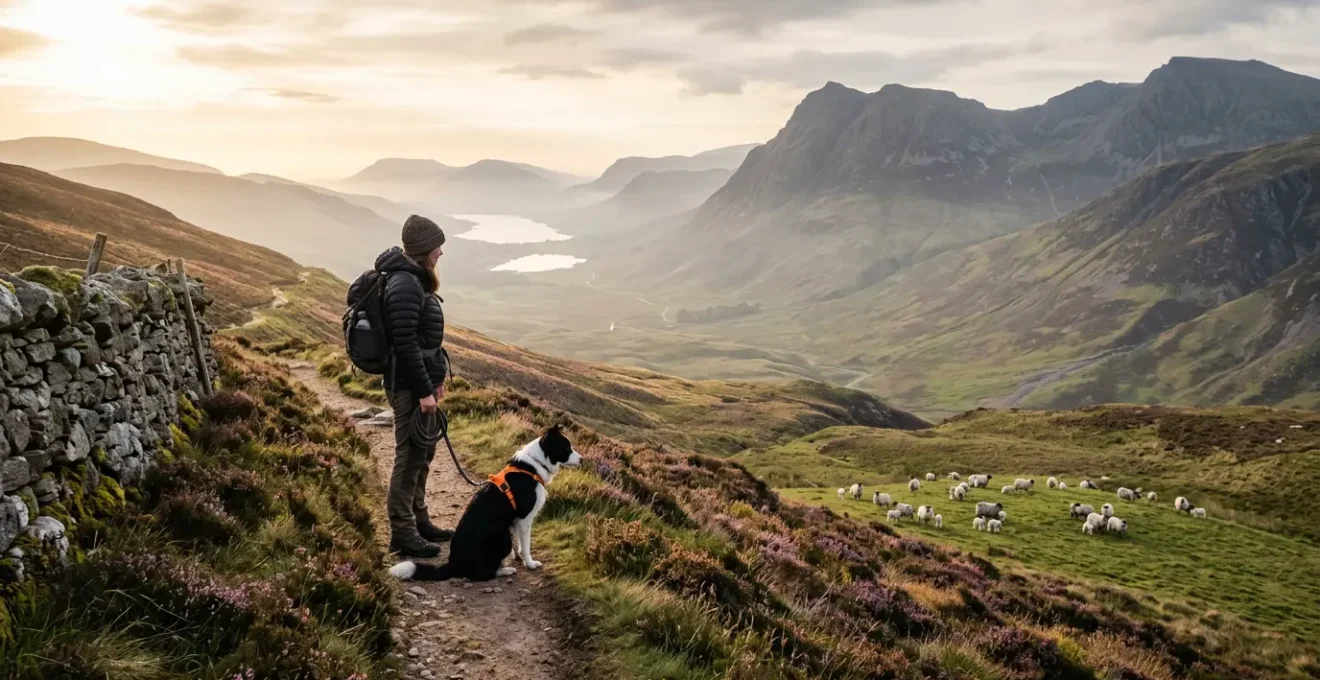
The key to walking your dog without fear in the Scottish countryside is shifting from simply following rules to understanding the farmer’s-eye view of the land.
- Seemingly small disturbances have significant, often invisible, financial and emotional consequences for farmers and wildlife.
- Your responsibilities extend beyond livestock to include biosecurity, waste management, and respecting wildlife habitats.
Recommendation: Adopt a mindset of ‘confident stewardship’—proactively managing your dog and your impact to protect the rural environment, ensuring a safe and welcome experience for everyone.
As a land manager in Scotland, I see the change every spring. The hills come alive not just with new lambs, but also with people eager to enjoy the longer days. Many, like you, bring a dog. And with that comes a palpable sense of anxiety: a fear of doing the wrong thing, of causing a problem, of not knowing the real rules. You’ve probably heard you need to keep your dog on a lead, but the fear often comes from not understanding the ‘why’ behind the rule. It’s more than just preventing a chase; it’s about managing a set of invisible pressures on the landscape and our livelihood.
Most guides will list the basic tenets of the Scottish Outdoor Access Code. They’ll tell you to be responsible, but they rarely explain what that looks like from the other side of the fence. They don’t talk about the stress that causes a ewe to reabsorb her lambs, the cost of a single dog intrusion, or the unseen diseases you might carry on your boots. This isn’t about scaring you away; it’s the opposite. It’s about replacing that fear with a deep, practical understanding.
The real key to enjoying the countryside with your dog isn’t a checklist of rules, but a change in perspective. This guide is designed to give you that farmer’s-eye view. We’ll go beyond the platitudes to explore the real-world consequences and practicalities, from gate etiquette to spotting toxic algae. By understanding the ‘why’, you’ll gain the confidence to make the right choices instinctively, becoming a welcome steward of the land, not a source of worry.
This article will walk you through the essential knowledge you need, covering the core responsibilities around livestock and expanding into the wider aspects of responsible access, including wildlife, biosecurity, and practical challenges like midges. Follow along to build your confidence for your next countryside adventure.
Summary: A Farmer’s Guide: How to Walk Your Dog in Scotland During Lambing Season Without Fear
- Why ‘Right to Roam’ Does Not Mean You Can Camp Anywhere?
- Smidge vs Avon Skin So Soft: Which Actually Repels Highland Midges?
- Red Deer or Golden Eagles: Which Species Is Easier to Spot Without Disturbing?
- The Toilet Paper Mistake That Pollutes Scottish Bothies
- How to Clean Your Boots to Stop the Spread of Phytophthora Ramorum?
- The Gate Etiquette Mistake That Angers Scottish Farmers
- Blue-Green Algae: How to Identify Toxic Blooms Before Your Dog Swims?
- How to Spot Otters in Scottish Lochs Without Scaring Them Away?
Why ‘Right to Roam’ Does Not Mean You Can Camp Anywhere?
The term ‘Right to Roam’ is powerful, but it’s often misunderstood. It’s not a pass to go anywhere you please, especially with a dog during lambing season. The foundation of the Scottish Outdoor Access Code is responsible access. This means your rights are balanced by your duty to care for the environment, respect the interests of land managers, and not interfere with agricultural operations. During lambing (typically April to July), this responsibility is at its most critical.
From a farmer’s perspective, a dog off-lead in a field of sheep isn’t just a nuisance; it’s a direct threat. ‘Worrying’ livestock doesn’t have to involve an attack. A dog simply running near ewes can cause enough stress to make them abort their lambs. The financial impact is real and immediate; research shows the average cost per dog attack incident is £697.33, but this figure doesn’t capture the hidden losses from stress-induced issues. In the most extreme cases, where a dog is actively attacking livestock and the owner is not present or able to stop it, a farmer has a legal defence to shoot the dog as a last resort to protect their flock. This is a devastating outcome for everyone, and it’s entirely preventable.
Your core responsibilities are clear:
- Never take your dog into fields where there are lambs, calves, or other young farm animals. Find an alternative route.
- In any field with adult livestock, your dog must be on a short lead or under very close control, and you should keep as far from the animals as possible.
- If cattle react aggressively, let your dog go and take the safest, shortest route out of the field. The cattle are likely reacting to the dog, not you.
- During the bird breeding season (April-July), keep dogs on a short lead on moorland and shores to protect ground-nesting birds.
Smidge vs Avon Skin So Soft: Which Actually Repels Highland Midges?
While managing your dog is the top priority, managing your own comfort is a close second, especially when facing the Highland midge. The sheer density of these insects can turn a pleasant walk into a torturous ordeal. On a bad day, surveys have recorded up to 2,000 midges per square meter. When you’re trying to focus on keeping your dog calm and controlled, being swarmed is a major distraction. Choosing the right repellent isn’t just about avoiding bites; it’s about maintaining your composure.
The debate over what works best has raged for years. The folk remedy, Avon Skin So Soft, gained a cult following, but modern science offers more targeted solutions. Understanding the ingredients and how they work is key to making an effective choice for you and ensuring you can focus on your dog and surroundings.
This table breaks down the differences between the main contenders, showing why a purpose-built repellent like Smidge, which is based on Saltidin (also known as Picaridin), is generally more reliable for the harsh conditions you can encounter in the Highlands.
| Product | Active Ingredient | Concentration | Protection Duration | Mechanism |
|---|---|---|---|---|
| Smidge | Saltidin (Picaridin) | 20% | Up to 8 hours | Blocks CO2 receptors |
| Avon Skin So Soft | Citronellol | Variable | 1-2 hours | Creates oily barrier |
| DEET Products | DEET | 50%+ | 5-9 hours | Blocks antennal receptors |
While DEET is effective, Saltidin-based products like Smidge are often preferred as they are less aggressive on clothing and equipment. The mechanism, which makes you ‘invisible’ to the midge’s sensors, is highly effective and offers long-lasting protection, allowing you to focus on responsible dog ownership, not on swatting insects.
Red Deer or Golden Eagles: Which Species Is Easier to Spot Without Disturbing?
The principles of avoiding disturbance extend from farm animals to Scotland’s incredible wildlife. The same stress response a dog can trigger in sheep is mirrored in wild species like red deer. For a dog owner, the challenge is to enjoy spotting these animals without becoming part of the problem. As farmer Alister Orr from East Ayrshire explains, the impact of disturbance on pregnant ewes is devastating, and this applies equally to wild animals during their own sensitive breeding periods. A dog running freely can cause a herd of deer to expend vital energy or flush a ground-nesting bird from its eggs.
So, which is easier to spot responsibly? Surprisingly, both can be observed with the right technique. Red deer are often more predictable. They are creatures of habit. By scanning ridgelines at dawn or dusk from a distance with binoculars, you can often spot their silhouettes against the skyline without ever needing to get close. You can learn to read the landscape for signs of their presence, like tracks or droppings, which tells a story without causing any disturbance at all.
As the image shows, learning to spot signs like a fresh hoof print in the peat is a key skill. It allows you to connect with the wildlife of an area intimately, without the animal ever knowing you were there. Golden eagles require more patience and a bit of luck. They are best spotted on windy days, using the updrafts to soar along high ridges. Again, the key is distance and observation. Use the landscape to your advantage, stay downwind, and keep still.
To do this successfully with a dog, you need excellent control:
- Train a solid ‘watch me’ command to redirect your dog’s attention the moment you spot wildlife.
- Practice a ‘settle’ command, teaching your dog to lie down and be calm while you observe.
- Always keep your dog on a lead during the April-July breeding season to protect unseen ground-nesting birds like curlew and lapwing.
The Toilet Paper Mistake That Pollutes Scottish Bothies
Responsible access isn’t just about how you interact with animals; it’s about leaving no trace of your visit. This is especially true when it comes to human and dog waste, an issue that plagues many beautiful and remote areas, including the network of simple shelters known as bothies. A common mistake people make is thinking that burying toilet paper is acceptable. In Scotland’s wet, acidic, and often cold soil, decomposition is incredibly slow. Buried toilet paper can remain for years, and when animals dig it up, it creates an unsightly and unhygienic mess.
The same principle applies with even greater force to dog waste. While using biodegradable bags is a good start, they must still be packed out. The conditions that slow down the breakdown of paper also slow the breakdown of these bags. Leaving a bag of dog waste on a trail or tucked behind a wall is worse than leaving the waste itself, as you are adding plastic to the pollution. There are no “poo fairies” in the Highlands. If you pack it in, you must pack it out.
From a land manager’s view, waste is not just an eyesore; it’s a health hazard for wildlife, livestock, and other people. A responsible dog owner in the backcountry comes prepared with a dedicated waste kit. This isn’t complicated; it’s just a system.
- Carry a small trowel for burying human waste (in a deep hole at least 30m from water sources), but always be prepared to pack out your toilet paper.
- Use a system of double-bagging or a dedicated dry bag for carrying out all used toilet paper and dog waste bags.
- Include hand sanitiser in your kit for hygiene.
- If you are staying near a car park or village, use the bins provided. If not, all waste comes home with you for proper disposal.
How to Clean Your Boots to Stop the Spread of Phytophthora Ramorum?
One of the most significant ‘invisible pressures’ a visitor can bring to the countryside is biological. You could be carrying microscopic threats on your boots and your dog’s paws without ever knowing it. Diseases like Phytophthora ramorum can have a devastating impact on our native trees, particularly larch. This disease, along with others affecting plants and animals, can be spread through mud and organic matter. Your boots, walking poles, bike tyres, and even your dog’s fur can become vectors for contamination.
This is your ‘biosecurity footprint’, and managing it is a crucial part of responsible access. For us on the ground, dealing with the fallout from these diseases is heartbreaking and costly. Yet, the preventative measures are incredibly simple. It’s about getting into the habit of ‘Check, Clean, Dry’ before and after every single outing, and especially when moving between different forests or glens.
Unfortunately, when it comes to enforcing rules, the legal system often fails to provide a deterrent. For livestock worrying, for instance, reports show that only 4% of charges result in convictions. This highlights why personal responsibility and proactive prevention are so much more effective than relying on enforcement after the damage is done. Your commitment to biosecurity is a perfect example of this proactive stewardship in action.
Your Biosecurity Protocol: A 5-Step Checklist
- Brush on Site: Before getting back in your car, use a stiff brush to remove all visible mud, seeds, and plant matter from your boots, clothing, and your dog’s fur and paws.
- Wash Thoroughly: Once at home (or at a designated cleaning station), wash your boots with water and a mild disinfectant. A quick rinse of your dog’s paws with clean water is also a good habit.
- Check Your Dog: Thoroughly inspect your dog’s coat, ears, and paws for ticks, burrs, and any other plant matter that might have been picked up along the way.
- Dry Everything: Allow all your equipment, especially footwear, to dry completely before your next outing. Many pathogens cannot survive in dry conditions.
- Repeat Between Areas: If your trip involves visiting multiple, distinct land areas (e.g., two different forests in one day), repeat a basic brush-down to avoid cross-contamination.
The Gate Etiquette Mistake That Angers Scottish Farmers
Nothing symbolises the boundary between public access and private land management more than a simple farm gate. And nothing causes more frustration for a farmer than a gate left open. It’s not just about the inconvenience of rounding up escaped stock; it’s about the very real and often unseen consequences. An open gate can lead to livestock wandering onto a road, causing a serious accident. It can lead to different groups of animals mixing, which can disrupt breeding programmes or spread disease. It is a matter of both animal welfare and public safety.
What many people don’t realise is the subtle, financial impact. Andrew Paterson, a farmer from Balfron, experienced this first-hand after a disturbance incident. He noted that the affected group of sheep had a much higher rate of reabsorption—where the ewe’s body absorbs the foetus due to stress. This is a direct financial loss that is completely invisible to the casual walker.
When we scanned in February, that group of sheep had a higher proportion of reabsorptions than any other group, so there’s a financial impact from that.
– Andrew Paterson, in The Scottish Farmer
The cardinal rule is simple: if you find a gate closed, close it behind you. If you find it open, leave it open. The problem arises when you’re unsure. Was it left open deliberately for stock movement, or negligently by the person before you? In this situation, the safest course of action is always to close it. A farmer would much rather have to get out of their vehicle to open a gate they left open than have their entire flock mixed or escaped.
When in doubt, use this hierarchy of action:
- Visual Check: Are there animals in either field? Does it look like they are being moved from one to the other?
- Track Assessment: Are there fresh vehicle tracks suggesting the farmer has just passed through and will be returning shortly?
- Gate Condition: A new or well-maintained gate is likely in active use and its status is important. An old, dilapidated gate tied with twine might be permanently closed (or open).
- The Default Action: When in any doubt, secure the gate. It is the lowest-risk option.
Blue-Green Algae: How to Identify Toxic Blooms Before Your Dog Swims?
The dangers in the countryside are not always on land. Scotland’s beautiful lochs and rivers can hide a seasonal threat that is particularly dangerous for dogs: blue-green algae. This is not actually algae but a type of bacteria called cyanobacteria, which can produce potent toxins. These toxins can be fatal to dogs if ingested, even in small quantities, and the effects can be rapid. The risk is highest in late summer during warm, calm weather, which encourages the bacteria to multiply and form a ‘bloom’.
For a dog owner, the most important skill is identification, because the first line of defence is avoidance. You must stop your dog from swimming in or drinking from any water you suspect might be affected. The visual signs can be quite distinctive. Look for water that resembles pea soup, green paint, or has a blue-green or brownish foam or scum on the surface, especially concentrated along the shoreline by the wind. A key difference from harmless filamentous algae is that blue-green algae scum will not break apart easily when poked with a stick; it will often form indistinct clumps.
If you suspect your dog has been exposed, every second counts. It is a veterinary emergency, and you should act immediately. Preventing your dog from licking its fur is crucial, as this is a primary route of ingestion after they leave the water.
Here is the emergency protocol every dog owner should know:
- Immediately exit the water and use clean, bottled water to rinse your dog’s coat thoroughly. Do not use the loch water.
- Prevent the dog from licking its fur or drinking any more water.
- Call the nearest vet immediately to inform them you are on your way with a suspected case of blue-green algae poisoning.
- Transport your dog to the vet as quickly as possible. Do not induce vomiting unless specifically instructed to by the vet.
- For public safety, report the suspected bloom to the Scottish Environment Protection Agency (SEPA) using their ‘Bloomin’ Algae’ app.
Key Takeaways
- Your ‘Right to Roam’ is secondary to your responsibility to prevent disturbance, especially during lambing season.
- Understanding the ‘invisible pressures’—like financial loss from stress and biosecurity risks—is key to responsible access.
- Proactive management of your dog, your waste, and even the dirt on your boots demonstrates true respect for the land and its managers.
How to Spot Otters in Scottish Lochs Without Scaring Them Away?
Applying all these principles of responsible access culminates in the ultimate reward: a truly wild encounter, like spotting an otter. These shy creatures are a testament to a healthy ecosystem, but they are incredibly sensitive to disturbance. Unlike spotting deer from a distant ridge, watching otters is an intimate, close-range experience that requires patience, stealth, and absolute control of your dog. A dog’s scent carried on the wind is enough to alert an otter to your presence and may cause it to abandon a favourite feeding spot for days.
Success is not about pursuit; it’s about anticipation. The best way to spot an otter is to learn their habits and find a good vantage point downwind, then simply wait. Your dog must be able to lie quietly and calmly by your side for potentially long periods. This is the pinnacle of the ‘settle’ command we discussed earlier. The goal is for the otter to go about its business completely unaware of your presence. The moment it spots you, the encounter is over, and you should quietly retreat.
Instead of searching for the animal itself, start by searching for its signs. This is a fantastic way to engage with the environment without causing any disturbance and is a great activity to do with a leashed dog. Learning to read the story the landscape tells is deeply rewarding. Look for these key indicators:
- Spraints: These are the otter’s droppings, often left on prominent rocks or under bridges. They are typically dark and tarry, containing fish bones and scales, and have a unique smell often described as being like jasmine tea or fresh fish.
- Slides: Look for muddy, worn paths leading from the bank into the water at regular entry and exit points.
- Feeding Remains: Otters will often use a favourite ‘table’ rock where they leave behind crab shells, fish bones, and other food remains.
- Tracks: In soft mud near the water’s edge, look for their distinctive five-toed prints, which often show webbing marks.
Ultimately, walking with your dog in the Scottish countryside is a partnership. It is a partnership between you and your dog, built on training and trust. And it is a partnership between you and the land, built on knowledge and respect. By embracing this farmer’s-eye view, you move beyond fear and become a confident, welcome visitor who helps protect this landscape for generations to come.
Frequently asked questions about Blue-Green Algae: How to Identify Toxic Blooms Before Your Dog Swims?
What visual signs indicate blue-green algae presence?
Look for pea-soup green water, paint-like surface scums, or foam that appears blue-green, green, or brownish. Unlike normal algae, it doesn’t break apart easily when poked with a stick.
What does toxic algae smell like?
Blue-green algae often produces a distinctive musty, earthy smell, sometimes described as rotting vegetation. This smell intensifies during bloom conditions.
When is blue-green algae most dangerous?
Risk is highest during warm, still weather from June to September, particularly in shallow, nutrient-rich lochs with agricultural runoff. Wind can concentrate toxic scums along downwind shores.